
 Posts


Tuesday, August 13, 2013
How I Lost My Innocence
Posting on Tabubilgirl has been somewhat sporadic for the last few months. There's a reason for that. Mr Tabubil and I have bought ourselves a flat - or an apartment, in North-American speak.
The flat that we've been renting for the last two years is a wonderful flat. We love it and we would have lived here forever and ever - were it not for one leeetle issue:
The street that runs outside our window is loud. Deceptively pretty, verged with green grass and ancient trees, our narrow little street runs almost all the way from one end of the city to the other. These two lanes are a major cross-town artery, and heavy traffic runs along it from dawn 'til Christmas. Rush hour lasts till ten at night, with all the honking and squealing that go with mile-long traffic jams, and when happily sozzled people, driving with dashing enthusiasm and panache, come back to Santiago from the discotheques in Vina del Mar (a city two hours away on the coast) we have two extra rush-hours at four-thirty every Saturday and Sunday morning. Complete with air-horns.
Sometimes the nicest flat in the world just isn't stay-able.
Hunting for a flat to buy is a very different process to hunting for a flat to rent. The stakes are higher, and the real estate agents are correspondingly more predatory.
"They'll try anything," my Dad told me. "They'll take you to see places that have nothing to do with what you asked for. They'll guilt-trip you when you tell 'em so - look at you with sorrowful, puppy-dog faces as they explain how they're doing exactly what you asked - only more so, because what they've got right there is better. Don't be buffaloed. A seasoned estate agent would eat raw puppy dogs for breakfast if it'd help them land a sale. And smile, and offer compliments to the chef."*
After our recent experiences with real estate agents in Australia I wasn't exactly inclined to come down on the side of the real-estate agents, but some of Dad's rhetoric was coming across a wee bit personal - eve bitter. And the very same day that he called me up to talk, a flat showed up on Chile's real-estate website, Portal Inmobilario, that hit every single one of the points on our want-list: it was in the right suburb, situated on the quietest corner of the quietest of streets, and it had a price smack-bang in the middle of our ballpark. There were even photos to go with the listing - not photographs of the insides of bathroom cabinets, or flash-lit corners where ceilings met walls (the people who sell flats on Portal Inmobilario have highly eccentric ideas about what other people want to see) but twenty-six photographs of actual rooms. And the rooms were beautiful.
I called the agent on the listing and made an appointment for that afternoon. Maybe I had just circumvented the whole puppy-eating circus and found the place on my very first go. I was so optimistic that I invited my mother-in-law to come with me. Just in case it was so much too good to be true that I needed a strong mind to provide a balancing opinion. The price was low, for what we'd be getting. Perhaps there were problems with the drains? We could deal with drains - a week or two with a good plumber and Bob's your proverbial, right? The place was a gem - there were photos to prove it!
When we arrived at the address on the listing, we found the agent waiting for us outside a smart, freshly painted little block of flats. There was even a tightly manicured garden of flowers out front. It was lovely.
The agent smiled warmly and held out a hand. "Charmed" he said, and turning his back on us, he walked briskly away up the street. "If you'll follow me -" he called over his shoulder, "we don't want to be late."
Running after him, I caught his arm and very politely (I like to think) asked him what the heck he thought he was playing at.
"Oh!" He said. His eyes were very wide and very surprised. "You thought that this was-? Oh no. Oh dear me, no. We don't give out the real addresses of the places we're selling."
He explained to me that in Chile, real-estate agents have to give out inaccurate addresses so that apartment owners aren't bothered day and night by people who've seen the apartment on the Portal and aren't really serious about things. It's the caring thing to do.
Four blocks of fast-paced rationalizations later, we came to a stop on the corner of one of the most chaotically noisy intersections in our half of Santiago. There is an apartment building there. It is a building that Mr Tabubil and I walk past almost every day. And when we do, we look up that that building and shake our heads and say "Spare me from ever having to live next to this sort of chaos. Ever." And we shake hands and affirm that we won't.
So I looked the agent firmly in both eyes and said "No."
The agent put on a puppy-dog face that would have won a muddy Labrador Retriever a reprieve from a year's worth of bath-times.
"And I came all this way…" He sighed a sigh. "What in the world are you looking for?"
Raising my voice to be heard while a fire-engine donged past and six taxis took him on with screaming car horns, I told him what I was looking for- the whole Tabubil spec: square footage, price-range, wants and not-wants -
The agent's doleful face cleared like a wet Sunday afternoon before an unexpected ray of sunshine.
"I understand." He cried. "I understand. Absolutely! You're so incredibly right. Do you hear the noise?" He swept his hand through the air, taking in the whole honking, heaving intersection. "What you want is quiet! I've got another flat - it's exactly the size you're looking for, just a few streets away. Would you like to see..?"
And, because the address he gave was on a street we knew - and because it was a quiet street, we said yes. We were practically right there anyway.
When we got there, the street was empty, as advertised, the building was pretty, and according to the agent, the flat in question was at the back, facing out onto a garden. While he rhapsodized, we were joined by his wife. She had armfuls of forms, and it turned out that to even enter the building I had to fill out those forms in triplicate, hand over my RUT (national ID number), and make written promises of exclusivity and follow-up.
And yet, we still went inside. After all, we were already there. The flat the agent had praised to the skies was barely a quarter of the square footage he'd promised me - and only if you included the building's emergency stairwell - all six flights of it- and the little cupboard in the elevator lobby where you threw out the trash. The kitchen was a swing-door closet fitted out with a single gas burner and a sink the size of a postage stamp, the "matrimonial bedroom" might have fitted a single mattress if you squeezed and didn’t care to close the door, the 'garden' was a rubbish-filled parking lot, and the rest of it, well - my mother-in-law took one look at the beaming agents and leaned toward me and said, out of the corner of her mouth, "Do I ever wish you spoke Dutch right now" and came down with an acute case of the coughs.
We couldn't get out of there fast enough.
Literally. The agent and his wife had blocked the door.
"Perhaps" they said, fixing me with two pairs of beady eyes, "your expectations are too high. This place is every thing you asked for. Were you imagining a palace?"
"I was imagining something that half-way approximated what I said I wanted."
Standing with his hands gripping both sides of the door, the agent shook his head. I was the most optimistically optimistic gringo who ever tried to buy a property in Santiago. Did I even know how lucky I was? Why - these two flats I was seeing today were the only two flats in my price range in this half of the city. Double what I was quoting was the bare minimum for a place smaller than this. Why - they were dealing with apartments at triple my price fifteen times a day!
Considering that his own agency listing on Portal Imobilario had had no less than sixteen properties in or below our price range, I admired his poker face. Behind me, my mother-in-law's coughing fit had given up all pretense and turned into full-blown giggles. Ducking under the agent's arm, I slipped neatly through the door into neutral territory. My mother-in-law followed me, shooting the agent a rather-too-decipherable look and laughing all the way.
Back down on the street, we found ourselves back in puppy-dog- territory again. The agent and his wife trailed us all the way to the end of the block, thrusting out handfuls of papers and promising that we'd regret not taking the specs of the best place we'd ever see in a year of looking.
We didn’t turn back. Blessed are they, it is said, who have not seen, and yet have believed. Blesseder still, I reckon, are those who come to belief sufficiently far in advance that they might go apartment-hunting in very pointy heels - the better for bringing down on the insteps of insufferable real estate agents!
*I appreciate that this is painting real-estate-agents with a very broad brush. If anyone chooses to feel offended, go sell your real estate with hearts and flowers and bunny-rabbits laid on, and come back to me with testimonials. We'll talk.

Thursday, July 18, 2013
Puerto Natales and Pampas
At the end of
April, while our Aussie guests were here, we all flew together down to
the far south of Chile. We were heading into the pampas – the thousands
on thousands of rolling kilometers of open southern grasslands, going
to Puerto Natales and the Torres del Paine.
We were going tower hunting.

Puerto Natales is the base camp for the Torres del Paine - from here you go out hiking, trekking, white water rafting, and for all of the other reasons people come down to the end of the world - even hang-gliding those stone fingers, if you’re semi-suicidal.

Since my last visit to Puerto Natales, the little town has gone upscale. The houses have turned into hostels and vegan cafes, and downtown, the shops cater almost exclusively to people needing sports shoes, hiking gear and artisanal chocolates of surpassing mediocrity.
(After a week in the park, I imagine that any sort of chocolate looks pretty good – especially chocolate that says “artisanal” on the wrapper and comes tied up in little ribbons. Caveat Emptor and all that, but if you’ve been hiking for a week, singing paeans to the wilderness over a smoky campfire and plates of tinned baked beans, any chocolate at all might actually taste just as good as that slab of grade-A Belgian dark that you’ve been dreaming about at night.)
The shabby little shop where nine years ago I had eaten hamburgers with a view has been gutted and painted white and turned into a temple of southern cuisine – serving up local Patagonian lamb and export-grade salmon like Chileans usually never get. They hadn’t changed the view, though. (an upgrade to that view would require a celestial choir and a couple of seraphim, and the seraphim would send you down to ten thousand thousand years in purgatory for imagining that it might need a coat of paint -)
This little town currently boasts at least 33 gastronomic establishments of sufficient note to have earned serious reviews across the interwebs, several of whose renown stretches beyond Patagonia. The afro-chilean fusion cuisine of Afrigonia regularly and reliably stacks up against high-concept palaces of cuisine in capital cities across the world. We considered it, even stood thoughtfully at the door, and then we went away and ate pizza. It’s the sort of thing you do when one member of your group is two feet high and prefers to spend his dinner hour crawling around the floor underneath the coat rack.
“We could eat in the other places” Sarah said “but it’s not a very nice thing to do to other diners. People go to places like that for romantic evenings out. They don’t want a small child shrieking and banging the silverware to remind them how romantic evenings can end up!”
“Canoodling with consequence.” I said.
“Exactly.” Miles reached out and caught a shaker of oregano before it hit the floor of the pizza parlor with a terminal crash. He raised a wry eyebrow. “Anywhere with real glasses is basically out. But pizza is good.”
This pizza was very very good indeed. Wood-fired, freshly made - at the Pizzeria Mesita Grande, on the corner of the Plaza de Armas at Arturo Prat 196, Puerto Natales.

Sarah, Miles and Laurie left Puerto Natales by boat – catching a ride on the Navimag cargo ferry up to Puerto Montt. Mr Tabubil and I waved them goodbye, and hopped in our car to drive back to Punta Arenas.
The pampas were blanketed by a heavy frost – the tall grass showing silver, each blade and leaf etched in ice. I asked Mr Tabubil to stop the car and stepped out to bring him sprays of grass, each autumn seed netted with rainbows where the headlights hit.
We were out so early that we were driving before the truckers were up, before the farmers and ranchers were out, and on all that long road it was only us-
As the sun rose, low places on the road filled up with mist – pooling there in choking fogs that lifted as we climbed out of the hollows to give shifting views of a world of color beyond the car - red and russet and gold, with eagles wheeling above us in the sky and herds of winter cattle with their heads down, blowing steam into the frozen grass.
We held hands across the gearstick, and smiled out at the silent autumn world and in toward each other – it was one of the moments, one of the times where you know, even as they happen, that you’ll be coming back to them over and over again for years. One of those Moments, you know?

Tuesday, July 16, 2013
Cueva del Milodon
At the end of
April, while our Aussie guests were here, we all flew together down to
the far south of Chile. We were heading into the pampas – the thousands
on thousands of rolling kilometers of open southern grasslands, going
to Puerto Natales and the Torres del Paine.
We were going tower hunting.

The Mylodon is an giant ground sloth that inhabited Patagonia up until about ten thousand years ago. They were very large animals – weighing in at around two hundred kilograms and standing three meters tall in their socks, and little bony plates (osteoderms) lodged inside their skin. Not many other animals would have tangled with a mylodon. They were tough customers, and it says something about how very tough the humans of these cold, windy parts were that they managed to take all of them out. One by one.

The Cueva del Milodon is a very large cave, where almost a hundred and twenty years ago, in 1895, the German explorer Hermann Eberhard dug up a cache of Mylodon bones and petrified Mylodon scat. Five minutes later, the place was overrun by looters and treasure hunters, but one hundred and twenty years later, archeologists still haunt the place, digging fitfully in corners, trying to convince visitors that the potholes and debris piles are just how the prehistoric human inhabitants left it.
When I first visited the cave nine years ago, Dad and had I considered the extinction a significant blow for interior design. I mean, really... Streaky mud floors, creeping damp, salt damage….
The cave doesn’t need the Mylodon – its two hundred meters of depth are staggeringly impressive all on their own. But a week of wind makes you punchy. It drives you to desperation, and when you snap, you break out in chintz. Dad and I considered something in an oversize floral print. Maybe a tiki bar in the back, to justify a few prehistoric flaming torches. And oh, the potential for hi-fi! At the back of the cave, where the wall curves up against the scree slope, the echoes get really big.
Dr Tabubil and and I halloo’d the reverberate fjord. “Tabubilgirl -erl –erl is a hottie -hottie -ottie!)”
Dad looked at us and looked at us and said dryly how pleased he was to see how far the level of human culture had risen since humans moved into the place.
Back then there wasn’t much there: a car park, marked roughly with logs, and a gravel path up the hill to the mouth of the cave –
Today the Cueva del Milodon has a café, a visitors centre, a ranger station, and an elevated walkway to take you all the way to the cave while walking six careful inches above the pampas grass. On a natural promontory in the mouth of the cave there is a life-size milodon done up in fiberglass and a plexiglass box holding a mummified scrap of genuine milodon skin, with genuine milodon fur on it –
We duly marveled and went down into the cave. It’s still hugely impressive – two hundred yawning meters of dark brown echoes and poetry of the gaping cavernous sort. Today, though, you can’t get near the echo wall. A gravel path circles through the cave, with chain-link ropes on each side and everywhere, signs explaining that only a fraction of the cave floor has been dug up and priceless artifacts lie centimeters beneath the virgin surface in every single direction, so kindly, gently, courteously please stay on the path. The signs urged, begged, pleaded and even tried for stern nursery tones, but it was patently obvious to even the most credulous viewer that nothing further from virgin earth had existed this cave at any time in geological history –
The floor of the cave looked like a major European city center during the blitzes of world war two, after the rescue crews had been through the place and added a layer of shafts and ladder holes to the chaos.
Chileans don’t much like being told where they can – or cannot - walk, and to my discretely outsize pleasure, every square meter of the cave floor that wasn’t actually vertical had recently accumulated a brand new layer of archeological interest – the overlapping footprints of hundreds and hundreds of sneakers and hiking boots. All together, they made a rather fetching pattern of interlocking divots and caterpillar prints, vaguely reminiscent of a carpet in a low-rent casino in Las Vegas. It would have gone great with the tiki bar and torches.
I took a step toward the echo wall, but Sarah blocked my leap across the chain-link rope.
“You have to think about examples, Tabubilgirl.” She said, and looked meaningfully at little Laurie hanging about behind me, round about the level of my knees.
“Yep.” Miles nodded sadly. “You’re a role model now. You want him learning bad habits? Do what the sign says except when you don’t because that doesn’t count, forget you ever saw it? Really, Tabubilgirl?”
I looked eloquently at the carpet of footprints, and mouthed a rude word over Laurie’s head.
“He’s two feet tall.” Sarah said. “He notices people, not the background stuff. You just spent two days playing patty-cake and spot-the-birds-on-poles with him in the backseat of a car. He thinks you’re the best thing to hit the earth since that first time he heard us singing baa baa black sheep. He’s tracking everything you do like those great big eagles on poles track sick sheep! Do you really want this for your legacy? What comes next? Running in the street?”
Well fine, then. Nine years since I was here last, and now, no echoes. I loitered moodily, sulking and kicking gravel about with my feet and taking bad photographs of the inside of the cave with no flash lighting until Laurie and his dismal parents had cleared a debris pile halfway to the entrance, and then I grabbed Mr Tabubil’s hand, nipped over the chain-link rope, and made a run for the wall.
“I don’t get this” Mr Tabubil panted as we climbed and slipped our way up the scree slope.“The cave echoes. That’s what caves do. But the echo isn’t any different over here-“
“HERE!!!” the cave rang. “HEREHereherehere Here!”
“Oh.” Mr Tabubil said, very softly, and the cave whispered back to him. I laughed, and the cave laughed. I tittered and the sound ran back and forth across the roof, chiming like stone bells.
Mr Tabubil growled a low “Ho Ha Ho.” Rumbles of sound around the walls of the cave, shivering through the rock. We laughed at each other and the cave laughed back – high, low, happy, gleeful, heated, cruel – until the air rocked and trembled and little Laurie in the mouth of the cave was crying in fear.
“Are you happy now?” An exasperated shout came from the cave entrance.
quake
“Appy!” The cave called back. “Ow? Now?”
“For Pete’s sake.” The voice said, disgusted. “You’ll be running on roads next. Right in front of him.”
Holding tightly to each other, Mr Tabubil and I slithered down the scree back to the path, grinning like loons. I could walk on the paths for another eight or nine years now. I was filled up.

We were going tower hunting.

The Mylodon is an giant ground sloth that inhabited Patagonia up until about ten thousand years ago. They were very large animals – weighing in at around two hundred kilograms and standing three meters tall in their socks, and little bony plates (osteoderms) lodged inside their skin. Not many other animals would have tangled with a mylodon. They were tough customers, and it says something about how very tough the humans of these cold, windy parts were that they managed to take all of them out. One by one.
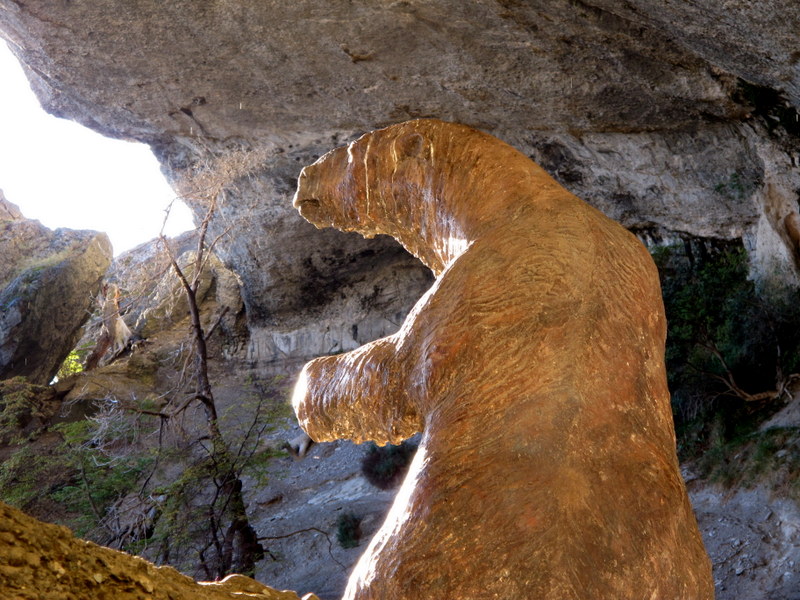
The Cueva del Milodon is a very large cave, where almost a hundred and twenty years ago, in 1895, the German explorer Hermann Eberhard dug up a cache of Mylodon bones and petrified Mylodon scat. Five minutes later, the place was overrun by looters and treasure hunters, but one hundred and twenty years later, archeologists still haunt the place, digging fitfully in corners, trying to convince visitors that the potholes and debris piles are just how the prehistoric human inhabitants left it.
When I first visited the cave nine years ago, Dad and had I considered the extinction a significant blow for interior design. I mean, really... Streaky mud floors, creeping damp, salt damage….
The cave doesn’t need the Mylodon – its two hundred meters of depth are staggeringly impressive all on their own. But a week of wind makes you punchy. It drives you to desperation, and when you snap, you break out in chintz. Dad and I considered something in an oversize floral print. Maybe a tiki bar in the back, to justify a few prehistoric flaming torches. And oh, the potential for hi-fi! At the back of the cave, where the wall curves up against the scree slope, the echoes get really big.
Dr Tabubil and and I halloo’d the reverberate fjord. “Tabubilgirl -erl –erl is a hottie -hottie -ottie!)”
Dad looked at us and looked at us and said dryly how pleased he was to see how far the level of human culture had risen since humans moved into the place.
Back then there wasn’t much there: a car park, marked roughly with logs, and a gravel path up the hill to the mouth of the cave –
Today the Cueva del Milodon has a café, a visitors centre, a ranger station, and an elevated walkway to take you all the way to the cave while walking six careful inches above the pampas grass. On a natural promontory in the mouth of the cave there is a life-size milodon done up in fiberglass and a plexiglass box holding a mummified scrap of genuine milodon skin, with genuine milodon fur on it –
We duly marveled and went down into the cave. It’s still hugely impressive – two hundred yawning meters of dark brown echoes and poetry of the gaping cavernous sort. Today, though, you can’t get near the echo wall. A gravel path circles through the cave, with chain-link ropes on each side and everywhere, signs explaining that only a fraction of the cave floor has been dug up and priceless artifacts lie centimeters beneath the virgin surface in every single direction, so kindly, gently, courteously please stay on the path. The signs urged, begged, pleaded and even tried for stern nursery tones, but it was patently obvious to even the most credulous viewer that nothing further from virgin earth had existed this cave at any time in geological history –
The floor of the cave looked like a major European city center during the blitzes of world war two, after the rescue crews had been through the place and added a layer of shafts and ladder holes to the chaos.
Chileans don’t much like being told where they can – or cannot - walk, and to my discretely outsize pleasure, every square meter of the cave floor that wasn’t actually vertical had recently accumulated a brand new layer of archeological interest – the overlapping footprints of hundreds and hundreds of sneakers and hiking boots. All together, they made a rather fetching pattern of interlocking divots and caterpillar prints, vaguely reminiscent of a carpet in a low-rent casino in Las Vegas. It would have gone great with the tiki bar and torches.
I took a step toward the echo wall, but Sarah blocked my leap across the chain-link rope.
“You have to think about examples, Tabubilgirl.” She said, and looked meaningfully at little Laurie hanging about behind me, round about the level of my knees.
“Yep.” Miles nodded sadly. “You’re a role model now. You want him learning bad habits? Do what the sign says except when you don’t because that doesn’t count, forget you ever saw it? Really, Tabubilgirl?”
I looked eloquently at the carpet of footprints, and mouthed a rude word over Laurie’s head.
“He’s two feet tall.” Sarah said. “He notices people, not the background stuff. You just spent two days playing patty-cake and spot-the-birds-on-poles with him in the backseat of a car. He thinks you’re the best thing to hit the earth since that first time he heard us singing baa baa black sheep. He’s tracking everything you do like those great big eagles on poles track sick sheep! Do you really want this for your legacy? What comes next? Running in the street?”
Well fine, then. Nine years since I was here last, and now, no echoes. I loitered moodily, sulking and kicking gravel about with my feet and taking bad photographs of the inside of the cave with no flash lighting until Laurie and his dismal parents had cleared a debris pile halfway to the entrance, and then I grabbed Mr Tabubil’s hand, nipped over the chain-link rope, and made a run for the wall.
“I don’t get this” Mr Tabubil panted as we climbed and slipped our way up the scree slope.“The cave echoes. That’s what caves do. But the echo isn’t any different over here-“
“HERE!!!” the cave rang. “HEREHereherehere Here!”
“Oh.” Mr Tabubil said, very softly, and the cave whispered back to him. I laughed, and the cave laughed. I tittered and the sound ran back and forth across the roof, chiming like stone bells.
Mr Tabubil growled a low “Ho Ha Ho.” Rumbles of sound around the walls of the cave, shivering through the rock. We laughed at each other and the cave laughed back – high, low, happy, gleeful, heated, cruel – until the air rocked and trembled and little Laurie in the mouth of the cave was crying in fear.
“Are you happy now?” An exasperated shout came from the cave entrance.
quake
“Appy!” The cave called back. “Ow? Now?”
“For Pete’s sake.” The voice said, disgusted. “You’ll be running on roads next. Right in front of him.”
Holding tightly to each other, Mr Tabubil and I slithered down the scree back to the path, grinning like loons. I could walk on the paths for another eight or nine years now. I was filled up.

Thursday, July 11, 2013
Lago Grey: A Scientific Explanation
At the end of April, while our Aussie guests were here, we all flew together down to the far south of Chile. We were heading into the pampas – the thousands on thousands of rolling kilometers of open southern grasslands, going to Puerto Natales and the Torres del Paine.
We were going tower hunting.

Icebergs are blue. Electric Blue. Celestial blue.
So are the rivers that flow away from glaciers, and the lakes that these rivers flow into, something that has always confused me. I had been taught that the celestial properties of icebergs are due to the way light rays percolate through the ice, and I didn’t see how that could translate to the ice when it melted.
I have since learned that the vivid color comes from rock flour, ground out of the Torres del Paine by the moving glaciers and suspended in the water. Nine years ago, however, I heard a different explanation.
In the summer you can go up to the face of the glacier in little boats –chugging along the ice face, hugging the curves and crags and chipping ice cubes from the glacier and drinking dreadful, three-day old whiskey with celestial ten-thousand year old ice.

Halfway along the lake, we had stopped to pick up a group of campers from a campsite on the lake shore. That campsite set a new benchmark for blasted, benighted and windswept, but the campers – a group of students from Santiago, were full of enthusiasm.
It was a mixed group, and the girls were inclined to worshipful adoration of the males. Up against the ice face, one of the girls spoke -
“The ice in that cleft is so blue it’s almost turquoise. Why is the ice so blue, Hari?”
A student in the middle of the pack smiled and stood tall.
“Ah." He said. He cleared his throat. "Ah ha. You know how water is made up of two H molecules and one O molecule?”
“Yes!”
“Well, it’s the H molecules that make ice white. When ice goes blue like this it means that all the H molecules have melted into the lake. That ice is there mostly O.”
“Ohhhh." The girl looked up at him with doe-like adulation.
From the back of our little crowd, a voice rose in a distinct Australian drawl.
“I’m guessing that none of you lot study Chemistry, then?”
I’m not saying that it was one of us. It might have been, but on the other hand, it might not. There were a lot of people on that boat. It could have been anyone.
Hari went back to more traditional means of impressing girls – flexing the muscles in his arms (the muscles in his brains having proved pretty much impervious to flexing) and drinking too much whiskey on ten-thousand year old rocks.

Those were some rocks. That water was the most pure water I’ve ever tasted. It tasted of theology; you could conceive of a pristine world, where the rain fell on antediluvian man through a sky that had never heard of aerial pollutants. Sucking on a chip of ice was like drinking explosions of absolute nothing. Like peppermint without the mint. Just the explosion.

Tuesday, July 9, 2013
Lago Grey
At the end of
April, while our Aussie guests were here, we all flew together down to
the far south of Chile. We were heading into the pampas – the thousands
on thousands of rolling kilometers of open southern grasslands, going
to Puerto Natales and the Torres del Paine.
We were going tower hunting.
We ate a lunch of peanut-butter-and-olive-paste sandwiches (try it before you knock it!) on a bench at a refugio (hiking camp) on the shore of one of those fantastic long blue lakes.

The electric water was spun into a chop by a wind- a tremendous, bloody-minded wind. It vacillated between gale-force and merely ferocious and it never, ever ceased. It was harsh enough to rush you off your feet, knock over the lip of a hanging valley, shake the car like a Christmas toy with all five of us inside it.
Snugged up against the feet of the Torres is one more long lake- Lago Grey, (although like the other lakes in the park, it runs to electric blue - and there's a scientific explanation for that) and at the end of the lake is the Grey Glacier (equally electric.) Lago Grey is bounded on the south by a wide sandbar that runs into a craggy island.
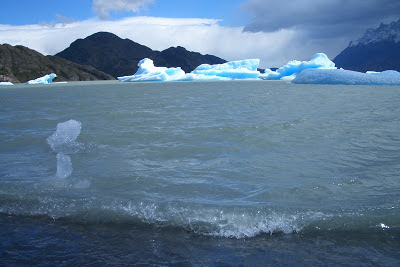
When the glacier calves, icebergs float down the lake to the sandbar, where they beach themselves and lie upturned with their bellies in the air, and dissolve slowly in the sun.

It’s an ice-elephant graveyard.

We walked along the shore of Lago Grey out to the sandbar, but that terrible wind was too strong for us. Little Laurie cried as ice crystals sliced his cheeks. The wind whipped around the edges of the Torres and raced down the length of the lake to wrap its fingers underneath us to pry us off the sand and lift us off our feet –

For a family holiday, it all felt entirely gratuitous. So we walked back down the lake to where we’d parked the car and we drove to the Hotel Grey and sat in its viewing lounge with the wind on the other side of plate glass windows. We had a lovely view twenty-six kilometers straight up the lake to the glacier, and we enjoyed it over cups of hot chocolate and coffee.
That is the civilized way of doing glaciers.

Laurie had an accident with his milk carton and had to be carried back to the car wrapped in Miles’ wind jacket. If you’re inclined to think that we were taking our holiday too soft – you imagine hiking a glacier with a two-year old in your backpack. And thank your lucky stars for plate glass windows.
We were going tower hunting.
We ate a lunch of peanut-butter-and-olive-paste sandwiches (try it before you knock it!) on a bench at a refugio (hiking camp) on the shore of one of those fantastic long blue lakes.

The electric water was spun into a chop by a wind- a tremendous, bloody-minded wind. It vacillated between gale-force and merely ferocious and it never, ever ceased. It was harsh enough to rush you off your feet, knock over the lip of a hanging valley, shake the car like a Christmas toy with all five of us inside it.
Snugged up against the feet of the Torres is one more long lake- Lago Grey, (although like the other lakes in the park, it runs to electric blue - and there's a scientific explanation for that) and at the end of the lake is the Grey Glacier (equally electric.) Lago Grey is bounded on the south by a wide sandbar that runs into a craggy island.
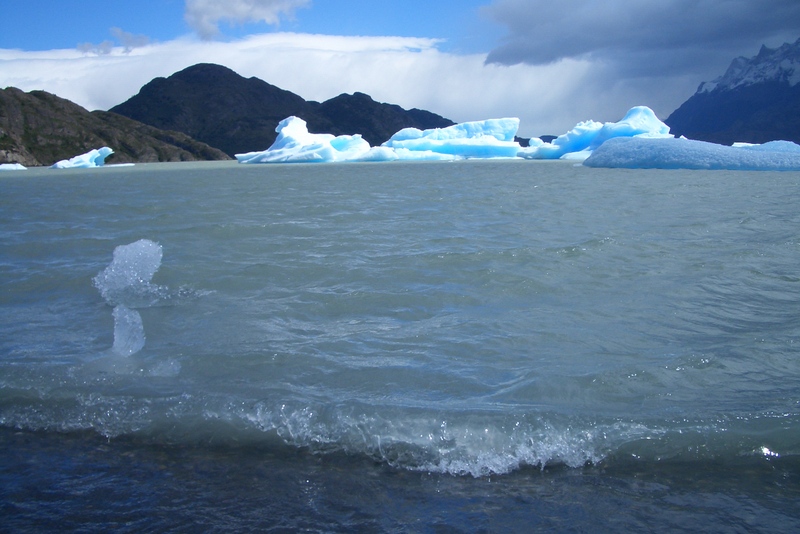
When the glacier calves, icebergs float down the lake to the sandbar, where they beach themselves and lie upturned with their bellies in the air, and dissolve slowly in the sun.

It’s an ice-elephant graveyard.

We walked along the shore of Lago Grey out to the sandbar, but that terrible wind was too strong for us. Little Laurie cried as ice crystals sliced his cheeks. The wind whipped around the edges of the Torres and raced down the length of the lake to wrap its fingers underneath us to pry us off the sand and lift us off our feet –

For a family holiday, it all felt entirely gratuitous. So we walked back down the lake to where we’d parked the car and we drove to the Hotel Grey and sat in its viewing lounge with the wind on the other side of plate glass windows. We had a lovely view twenty-six kilometers straight up the lake to the glacier, and we enjoyed it over cups of hot chocolate and coffee.
That is the civilized way of doing glaciers.

Laurie had an accident with his milk carton and had to be carried back to the car wrapped in Miles’ wind jacket. If you’re inclined to think that we were taking our holiday too soft – you imagine hiking a glacier with a two-year old in your backpack. And thank your lucky stars for plate glass windows.
Thursday, July 4, 2013
Animals in the Deep South (Patagonian Edition)
At the end of April, while our Aussie guests were here, we all flew together down to the far south of Chile. We were heading into the pampas – the thousands on thousands of rolling kilometers of open southern grasslands, going to Puerto Natales and the Torres del Paine.
We were going tower hunting.
The first time I visited the Torres del Paine, we came in summer, when the guanacos were spreading out across the park, and half the animals seemed to be babies. We drove through herds of ‘em - mothers, babies, fathers, uncles, brothers and sisters, stepping daintily from behind tussocks of spike-eared grass to pace regally along side of our car.

They posed, profile rampant, with noble carriage and enormous long lashed eyes – such carriage as only a camelid can sustain.

Babies pranced, facing into the wind, kicking up their heels in the spring sunshine.

We promised ourselves that we’d only stop to photograph a herd, then only for a baby, then for a baby suckling, a baby nuzzling, a baby galloping across a hill.

In an hour we traveled two kilometers, and forced ourselves to become more selective. We’d stop only for a noble profile, held high in disdain and hauteur against a setting sun – and we stopped again, almost immediately.

Our criteria narrowed further. New species only, and on cue, a silver tipped Patagonian fox strolled up to the road, sat down and yawned. Five minutes later he stood up again and trotted away, a long plumed tail sweeping raindrops from the bushes.

Do the animals have a contract with the park service? To pose for so many hours a day, and in return – no radio collars, no annual predation by scientists that dope and weigh and measure and draw blood and leave them lying woozy and cotton mouthed in the grass?
A park guide told us that we had a fifty percent chance of seeing a puma. There were four of us; we reckoned we should see two of them.
I admit that our statistics were more optimistic than scientific. We never did see a mountain lion – that coup was saved for this second time around, when Mr Tabubil shouted out from his perch in the driver’s seat–
“Hey!” he yelled, swinging us around a hummock and down toward one of the innumerable long lakes. “What’s about the size of a lion, with a long tail – running really low to the ground? Running really fast?”
I stared at him from the back next to the baby seat, thick with envy.
“That WAS a lion.” I said at last. “A puma.”
“Really?” He threw us around a hairpin bend. “It was fast.”
And that was that.
Lions there were, apparently, but in April we were too late for babies. The herds had grown up, and split up, or split for warmer pastures. We saw guanacos, distantly, in small grazing herds, but they were too far away to be seen clear, and their proud profiles were shrunk to tufts and tussocks of brown grass, diminished by the terrible immensity of bad poetry rising up behind them.

Tuesday, July 2, 2013
Torres del Paine: Into the Park
At the end of April, while our Aussie guests were here, we all flew together down to the far south of Chile. We were heading into the pampas – the thousands on thousands of rolling kilometers of open southern grasslands, going to Puerto Natales and the Torres del Paine.
We were going tower hunting.
The National Park of Torres del Paine begins a hundred kilometers north of Puerto Natales, but the park is a large one, and the towers themselves are another hundred kilometers further north. If you want to go see them in one day, you have to start very early indeed.
We left our hotel before the sun was up and drove out into a thick white fog. Little Laurie in his car seat passed the time counting ‘birds on poles.” Nothing was moving in that fog. Even the birds were grounded.
These weren’t dainty meadowlarks or plover. Talons like garden forks were sunk into fence posts on both sides of the road and above them, hawks and eagles the size of combine harvesters loomed damp and indistinct, waiting for the fog to lift.
We drove slow, peering into the swirling fog, watching out for headlights of other cars and gauging bends. Watching so close, you see things in the mist – swirling shapes that come out of the fog and go back into it before you know if you’re seeing truly or seeing ghosts –
Ahead of us, the white began to boil. We hesitated, braked, in case the boil was real - and sudden as a camera shutter coming down, the fog turned and we were driving through sheep. Masses of sheep. hundreds of sheep. As sea of shaggy white backs, huasos (cowboys) on horseback, little islands in their sheepskin trousers and flat, wide-brimmed hats bobbing among them like little floating islands. A dozen working dogs slunk low against the grey grass, tag-teaming strays that tried to bolt out of the herd into the fog, growling and nipping, chivvying them back into the pressed mass. The huasos slapped their reins and whistled to the dogs and jinked their horses left, right, and left again – and the whole boiling, seething mass flowed around us like a river in a flood, carried swiftly down upon a current of snapping dog and jinking horse -

Twenty kilometers further up the road, we met cattle. They came at us in snatches of shifting brown bodies, bellowing and steaming all around us in the murk. Mindful of another bull we’d met, on different road down near Lago Ranco, we pulled to the side of the road and stopped.
A huaso on his horse loomed up out of the white. He wore a patch across his right eye, and in his frilled sheepskin trousers and flat hat he looked a proper pirate. He grinned down at us from his horse and raised his hand, and like the parting of the waters, a narrow slot opened up between the churning animals. We edged forward. A dog barked –one sharp crack – and a great big brown body lurched. We shot forward and were through.
Behind us the one-eyed cowboy gave a whoop and waved his hat – and we were gone – they were gone, swallowed up again by the white.

So late in the year, many people don’t see much more of the park than this. Even in high summer you might come for a week and see no more than ghosts of foothills, thinly, through the shifting mist.
But for whatever reason – perhaps our one-eye’d huaso had called it up - it was our day. As we cleared the grazing country and started up into the foothills of the park the fog lifted, and there they were: the Torres del Paine –
As if the road were a geological divide, a massif rose up- crowned with hanging glaciers and shattered rock fingers - a slab of mountain like the bottom of the world turned on its end and reaching up into the sky-

We were back to improbable poetry again. How else could anybody sensible describe this place? When a white fog rises one expects- the narrative demands - something windswept and barren, a sere and alien beauty – if beauty at all.
Not this–
We had come out of the fog into the middle of a moonscape - domed hummocks and puddle lakes that meandered out to eternity with no horizon and no base level. There was no perspective– just up and down and round, vivid in primary yellow and primrose and green.

We drove for hours over the rolling ground, the towers on our right drifting in and out of clouds. Here at the top of the world, roads snaked and switch-backed, throwing themselves from one side to the other of pocket-handkerchief-sized valleys with their bellies full of water, little lakes, overgrown, in tones of emerald, chartreuse, gold and burgundy and olive, sweeping out from the centre, and then emerald again, where the water met the autumn grass at the edge of the next rise –

And over that next rise, we’d teeter on the lip of a hanging valley: three hundred meters straight down to a long lake the color of blue glacier ice, and on the other side of that, that wall again–no trees, no bushes, no grass, no green, just a fist punching up through the roof of the world –

Subscribe to:
Posts (Atom)

