Showing posts with label Travel. Show all posts
Thursday, May 15, 2014
Wooden Flowers on the Street
On the street yesterday, an old man was selling wooden roses.
"Mil pesos por flor! Escoje tu favorita!" (A thousand pesos (2 dollars) for a flower! Pick your favorite!)
Painted all the colors that roses come in, they were nestled in a nest of real rose leaves, so cunningly, cleverly painted and tinted that they were indistinguishable from real flowers.
"Mil pesos por flor - they never fade!"
When we sailed into Pucon on our first trip into town for groceries, we found ourselves braking abruptly on the outskirts of town - enchanted by booths selling flowers- flowers that should have been buds so early in the spring - on bushes just starting to green. There were full-blown summer roses, daliahs in pink and peach and yellow and red and carnations the size of my open hand.
Climbing out of the car, we investigated. The flowers were made from shaved wood, gathered and furled around long wooden stakes and sunk into the base of hothouse rose bushes, so that the flowers appeared to grow together out of greenery that appropriate to absolutely none of them.
The flowers are made from mimbre wood. A plant of the wicker family, mimbre has a thick, whippy stem and grown along the banks of waterways - everywhere, then, in this part of the country. The wood is shaved in spirals, using a device that resembles a large pencil sharpener, and the shavings are glued in an outward-facing spiral around a daisy-like wooden base.
At the back of the booths, craftswoman were painting the flowers – dabbing and tinting and splattering so cunningly and so cleverly that the wooden toys were indistinguishable from real flowers. We wandered from booth to booth, becoming familiar with the different flowers and techniques, noting the difference from worker to worker- this woman was masterful with dahlias, another crafted carnations that could have stood undiscovered in a bouquet of living flowers, that one had perfected the deep, gleaming tint of a blood-red rose -
We bought a bouquet of daliahs – mounted on 28 inch wooden stems - to bring home with us.
"How are we going to get these home?" Mr Tabubil said. "They're so terribly delicate. They won't last the drive back to Temuco, let alone a plane flight."
The flower lady tugged the flower heads away from their stems, and sank them among exelsior and foam peanuts in a rather staggering array of boxes.
"Secure." She said to us. And sniffed. "You think you're the first tourists to buy a flower?"
The rather-spear-like stems, she tied up with a strip of masking tape around their middles and handed them to us, just like that.
"Which leaves us with another problem." Mr Tabubil said, under his breath. "Four extra pieces of hand luggage and an armful of sharp pointy sticks. We are never getting this lot onto the plane."
But to our surprise, we did.
Temuco airport was far too small and laid back to give any particular damn about what or how much of anything its passengers were bringing through the x-ray machine. Cooler chests? Pastry Boxes? Armfuls of of gift-wrapped sausages? A gross of nintendo platforms and bags of spare batteries? It was Christmas day. A few extra boxes and an armload of dangerously spikey sticks weren't worth raising an eyebrow over. We flew home to Santiago, comfortably squashed among the luggage of Temucan grandparents flying to the capital for Christmas dinner with their grandchildren, paper crinkling in their pockets, and coils of ribbon spilling out of the luggage compartments above our heads. A box or two of flowers seemed just the right sort of extra luggage for that sort of day.
Labels:
art and design,
Christmas,
gardening,
tourists,
Travel
Tuesday, May 13, 2014
Volcán Villarica
One of the biggest reasons to come to Pucon is the opportunity to climb the Villarica Volcano. Volcán Villarica has one of the world's most accessible lava lakes in its caldera - and when the conditions are right, you can climb to the top and look right down into it. The main shopping street in Pucon is lined with sports outfitters and touring companies - all of similar degrees of reputability - all of whom will outfit you with a full cold weather climbing kit and lead you on a climb up to the volcano caldera. The tour leaves extremely early in the morning and is not an easy climb - five to six hours slogging up a snowfield, climbing at an angle often above 45 degrees.
On a scale of tourist-wranglers, the Pucon fellows are extreme professionals. My dad and my sister have both made the climb and reckon that it was a positively exciting and majorly memorable experience. Their group took five hours to climb to the caldera, but the return trip took scarcely more than an hour – the climbers all slide down the trail on the seats of their pants! Dr Tabubil even saw one guy climbing up with a snowboard on his back, prepared for a seriously awesome return trip. There's an excellent description of the climb here on the Go World Travel blog. As for Dad and Dr Tabubil, their only regret of the climb was that the day they climbed Villarica, the lava pack was too low in the caldera to be seen. Like any volcano, Villarica plays by its own rules. Some days the lava glows brightly, some days it does not - but always, the view from the summit is spectacular.
The lower reaches of Volcán Villarica belong to a small ski resort - when the lifts are running, they cut an hour off of the climb. One evening, Mr Tabubil and I drove up a deeply graded road to the base of the ski lifts, and turned out onto a rutted service lane.

We'd passed through a conifer forest into a lava field - a land of ash and stunted twisted trees and low, badly-growing bracken. The weather was close and clammy - and we found it an almost sinister experience, as we drove the vegetation petered out and we were driving through a wrecked and shattered landscape; cold and damp, gray ash underfoot, and the only foliage scattered spikes of livid orange flowers. Our imaginations were boundless. The flowers were like flames, licking out of the ground. Thick mists curled and wraithed. It was a landscape straight out of Tolkein. We'd driven out of life and into Mordor; nowhere could be more like Mordor than the slopes of that volcano, not even the landscapes inside Tolkein's own head.
Abandoning the car, we climbed on foot. I sat down on a small rise and let Mr Tabubil go on ahead. He disappeared into the mist and I imagined that I was sitting outside the Gates of the Dead, watching the Dead armies pass before me as shapes in the murk - and heard, behind me, a sharp crack. I turned. Mr Tabubil stood about 5 feet away, frozen in mid-stealth. He had spent a good ten minutes, crazy man, working his way silently back toward me across the moss, planning to sneak up behind me, gargle “Got you, my Precious!” and hopefully watch me jump off my rock and fall into a ravine.
I do wish he hadn’t stepped on that twig!
Thursday, May 8, 2014
Pucon: The Big Picture
We felt rather guilty for hiding in our own little patch of paradise instead of going out and exploring all of the other paradises around us. But hiding was what we needed, and the splendid people of the Cabañas Azul del Parque let us have it.
That time, we had stayed right in downtown Pucon, a beautiful little lake-side town, small and alpine picture post-card-y and green and pink and blue and yellow and red with growing things. Spring arrives late in the South and the whole world seemed like one enormous flower garden. Not only in the town; wild rambling roses and hydrangea and gladioli and bright coral colored wildflowers sprang out of every roadside cutting and the bank of every wild mountain river and stream. In an extremely unexpected way, The place reminded me of Papua New Guinea – in the way that every space and crack that could hold soil was blooming and flourishing and EXPLODING with life.
We had taken rooms at the Gran Hotel Pucon - the sort of grand lake resort popular in the United States in the first part of the twentieth century. It was an ancient, rambling building with equally ancient and saggy beds and manicured lawns running down to a black sand beach. There were salsa classes and volleyball matches from dawn to dusk and little children EVERYWHERE. It was entirely delightful, and Dr Tabubil and I shared a room with a perfect clear view up main street to the volcano. We’d sit in our room in the evening and watch it smoking.
One day, Dr Tabubil and I left Villarica and drove to another lake, and took a pedal boat out to a rare “white beach,” whose sand was made of limestone instead of basalt. The water was clear as glass, fathoms deep. We'd forgotten to bring swimsuits, but it was terribly hot, so Dr Tabubil and I nipped round the point of a little white bay and found a small secluded cove and stripped to our underwear. Almost simultaneously - and please remember how glassy-clear the water was - a huge pedal boat full of teenage Chilean males rounded the point and hove to alongside. Shrill whistling. LOTS of it. Tabubilgirl sank into the water, groping for her bra. Dr Tabubil turned her back, which accentuated the delicate lapping of the water across her posterior. They had a video camera. Thanks, guys.
In all seriousness, the cultural mores in play here are fascinating, aren't they? We were wearing more clothing than makes up most Chilean swimsuits, yet the different fabrics made them verboten underwear and indecent for public exposure.
Huh.
Mr Tabubil and I did go hunting for that white lake, but our directions to the "white sand beach" led us instead to Lake Caburga- a happy little holiday town set on a stretch of grey muddy sand buried under about seven and a half thousand sunbathers, and a shallow, sandy lake, the water tepid from the sun, and the bottom half sand, half-slime. Past and present Presidents prefer Caburga for their holidays, but we looked around and drove back to Lago Villarica- where the water was cleanly cold and the beach our very own.
Tuesday, May 6, 2014
Villarica and Los Pozones: Running Hot and Cold
In the daylight, lake Villarica was wide and blue, and the mountains across the lake were green and sharp-tipped. We walked out of the cabana onto the terrace and looked up to see the snow-capped cinder cone of Volcán Villarica rising up behind the trees. We would spend much of the next week sitting on our terrace and watching it smoking - exuberant puffs of white smoke. Puff. Puff. Poof!

It gave a certain frission to a peaceful holiday breakfast.
All that week we kept to a rigorous schedule. We slept late, waking half a hour before a very nice woman arrived at eleven to service the cabana. While the beds were made and the bathroom swept, we lay on lounge chairs under a tree and watched the light shift over the lake.
When the nice woman finished and gone, we went back to bed for a nice hearty nap, then lunched, swam in the lake for an hour or so, and drove into Pucon to buy groceries for a BBQ dinner on the terrace. After dinner we wound sit out by the lake until the light died, then we would come inside and read to each other until it was time again to go to bed.
It was an utterly splendid place for a holiday - lazy volcanic frissions and all. We had arrived just before the season opened -the season opens the week of the new year, more or less, and the beach and the lake were all our own.
But things were happening. One day a row of floats appeared in the lake to mark a swimming area. The next day, a row of freshly painted wooden benches was laid out on the shore. A lifeguard tower was trundled down onto the beach. The next a pack of teenage boys and girls arrived at the little swimming beach - hooting and splashing distantly, jumping off the jetty, adding a touch of holiday gaiety to the scene.
We swam in the lake every afternoon. The water was very clear and the lake slopes so steeply away from the shoreline that a short jetty can make for splendid diving - straight into water the color and consistency of bottled ice-cubes.
I love me my fresh water - any way, any how, and any where, and I could stand Villarica for a good hour or so before i started to feel a little nippy. My Canadian Mr Tabubil, who can handle temperatures staggeringly below zero if they occur on the other side of a parka and good set of thermal underwear, is not quite so comfortable with water. That man can - and has- caught a nasty chill off of a reef in the Hawaiian islands. Down at Villarica, he'd stand on the jetty, working up the courage to jump, then rise up vertically from the depths at a velocity only slightly slower than the one he'd taken going in, and spend the rest of my vivid, brisk and breezy hour sulking in the sun complaining about chilblains and yelling when I dripped on him.
One day, we dragged ourselves away from our quiet beach and drove to the hot springs at Los Pozones. There are many volcanic hot springs in the region. Some of these hot springs have decadent lodges built around them, with saunas and plunge pools and café-bars. Others are nothing more than natural pools in the forest.
The water was extremely hot. The weather was also extremely hot - it was a good 30 degrees C in the sun, but the temperature differential was still great enough to have steam billowing from the pools. We've done this rodeo before, and thought it pretty good, all things considered. Los Pozones, however, puts a twist on the formula. The idea was to alternate sitting in the hot spring with jumping into the icy river next door, and THAT water made Lago Villarica feel like a tepid bath - those tumbling rapids must have topped out at a neat 4 degrees C. After plunging in once and making a hellofalotofnoise before I got out in a hellofahurry, I sat on a rock on the riverbank and let Mr Tabubil gallantly splash me. This ridiculous regimen was supposed to open your pores and fill you simply to the brim with sulfur and minerals and healthy vitality. On a more temperate day the pools would have been an utterly sybaritic luxury, and we have decided to return mid-year, in deep winter, and spend a week sitting in hot-springs when the weather is sensible. As it was, between the extreme cold and the extreme heat, all I got was a sniffle.
Humph.
Thursday, May 1, 2014
South to Pucon
The week before Christmas, Mr Tabubil and I flew south from Santiago to Pucon. Pucon is a small town at the head of Lake Villarica, a very long, very deep, and very beautiful lake some 800 km south of Santiago. We took a late-evening flight from Santiago to Temuco, the nearest large city to Lake Villarica, and rented a car to drive the last hundred-odd kilometers.
In Temuco, the air was very deep and very fresh, and as we always do after a long spell in the capital, we stood about swallowing it in in long, deep gulps - we could have eaten it, it tasted so cool and crisp and invigorating, and, after all the renovation chaos of the past few months - needful.
It was full night by the time we were on the road, and we drove along the 199 in the dark. It was very dark – a terrible deep dark, compared to Santiago with its all-night haze of sodium-yellow light. We drove with our headlights on high-beam, feeling terrifically dangerous as we sped along the country highway through the black night. There were no other cars with us on the road, and it was very black and very lonely and terribly, terrifically, dark. Periodically, a long-distance bus came roaring out of the night toward us, and its own high beams - brighter than ours - would catch us full in the face. We'd flinch and pull further into our own side of the road, crowding the verge as it came blazing toward us, its forehead lit up with Castro, Puerto Montt, Valdivia – the names of cities impossibly far away to the south, and at the very bottom of the list, Santiago. These buses would roar on all through the night, their passengers sleeping behind drawn curtains in their long-haul cushioned seats; they would miss all of this incredible blackness, waking in seven or eight hours to the sodium-vapor haze of a Santiago dawn.
Lake Villarica is very deep and very beautiful and - at Christmas time - very cold. On its western shore the small resort town of Pucon, and Pucon sits directly on the feet of the Villarica Volcano. Volcán Villarica is a snow covered cinder cone, very much alive and stupendously spectacular as a view. In the mountains around her are hiking trails across mountain ranges and hanging valleys, swift-moving mountain rivers for white water rafting, slow, lazy rivers for floating and fly-fishing, caves for spelunking, hot springs for soaking, blue lakes for boating, and long lake shores for lying in the sun –
We had booked a cabaña (holiday cottage) at the Cabañas Azul del Parque - a property of a dozen or so holiday cottages half-way down the lake. We arrived there just on midnight. The manager was waiting up for us, dozing in a pine-wood office under a yellow desk-lamp. He led us down a narrow grassed lane, lighting the way with a torch while we bumped in our car behind him with our lights on dim.
He unlocked our cottage door and led us straight through the cabin to a terrace facing on to the lake. We stepped out into silence, and lake sounds and a huge yellow moon. Unnoticed on the road, the moon had risen and it was riding full and heavy above the water. From our feet a wide white moon-trail stretched out across the lake to meet it. It was so wide and white that we could have walked clear and confident all the way across to the mountains that stood sharp and silhouette on the other side.
Mr Tabubil and I looked at each other and we looked up at the moon and all the sharp, heavy things we'd been carrying for last few months slid loose under our skin and fell away into the lake, and were lost in the big water.
We thanked the man for bringing us here. He smiled, and we thanked him again, and asked how long we could stay -
He smiled again, and said that we could be here as long as we cared to stay.
We went to sleep in a wide double bed with the water on the other side of the window, and in the morning we called the airport and changed our flights until the very last minute possible before we had to be at work -
And it was a good day.
Thursday, July 18, 2013
Puerto Natales and Pampas
At the end of
April, while our Aussie guests were here, we all flew together down to
the far south of Chile. We were heading into the pampas – the thousands
on thousands of rolling kilometers of open southern grasslands, going
to Puerto Natales and the Torres del Paine.
We were going tower hunting.
Puerto Natales is the base camp for the Torres del Paine - from here you go out hiking, trekking, white water rafting, and for all of the other reasons people come down to the end of the world - even hang-gliding those stone fingers, if you’re semi-suicidal.
Since my last visit to Puerto Natales, the little town has gone upscale. The houses have turned into hostels and vegan cafes, and downtown, the shops cater almost exclusively to people needing sports shoes, hiking gear and artisanal chocolates of surpassing mediocrity.
(After a week in the park, I imagine that any sort of chocolate looks pretty good – especially chocolate that says “artisanal” on the wrapper and comes tied up in little ribbons. Caveat Emptor and all that, but if you’ve been hiking for a week, singing paeans to the wilderness over a smoky campfire and plates of tinned baked beans, any chocolate at all might actually taste just as good as that slab of grade-A Belgian dark that you’ve been dreaming about at night.)
The shabby little shop where nine years ago I had eaten hamburgers with a view has been gutted and painted white and turned into a temple of southern cuisine – serving up local Patagonian lamb and export-grade salmon like Chileans usually never get. They hadn’t changed the view, though. (an upgrade to that view would require a celestial choir and a couple of seraphim, and the seraphim would send you down to ten thousand thousand years in purgatory for imagining that it might need a coat of paint -)
This little town currently boasts at least 33 gastronomic establishments of sufficient note to have earned serious reviews across the interwebs, several of whose renown stretches beyond Patagonia. The afro-chilean fusion cuisine of Afrigonia regularly and reliably stacks up against high-concept palaces of cuisine in capital cities across the world. We considered it, even stood thoughtfully at the door, and then we went away and ate pizza. It’s the sort of thing you do when one member of your group is two feet high and prefers to spend his dinner hour crawling around the floor underneath the coat rack.
“We could eat in the other places” Sarah said “but it’s not a very nice thing to do to other diners. People go to places like that for romantic evenings out. They don’t want a small child shrieking and banging the silverware to remind them how romantic evenings can end up!”
“Canoodling with consequence.” I said.
“Exactly.” Miles reached out and caught a shaker of oregano before it hit the floor of the pizza parlor with a terminal crash. He raised a wry eyebrow. “Anywhere with real glasses is basically out. But pizza is good.”
This pizza was very very good indeed. Wood-fired, freshly made - at the Pizzeria Mesita Grande, on the corner of the Plaza de Armas at Arturo Prat 196, Puerto Natales.
Sarah, Miles and Laurie left Puerto Natales by boat – catching a ride on the Navimag cargo ferry up to Puerto Montt. Mr Tabubil and I waved them goodbye, and hopped in our car to drive back to Punta Arenas.
The pampas were blanketed by a heavy frost – the tall grass showing silver, each blade and leaf etched in ice. I asked Mr Tabubil to stop the car and stepped out to bring him sprays of grass, each autumn seed netted with rainbows where the headlights hit.
We were out so early that we were driving before the truckers were up, before the farmers and ranchers were out, and on all that long road it was only us-
As the sun rose, low places on the road filled up with mist – pooling there in choking fogs that lifted as we climbed out of the hollows to give shifting views of a world of color beyond the car - red and russet and gold, with eagles wheeling above us in the sky and herds of winter cattle with their heads down, blowing steam into the frozen grass.
We held hands across the gearstick, and smiled out at the silent autumn world and in toward each other – it was one of the moments, one of the times where you know, even as they happen, that you’ll be coming back to them over and over again for years. One of those Moments, you know?
We were going tower hunting.
Puerto Natales is the base camp for the Torres del Paine - from here you go out hiking, trekking, white water rafting, and for all of the other reasons people come down to the end of the world - even hang-gliding those stone fingers, if you’re semi-suicidal.
Since my last visit to Puerto Natales, the little town has gone upscale. The houses have turned into hostels and vegan cafes, and downtown, the shops cater almost exclusively to people needing sports shoes, hiking gear and artisanal chocolates of surpassing mediocrity.
(After a week in the park, I imagine that any sort of chocolate looks pretty good – especially chocolate that says “artisanal” on the wrapper and comes tied up in little ribbons. Caveat Emptor and all that, but if you’ve been hiking for a week, singing paeans to the wilderness over a smoky campfire and plates of tinned baked beans, any chocolate at all might actually taste just as good as that slab of grade-A Belgian dark that you’ve been dreaming about at night.)
The shabby little shop where nine years ago I had eaten hamburgers with a view has been gutted and painted white and turned into a temple of southern cuisine – serving up local Patagonian lamb and export-grade salmon like Chileans usually never get. They hadn’t changed the view, though. (an upgrade to that view would require a celestial choir and a couple of seraphim, and the seraphim would send you down to ten thousand thousand years in purgatory for imagining that it might need a coat of paint -)
This little town currently boasts at least 33 gastronomic establishments of sufficient note to have earned serious reviews across the interwebs, several of whose renown stretches beyond Patagonia. The afro-chilean fusion cuisine of Afrigonia regularly and reliably stacks up against high-concept palaces of cuisine in capital cities across the world. We considered it, even stood thoughtfully at the door, and then we went away and ate pizza. It’s the sort of thing you do when one member of your group is two feet high and prefers to spend his dinner hour crawling around the floor underneath the coat rack.
“We could eat in the other places” Sarah said “but it’s not a very nice thing to do to other diners. People go to places like that for romantic evenings out. They don’t want a small child shrieking and banging the silverware to remind them how romantic evenings can end up!”
“Canoodling with consequence.” I said.
“Exactly.” Miles reached out and caught a shaker of oregano before it hit the floor of the pizza parlor with a terminal crash. He raised a wry eyebrow. “Anywhere with real glasses is basically out. But pizza is good.”
This pizza was very very good indeed. Wood-fired, freshly made - at the Pizzeria Mesita Grande, on the corner of the Plaza de Armas at Arturo Prat 196, Puerto Natales.
Sarah, Miles and Laurie left Puerto Natales by boat – catching a ride on the Navimag cargo ferry up to Puerto Montt. Mr Tabubil and I waved them goodbye, and hopped in our car to drive back to Punta Arenas.
The pampas were blanketed by a heavy frost – the tall grass showing silver, each blade and leaf etched in ice. I asked Mr Tabubil to stop the car and stepped out to bring him sprays of grass, each autumn seed netted with rainbows where the headlights hit.
We were out so early that we were driving before the truckers were up, before the farmers and ranchers were out, and on all that long road it was only us-
As the sun rose, low places on the road filled up with mist – pooling there in choking fogs that lifted as we climbed out of the hollows to give shifting views of a world of color beyond the car - red and russet and gold, with eagles wheeling above us in the sky and herds of winter cattle with their heads down, blowing steam into the frozen grass.
We held hands across the gearstick, and smiled out at the silent autumn world and in toward each other – it was one of the moments, one of the times where you know, even as they happen, that you’ll be coming back to them over and over again for years. One of those Moments, you know?
Tuesday, July 9, 2013
Lago Grey
At the end of
April, while our Aussie guests were here, we all flew together down to
the far south of Chile. We were heading into the pampas – the thousands
on thousands of rolling kilometers of open southern grasslands, going
to Puerto Natales and the Torres del Paine.
We were going tower hunting.
We ate a lunch of peanut-butter-and-olive-paste sandwiches (try it before you knock it!) on a bench at a refugio (hiking camp) on the shore of one of those fantastic long blue lakes.
The electric water was spun into a chop by a wind- a tremendous, bloody-minded wind. It vacillated between gale-force and merely ferocious and it never, ever ceased. It was harsh enough to rush you off your feet, knock over the lip of a hanging valley, shake the car like a Christmas toy with all five of us inside it.
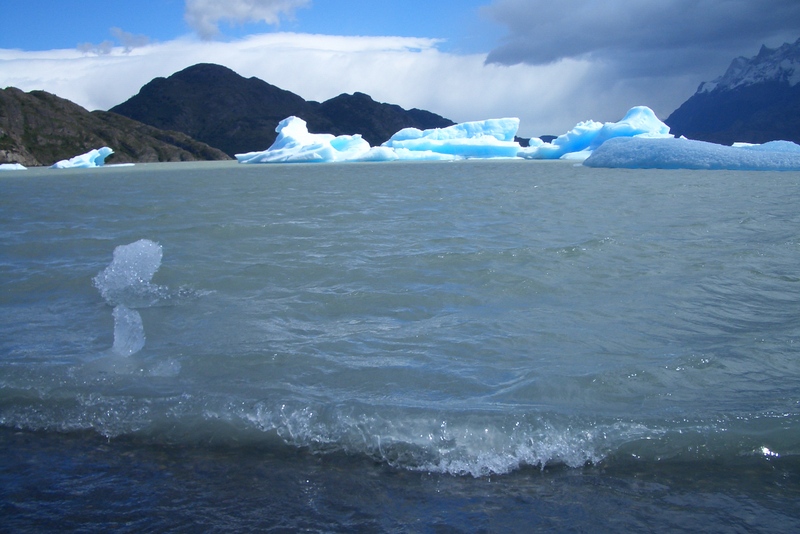
Snugged up against the feet of the Torres is one more long lake- Lago Grey, (although like the other lakes in the park, it runs to electric blue - and there's a scientific explanation for that) and at the end of the lake is the Grey Glacier (equally electric.) Lago Grey is bounded on the south by a wide sandbar that runs into a craggy island.
When the glacier calves, icebergs float down the lake to the sandbar, where they beach themselves and lie upturned with their bellies in the air, and dissolve slowly in the sun.
It’s an ice-elephant graveyard.
We walked along the shore of Lago Grey out to the sandbar, but that terrible wind was too strong for us. Little Laurie cried as ice crystals sliced his cheeks. The wind whipped around the edges of the Torres and raced down the length of the lake to wrap its fingers underneath us to pry us off the sand and lift us off our feet –
For a family holiday, it all felt entirely gratuitous. So we walked back down the lake to where we’d parked the car and we drove to the Hotel Grey and sat in its viewing lounge with the wind on the other side of plate glass windows. We had a lovely view twenty-six kilometers straight up the lake to the glacier, and we enjoyed it over cups of hot chocolate and coffee.
That is the civilized way of doing glaciers.
Laurie had an accident with his milk carton and had to be carried back to the car wrapped in Miles’ wind jacket. If you’re inclined to think that we were taking our holiday too soft – you imagine hiking a glacier with a two-year old in your backpack. And thank your lucky stars for plate glass windows.
We were going tower hunting.
We ate a lunch of peanut-butter-and-olive-paste sandwiches (try it before you knock it!) on a bench at a refugio (hiking camp) on the shore of one of those fantastic long blue lakes.
The electric water was spun into a chop by a wind- a tremendous, bloody-minded wind. It vacillated between gale-force and merely ferocious and it never, ever ceased. It was harsh enough to rush you off your feet, knock over the lip of a hanging valley, shake the car like a Christmas toy with all five of us inside it.
Snugged up against the feet of the Torres is one more long lake- Lago Grey, (although like the other lakes in the park, it runs to electric blue - and there's a scientific explanation for that) and at the end of the lake is the Grey Glacier (equally electric.) Lago Grey is bounded on the south by a wide sandbar that runs into a craggy island.
When the glacier calves, icebergs float down the lake to the sandbar, where they beach themselves and lie upturned with their bellies in the air, and dissolve slowly in the sun.
It’s an ice-elephant graveyard.
We walked along the shore of Lago Grey out to the sandbar, but that terrible wind was too strong for us. Little Laurie cried as ice crystals sliced his cheeks. The wind whipped around the edges of the Torres and raced down the length of the lake to wrap its fingers underneath us to pry us off the sand and lift us off our feet –
For a family holiday, it all felt entirely gratuitous. So we walked back down the lake to where we’d parked the car and we drove to the Hotel Grey and sat in its viewing lounge with the wind on the other side of plate glass windows. We had a lovely view twenty-six kilometers straight up the lake to the glacier, and we enjoyed it over cups of hot chocolate and coffee.
That is the civilized way of doing glaciers.
Laurie had an accident with his milk carton and had to be carried back to the car wrapped in Miles’ wind jacket. If you’re inclined to think that we were taking our holiday too soft – you imagine hiking a glacier with a two-year old in your backpack. And thank your lucky stars for plate glass windows.
Thursday, July 4, 2013
Animals in the Deep South (Patagonian Edition)
At the end of April, while our Aussie guests were here, we all flew together down to the far south of Chile. We were heading into the pampas – the thousands on thousands of rolling kilometers of open southern grasslands, going to Puerto Natales and the Torres del Paine.
We were going tower hunting.
The first time I visited the Torres del Paine, we came in summer, when the guanacos were spreading out across the park, and half the animals seemed to be babies. We drove through herds of ‘em - mothers, babies, fathers, uncles, brothers and sisters, stepping daintily from behind tussocks of spike-eared grass to pace regally along side of our car.
They posed, profile rampant, with noble carriage and enormous long lashed eyes – such carriage as only a camelid can sustain.

Babies pranced, facing into the wind, kicking up their heels in the spring sunshine.
We promised ourselves that we’d only stop to photograph a herd, then only for a baby, then for a baby suckling, a baby nuzzling, a baby galloping across a hill.

In an hour we traveled two kilometers, and forced ourselves to become more selective. We’d stop only for a noble profile, held high in disdain and hauteur against a setting sun – and we stopped again, almost immediately.

Our criteria narrowed further. New species only, and on cue, a silver tipped Patagonian fox strolled up to the road, sat down and yawned. Five minutes later he stood up again and trotted away, a long plumed tail sweeping raindrops from the bushes.
Do the animals have a contract with the park service? To pose for so many hours a day, and in return – no radio collars, no annual predation by scientists that dope and weigh and measure and draw blood and leave them lying woozy and cotton mouthed in the grass?
A park guide told us that we had a fifty percent chance of seeing a puma. There were four of us; we reckoned we should see two of them.
I admit that our statistics were more optimistic than scientific. We never did see a mountain lion – that coup was saved for this second time around, when Mr Tabubil shouted out from his perch in the driver’s seat–
“Hey!” he yelled, swinging us around a hummock and down toward one of the innumerable long lakes. “What’s about the size of a lion, with a long tail – running really low to the ground? Running really fast?”
I stared at him from the back next to the baby seat, thick with envy.
“That WAS a lion.” I said at last. “A puma.”
“Really?” He threw us around a hairpin bend. “It was fast.”
And that was that.
Lions there were, apparently, but in April we were too late for babies. The herds had grown up, and split up, or split for warmer pastures. We saw guanacos, distantly, in small grazing herds, but they were too far away to be seen clear, and their proud profiles were shrunk to tufts and tussocks of brown grass, diminished by the terrible immensity of bad poetry rising up behind them.
We were going tower hunting.
The first time I visited the Torres del Paine, we came in summer, when the guanacos were spreading out across the park, and half the animals seemed to be babies. We drove through herds of ‘em - mothers, babies, fathers, uncles, brothers and sisters, stepping daintily from behind tussocks of spike-eared grass to pace regally along side of our car.
They posed, profile rampant, with noble carriage and enormous long lashed eyes – such carriage as only a camelid can sustain.

Babies pranced, facing into the wind, kicking up their heels in the spring sunshine.
We promised ourselves that we’d only stop to photograph a herd, then only for a baby, then for a baby suckling, a baby nuzzling, a baby galloping across a hill.

In an hour we traveled two kilometers, and forced ourselves to become more selective. We’d stop only for a noble profile, held high in disdain and hauteur against a setting sun – and we stopped again, almost immediately.

Our criteria narrowed further. New species only, and on cue, a silver tipped Patagonian fox strolled up to the road, sat down and yawned. Five minutes later he stood up again and trotted away, a long plumed tail sweeping raindrops from the bushes.
Do the animals have a contract with the park service? To pose for so many hours a day, and in return – no radio collars, no annual predation by scientists that dope and weigh and measure and draw blood and leave them lying woozy and cotton mouthed in the grass?
A park guide told us that we had a fifty percent chance of seeing a puma. There were four of us; we reckoned we should see two of them.
I admit that our statistics were more optimistic than scientific. We never did see a mountain lion – that coup was saved for this second time around, when Mr Tabubil shouted out from his perch in the driver’s seat–
“Hey!” he yelled, swinging us around a hummock and down toward one of the innumerable long lakes. “What’s about the size of a lion, with a long tail – running really low to the ground? Running really fast?”
I stared at him from the back next to the baby seat, thick with envy.
“That WAS a lion.” I said at last. “A puma.”
“Really?” He threw us around a hairpin bend. “It was fast.”
And that was that.
Lions there were, apparently, but in April we were too late for babies. The herds had grown up, and split up, or split for warmer pastures. We saw guanacos, distantly, in small grazing herds, but they were too far away to be seen clear, and their proud profiles were shrunk to tufts and tussocks of brown grass, diminished by the terrible immensity of bad poetry rising up behind them.
Tuesday, July 2, 2013
Torres del Paine: Into the Park
At the end of April, while our Aussie guests were here, we all flew together down to the far south of Chile. We were heading into the pampas – the thousands on thousands of rolling kilometers of open southern grasslands, going to Puerto Natales and the Torres del Paine.
We were going tower hunting.
The National Park of Torres del Paine begins a hundred kilometers north of Puerto Natales, but the park is a large one, and the towers themselves are another hundred kilometers further north. If you want to go see them in one day, you have to start very early indeed.
We left our hotel before the sun was up and drove out into a thick white fog. Little Laurie in his car seat passed the time counting ‘birds on poles.” Nothing was moving in that fog. Even the birds were grounded.
These weren’t dainty meadowlarks or plover. Talons like garden forks were sunk into fence posts on both sides of the road and above them, hawks and eagles the size of combine harvesters loomed damp and indistinct, waiting for the fog to lift.
We drove slow, peering into the swirling fog, watching out for headlights of other cars and gauging bends. Watching so close, you see things in the mist – swirling shapes that come out of the fog and go back into it before you know if you’re seeing truly or seeing ghosts –
Ahead of us, the white began to boil. We hesitated, braked, in case the boil was real - and sudden as a camera shutter coming down, the fog turned and we were driving through sheep. Masses of sheep. hundreds of sheep. As sea of shaggy white backs, huasos (cowboys) on horseback, little islands in their sheepskin trousers and flat, wide-brimmed hats bobbing among them like little floating islands. A dozen working dogs slunk low against the grey grass, tag-teaming strays that tried to bolt out of the herd into the fog, growling and nipping, chivvying them back into the pressed mass. The huasos slapped their reins and whistled to the dogs and jinked their horses left, right, and left again – and the whole boiling, seething mass flowed around us like a river in a flood, carried swiftly down upon a current of snapping dog and jinking horse -
Twenty kilometers further up the road, we met cattle. They came at us in snatches of shifting brown bodies, bellowing and steaming all around us in the murk. Mindful of another bull we’d met, on different road down near Lago Ranco, we pulled to the side of the road and stopped.
A huaso on his horse loomed up out of the white. He wore a patch across his right eye, and in his frilled sheepskin trousers and flat hat he looked a proper pirate. He grinned down at us from his horse and raised his hand, and like the parting of the waters, a narrow slot opened up between the churning animals. We edged forward. A dog barked –one sharp crack – and a great big brown body lurched. We shot forward and were through.
Behind us the one-eyed cowboy gave a whoop and waved his hat – and we were gone – they were gone, swallowed up again by the white.
So late in the year, many people don’t see much more of the park than this. Even in high summer you might come for a week and see no more than ghosts of foothills, thinly, through the shifting mist.
But for whatever reason – perhaps our one-eye’d huaso had called it up - it was our day. As we cleared the grazing country and started up into the foothills of the park the fog lifted, and there they were: the Torres del Paine –
As if the road were a geological divide, a massif rose up- crowned with hanging glaciers and shattered rock fingers - a slab of mountain like the bottom of the world turned on its end and reaching up into the sky-
We were back to improbable poetry again. How else could anybody sensible describe this place? When a white fog rises one expects- the narrative demands - something windswept and barren, a sere and alien beauty – if beauty at all.
Not this–
We had come out of the fog into the middle of a moonscape - domed hummocks and puddle lakes that meandered out to eternity with no horizon and no base level. There was no perspective– just up and down and round, vivid in primary yellow and primrose and green.
We drove for hours over the rolling ground, the towers on our right drifting in and out of clouds. Here at the top of the world, roads snaked and switch-backed, throwing themselves from one side to the other of pocket-handkerchief-sized valleys with their bellies full of water, little lakes, overgrown, in tones of emerald, chartreuse, gold and burgundy and olive, sweeping out from the centre, and then emerald again, where the water met the autumn grass at the edge of the next rise –
And over that next rise, we’d teeter on the lip of a hanging valley: three hundred meters straight down to a long lake the color of blue glacier ice, and on the other side of that, that wall again–no trees, no bushes, no grass, no green, just a fist punching up through the roof of the world –
Thursday, June 27, 2013
Poetry; the need for, in excess(es).
At the end of April, while our Aussie guests were here, we all flew together down to the far south of Chile. We were heading into the pampas – the thousands on thousands of rolling kilometers of open southern grasslands, going to Puerto Natales and the Torres del Paine.
We were going tower hunting.
Sometimes it’s all about poetry. At the end of April, while our Aussie guests were here, we all flew together down to the to the city of Punta Arenas (lit. Sandy Point) in Patagonia in the south of Chile. Punta Arenas is situated right on the Strait of Magallenes - a stout little town with neoclassical houses wrapped around a tidy Plaza de Armas, a university, the Chilean Antarctic Institute, and rather a lot of military.
(I rather like the Antarctic Institute. The sign on their front door is refrigerated, so that the continent in their logo can have a polar icecap.)
The military protects Chile’s southern flank: the strait, the Drake Passage and the southern ocean generally (or at least as far as Argentina lets them.) We weren’t going that way. We were heading away from the sea into the pampas – the thousands on thousands of rolling kilometers of open southern grasslands. We were going north to Puerto Natales and the Torres del Paine, where the spine of the Andes mountains breaks the plains and makes a border with Argentina. We were going tower hunting.
I have been here once
before. Nine years ago, on Boxing Day
(December 26), I flew down here with my parents and my sister for a mid-summer
week in Patagonia. These southern pampas are grazing country – on maps the rolling
lands is broken into estancias (ranches, or stations) for sheep and
cattle. At that point in the year, the
spring weather was tuned to maximum, and we drove out across endless,
undulating plains of waving grass.
Thunderheads moved across the sky at a rolling gallop, faster than the
wind that came in waves and shook the grass from green to russet to gold and
back to green again.
This time around, at the end of April, the short summer was done, and we were heading at that same rolling gallop headfirst into winter. The grass was brown and silver, short and broken, and the line between the sky and the horizon was so sharp you could have marked it out with a pencil and carried away with you.
Poetry would come in handy here. Puerto Natales is a small town sitting on the shore of the Ultima Esperanza (lit. Last Hope) Sound, two hundred and fifty kilometers Punta Arenas. Puerto Natales serves as a base camp for the great National Park of Torres del Paine – lying another hundred-odd kilometers to the north. The views from the town across the fjord are tremendous – the hills on the far side show as thick patches of bruised blue and purple and the air is so thick with oxygen that the sky lays down layers of color, one on top of the other, until the hills and sky all run together like watercolor paints –
Do you know the poem about the Assyrians?
“The Assyrian came all down like the wolf on the fold/ And his cohorts were gleaming, in purple and gold-”
and goes on to Angels of Death and wailing widows and forests scattered on autumn winds and sprays of surf on bloody rocks?
Just like that. The sunsets were exactly like that.
Wednesday, March 20, 2013
We go Shopping.
Mr
Tabubil and I have just returned from three weeks holiday – a week in Holland,
so that I might see a bit of his country and meet his family, and two weeks together
after that in Italy. Right now, we're in back in Holland.
They day after our boat trip we flew back to
Holland - out of a cozy little airport called Treviso about 40 minutes by
express bus from Venice.* The airport is small and charmingly built, but the
staff there wrapped up every single stereotype you have ever heard about the
Italian civil service and tied it with a ribbon. I’ve never been so glad to get onto a budget
holiday airliner in my life.
We had saved the last treat of our holiday for
the every end of it. Back
in Leidschendam we went grocery shopping. We’d
brought an extra suitcase along with us to Europe, and on our last day in
Holland we stuffed it with Dutch licorice and Dutch chocolate sprinkles and
aniseed powder and jam and cookies and blended spice mixes and breakfast cereal
(it’s called Brinta, and it looks, tastes and smells like home-made
papier-mâché, and don’t ASK what the leftovers do to steel spoons, but Mr
Tabubil grew up on the stuff, and I gave up commenting years ago) - exactly 23
extra kilos of comestible stuff.
At the airport, we discovered that we’d forgotten
to pack the curried ketchup. But with two kilos of salty Dutch licorice in our
hand luggage to sustain us, we weren’t exactly hurting.
We flew home.
*That day we traveled by foot, by boat, by bus, by plane, by train, and by automobile. Mr Tabubil was openly regretful that he hadn’t found a way to fit a hydrofoil and donkey-cart into the list.
Subscribe to:
Posts (Atom)