
 Posts
Posts


Mr Tabubil is feeling peevish. That 8.3 earthquake last September knocked our front door out of skew. and we now have a one centimeter gap between the bottom of the door and the floor. It's not much gap, but in cold weather it leaks heat like a broken sieve, and whenever there's a wind, the draft hits the far side of the apartment with a speed that makes one ponder more exotic aspects of physics and meteorology. It's probably something quantum.*
Mr Tabubil has bought a rubber weather strip to cover the gap.
We didn't get one last winter, because most of the city was in our position, and there was a run on the hardware stores and by the time everything was back in stock, the weather was warm.
This evening he took the door off its hinges, screwed on the brass plate of the weather strip, and spent three quarters of an hour fussing and straining and worrying and fiddling and putting a hold in his hand and hammering and crimping and bashing and pulling to get the un-skewed door back on its hinges. Turns out a lot of things were out of skew.
And then he closed the door - and the rubber bit of the weather strip, quite unceremoniously, peeled off.
Ow.
Right now he is browsing the websites of the major hardware chains with the request to be left alone please, and, at intervals, huffing hugely.
*(Sir Pterry - respect.)
Showing posts with label geology. Show all posts
Showing posts with label geology. Show all posts
Tuesday, August 16, 2016

Tuesday, May 13, 2014
Volcán Villarica

One of the biggest reasons to come to Pucon is the opportunity to climb the Villarica Volcano. Volcán Villarica has one of the world's most accessible lava lakes in its caldera - and when the conditions are right, you can climb to the top and look right down into it. The main shopping street in Pucon is lined with sports outfitters and touring companies - all of similar degrees of reputability - all of whom will outfit you with a full cold weather climbing kit and lead you on a climb up to the volcano caldera. The tour leaves extremely early in the morning and is not an easy climb - five to six hours slogging up a snowfield, climbing at an angle often above 45 degrees.

On a scale of tourist-wranglers, the Pucon fellows are extreme professionals. My dad and my sister have both made the climb and reckon that it was a positively exciting and majorly memorable experience. Their group took five hours to climb to the caldera, but the return trip took scarcely more than an hour – the climbers all slide down the trail on the seats of their pants! Dr Tabubil even saw one guy climbing up with a snowboard on his back, prepared for a seriously awesome return trip. There's an excellent description of the climb here on the Go World Travel blog. As for Dad and Dr Tabubil, their only regret of the climb was that the day they climbed Villarica, the lava pack was too low in the caldera to be seen. Like any volcano, Villarica plays by its own rules. Some days the lava glows brightly, some days it does not - but always, the view from the summit is spectacular.
The lower reaches of Volcán Villarica belong to a small ski resort - when the lifts are running, they cut an hour off of the climb. One evening, Mr Tabubil and I drove up a deeply graded road to the base of the ski lifts, and turned out onto a rutted service lane.

We'd passed through a conifer forest into a lava field - a land of ash and stunted twisted trees and low, badly-growing bracken. The weather was close and clammy - and we found it an almost sinister experience, as we drove the vegetation petered out and we were driving through a wrecked and shattered landscape; cold and damp, gray ash underfoot, and the only foliage scattered spikes of livid orange flowers. Our imaginations were boundless. The flowers were like flames, licking out of the ground. Thick mists curled and wraithed. It was a landscape straight out of Tolkein. We'd driven out of life and into Mordor; nowhere could be more like Mordor than the slopes of that volcano, not even the landscapes inside Tolkein's own head.
Abandoning the car, we climbed on foot. I sat down on a small rise and let Mr Tabubil go on ahead. He disappeared into the mist and I imagined that I was sitting outside the Gates of the Dead, watching the Dead armies pass before me as shapes in the murk - and heard, behind me, a sharp crack. I turned. Mr Tabubil stood about 5 feet away, frozen in mid-stealth. He had spent a good ten minutes, crazy man, working his way silently back toward me across the moss, planning to sneak up behind me, gargle “Got you, my Precious!” and hopefully watch me jump off my rock and fall into a ravine.
I do wish he hadn’t stepped on that twig!
Thursday, May 1, 2014
South to Pucon

The week before Christmas, Mr Tabubil and I flew south from Santiago to Pucon. Pucon is a small town at the head of Lake Villarica, a very long, very deep, and very beautiful lake some 800 km south of Santiago. We took a late-evening flight from Santiago to Temuco, the nearest large city to Lake Villarica, and rented a car to drive the last hundred-odd kilometers.
In Temuco, the air was very deep and very fresh, and as we always do after a long spell in the capital, we stood about swallowing it in in long, deep gulps - we could have eaten it, it tasted so cool and crisp and invigorating, and, after all the renovation chaos of the past few months - needful.
It was full night by the time we were on the road, and we drove along the 199 in the dark. It was very dark – a terrible deep dark, compared to Santiago with its all-night haze of sodium-yellow light. We drove with our headlights on high-beam, feeling terrifically dangerous as we sped along the country highway through the black night. There were no other cars with us on the road, and it was very black and very lonely and terribly, terrifically, dark. Periodically, a long-distance bus came roaring out of the night toward us, and its own high beams - brighter than ours - would catch us full in the face. We'd flinch and pull further into our own side of the road, crowding the verge as it came blazing toward us, its forehead lit up with Castro, Puerto Montt, Valdivia – the names of cities impossibly far away to the south, and at the very bottom of the list, Santiago. These buses would roar on all through the night, their passengers sleeping behind drawn curtains in their long-haul cushioned seats; they would miss all of this incredible blackness, waking in seven or eight hours to the sodium-vapor haze of a Santiago dawn.
Lake Villarica is very deep and very beautiful and - at Christmas time - very cold. On its western shore the small resort town of Pucon, and Pucon sits directly on the feet of the Villarica Volcano. Volcán Villarica is a snow covered cinder cone, very much alive and stupendously spectacular as a view. In the mountains around her are hiking trails across mountain ranges and hanging valleys, swift-moving mountain rivers for white water rafting, slow, lazy rivers for floating and fly-fishing, caves for spelunking, hot springs for soaking, blue lakes for boating, and long lake shores for lying in the sun –

We had booked a cabaña (holiday cottage) at the Cabañas Azul del Parque - a property of a dozen or so holiday cottages half-way down the lake. We arrived there just on midnight. The manager was waiting up for us, dozing in a pine-wood office under a yellow desk-lamp. He led us down a narrow grassed lane, lighting the way with a torch while we bumped in our car behind him with our lights on dim.
He unlocked our cottage door and led us straight through the cabin to a terrace facing on to the lake. We stepped out into silence, and lake sounds and a huge yellow moon. Unnoticed on the road, the moon had risen and it was riding full and heavy above the water. From our feet a wide white moon-trail stretched out across the lake to meet it. It was so wide and white that we could have walked clear and confident all the way across to the mountains that stood sharp and silhouette on the other side.
Mr Tabubil and I looked at each other and we looked up at the moon and all the sharp, heavy things we'd been carrying for last few months slid loose under our skin and fell away into the lake, and were lost in the big water.
We thanked the man for bringing us here. He smiled, and we thanked him again, and asked how long we could stay -
He smiled again, and said that we could be here as long as we cared to stay.
We went to sleep in a wide double bed with the water on the other side of the window, and in the morning we called the airport and changed our flights until the very last minute possible before we had to be at work -
And it was a good day.
Tuesday, July 16, 2013
Cueva del Milodon
At the end of
April, while our Aussie guests were here, we all flew together down to
the far south of Chile. We were heading into the pampas – the thousands
on thousands of rolling kilometers of open southern grasslands, going
to Puerto Natales and the Torres del Paine.
We were going tower hunting.

The Mylodon is an giant ground sloth that inhabited Patagonia up until about ten thousand years ago. They were very large animals – weighing in at around two hundred kilograms and standing three meters tall in their socks, and little bony plates (osteoderms) lodged inside their skin. Not many other animals would have tangled with a mylodon. They were tough customers, and it says something about how very tough the humans of these cold, windy parts were that they managed to take all of them out. One by one.

The Cueva del Milodon is a very large cave, where almost a hundred and twenty years ago, in 1895, the German explorer Hermann Eberhard dug up a cache of Mylodon bones and petrified Mylodon scat. Five minutes later, the place was overrun by looters and treasure hunters, but one hundred and twenty years later, archeologists still haunt the place, digging fitfully in corners, trying to convince visitors that the potholes and debris piles are just how the prehistoric human inhabitants left it.
When I first visited the cave nine years ago, Dad and had I considered the extinction a significant blow for interior design. I mean, really... Streaky mud floors, creeping damp, salt damage….
The cave doesn’t need the Mylodon – its two hundred meters of depth are staggeringly impressive all on their own. But a week of wind makes you punchy. It drives you to desperation, and when you snap, you break out in chintz. Dad and I considered something in an oversize floral print. Maybe a tiki bar in the back, to justify a few prehistoric flaming torches. And oh, the potential for hi-fi! At the back of the cave, where the wall curves up against the scree slope, the echoes get really big.
Dr Tabubil and and I halloo’d the reverberate fjord. “Tabubilgirl -erl –erl is a hottie -hottie -ottie!)”
Dad looked at us and looked at us and said dryly how pleased he was to see how far the level of human culture had risen since humans moved into the place.
Back then there wasn’t much there: a car park, marked roughly with logs, and a gravel path up the hill to the mouth of the cave –
Today the Cueva del Milodon has a café, a visitors centre, a ranger station, and an elevated walkway to take you all the way to the cave while walking six careful inches above the pampas grass. On a natural promontory in the mouth of the cave there is a life-size milodon done up in fiberglass and a plexiglass box holding a mummified scrap of genuine milodon skin, with genuine milodon fur on it –
We duly marveled and went down into the cave. It’s still hugely impressive – two hundred yawning meters of dark brown echoes and poetry of the gaping cavernous sort. Today, though, you can’t get near the echo wall. A gravel path circles through the cave, with chain-link ropes on each side and everywhere, signs explaining that only a fraction of the cave floor has been dug up and priceless artifacts lie centimeters beneath the virgin surface in every single direction, so kindly, gently, courteously please stay on the path. The signs urged, begged, pleaded and even tried for stern nursery tones, but it was patently obvious to even the most credulous viewer that nothing further from virgin earth had existed this cave at any time in geological history –
The floor of the cave looked like a major European city center during the blitzes of world war two, after the rescue crews had been through the place and added a layer of shafts and ladder holes to the chaos.
Chileans don’t much like being told where they can – or cannot - walk, and to my discretely outsize pleasure, every square meter of the cave floor that wasn’t actually vertical had recently accumulated a brand new layer of archeological interest – the overlapping footprints of hundreds and hundreds of sneakers and hiking boots. All together, they made a rather fetching pattern of interlocking divots and caterpillar prints, vaguely reminiscent of a carpet in a low-rent casino in Las Vegas. It would have gone great with the tiki bar and torches.
I took a step toward the echo wall, but Sarah blocked my leap across the chain-link rope.
“You have to think about examples, Tabubilgirl.” She said, and looked meaningfully at little Laurie hanging about behind me, round about the level of my knees.
“Yep.” Miles nodded sadly. “You’re a role model now. You want him learning bad habits? Do what the sign says except when you don’t because that doesn’t count, forget you ever saw it? Really, Tabubilgirl?”
I looked eloquently at the carpet of footprints, and mouthed a rude word over Laurie’s head.
“He’s two feet tall.” Sarah said. “He notices people, not the background stuff. You just spent two days playing patty-cake and spot-the-birds-on-poles with him in the backseat of a car. He thinks you’re the best thing to hit the earth since that first time he heard us singing baa baa black sheep. He’s tracking everything you do like those great big eagles on poles track sick sheep! Do you really want this for your legacy? What comes next? Running in the street?”
Well fine, then. Nine years since I was here last, and now, no echoes. I loitered moodily, sulking and kicking gravel about with my feet and taking bad photographs of the inside of the cave with no flash lighting until Laurie and his dismal parents had cleared a debris pile halfway to the entrance, and then I grabbed Mr Tabubil’s hand, nipped over the chain-link rope, and made a run for the wall.
“I don’t get this” Mr Tabubil panted as we climbed and slipped our way up the scree slope.“The cave echoes. That’s what caves do. But the echo isn’t any different over here-“
“HERE!!!” the cave rang. “HEREHereherehere Here!”
“Oh.” Mr Tabubil said, very softly, and the cave whispered back to him. I laughed, and the cave laughed. I tittered and the sound ran back and forth across the roof, chiming like stone bells.
Mr Tabubil growled a low “Ho Ha Ho.” Rumbles of sound around the walls of the cave, shivering through the rock. We laughed at each other and the cave laughed back – high, low, happy, gleeful, heated, cruel – until the air rocked and trembled and little Laurie in the mouth of the cave was crying in fear.
“Are you happy now?” An exasperated shout came from the cave entrance.
quake
“Appy!” The cave called back. “Ow? Now?”
“For Pete’s sake.” The voice said, disgusted. “You’ll be running on roads next. Right in front of him.”
Holding tightly to each other, Mr Tabubil and I slithered down the scree back to the path, grinning like loons. I could walk on the paths for another eight or nine years now. I was filled up.

We were going tower hunting.

The Mylodon is an giant ground sloth that inhabited Patagonia up until about ten thousand years ago. They were very large animals – weighing in at around two hundred kilograms and standing three meters tall in their socks, and little bony plates (osteoderms) lodged inside their skin. Not many other animals would have tangled with a mylodon. They were tough customers, and it says something about how very tough the humans of these cold, windy parts were that they managed to take all of them out. One by one.
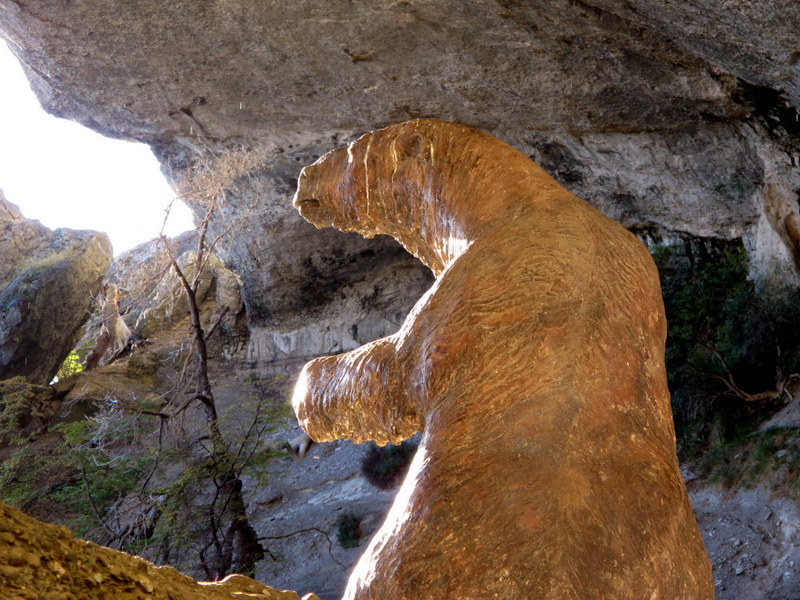
The Cueva del Milodon is a very large cave, where almost a hundred and twenty years ago, in 1895, the German explorer Hermann Eberhard dug up a cache of Mylodon bones and petrified Mylodon scat. Five minutes later, the place was overrun by looters and treasure hunters, but one hundred and twenty years later, archeologists still haunt the place, digging fitfully in corners, trying to convince visitors that the potholes and debris piles are just how the prehistoric human inhabitants left it.
When I first visited the cave nine years ago, Dad and had I considered the extinction a significant blow for interior design. I mean, really... Streaky mud floors, creeping damp, salt damage….
The cave doesn’t need the Mylodon – its two hundred meters of depth are staggeringly impressive all on their own. But a week of wind makes you punchy. It drives you to desperation, and when you snap, you break out in chintz. Dad and I considered something in an oversize floral print. Maybe a tiki bar in the back, to justify a few prehistoric flaming torches. And oh, the potential for hi-fi! At the back of the cave, where the wall curves up against the scree slope, the echoes get really big.
Dr Tabubil and and I halloo’d the reverberate fjord. “Tabubilgirl -erl –erl is a hottie -hottie -ottie!)”
Dad looked at us and looked at us and said dryly how pleased he was to see how far the level of human culture had risen since humans moved into the place.
Back then there wasn’t much there: a car park, marked roughly with logs, and a gravel path up the hill to the mouth of the cave –
Today the Cueva del Milodon has a café, a visitors centre, a ranger station, and an elevated walkway to take you all the way to the cave while walking six careful inches above the pampas grass. On a natural promontory in the mouth of the cave there is a life-size milodon done up in fiberglass and a plexiglass box holding a mummified scrap of genuine milodon skin, with genuine milodon fur on it –
We duly marveled and went down into the cave. It’s still hugely impressive – two hundred yawning meters of dark brown echoes and poetry of the gaping cavernous sort. Today, though, you can’t get near the echo wall. A gravel path circles through the cave, with chain-link ropes on each side and everywhere, signs explaining that only a fraction of the cave floor has been dug up and priceless artifacts lie centimeters beneath the virgin surface in every single direction, so kindly, gently, courteously please stay on the path. The signs urged, begged, pleaded and even tried for stern nursery tones, but it was patently obvious to even the most credulous viewer that nothing further from virgin earth had existed this cave at any time in geological history –
The floor of the cave looked like a major European city center during the blitzes of world war two, after the rescue crews had been through the place and added a layer of shafts and ladder holes to the chaos.
Chileans don’t much like being told where they can – or cannot - walk, and to my discretely outsize pleasure, every square meter of the cave floor that wasn’t actually vertical had recently accumulated a brand new layer of archeological interest – the overlapping footprints of hundreds and hundreds of sneakers and hiking boots. All together, they made a rather fetching pattern of interlocking divots and caterpillar prints, vaguely reminiscent of a carpet in a low-rent casino in Las Vegas. It would have gone great with the tiki bar and torches.
I took a step toward the echo wall, but Sarah blocked my leap across the chain-link rope.
“You have to think about examples, Tabubilgirl.” She said, and looked meaningfully at little Laurie hanging about behind me, round about the level of my knees.
“Yep.” Miles nodded sadly. “You’re a role model now. You want him learning bad habits? Do what the sign says except when you don’t because that doesn’t count, forget you ever saw it? Really, Tabubilgirl?”
I looked eloquently at the carpet of footprints, and mouthed a rude word over Laurie’s head.
“He’s two feet tall.” Sarah said. “He notices people, not the background stuff. You just spent two days playing patty-cake and spot-the-birds-on-poles with him in the backseat of a car. He thinks you’re the best thing to hit the earth since that first time he heard us singing baa baa black sheep. He’s tracking everything you do like those great big eagles on poles track sick sheep! Do you really want this for your legacy? What comes next? Running in the street?”
Well fine, then. Nine years since I was here last, and now, no echoes. I loitered moodily, sulking and kicking gravel about with my feet and taking bad photographs of the inside of the cave with no flash lighting until Laurie and his dismal parents had cleared a debris pile halfway to the entrance, and then I grabbed Mr Tabubil’s hand, nipped over the chain-link rope, and made a run for the wall.
“I don’t get this” Mr Tabubil panted as we climbed and slipped our way up the scree slope.“The cave echoes. That’s what caves do. But the echo isn’t any different over here-“
“HERE!!!” the cave rang. “HEREHereherehere Here!”
“Oh.” Mr Tabubil said, very softly, and the cave whispered back to him. I laughed, and the cave laughed. I tittered and the sound ran back and forth across the roof, chiming like stone bells.
Mr Tabubil growled a low “Ho Ha Ho.” Rumbles of sound around the walls of the cave, shivering through the rock. We laughed at each other and the cave laughed back – high, low, happy, gleeful, heated, cruel – until the air rocked and trembled and little Laurie in the mouth of the cave was crying in fear.
“Are you happy now?” An exasperated shout came from the cave entrance.
quake
“Appy!” The cave called back. “Ow? Now?”
“For Pete’s sake.” The voice said, disgusted. “You’ll be running on roads next. Right in front of him.”
Holding tightly to each other, Mr Tabubil and I slithered down the scree back to the path, grinning like loons. I could walk on the paths for another eight or nine years now. I was filled up.

Thursday, July 11, 2013
Lago Grey: A Scientific Explanation
At the end of April, while our Aussie guests were here, we all flew together down to the far south of Chile. We were heading into the pampas – the thousands on thousands of rolling kilometers of open southern grasslands, going to Puerto Natales and the Torres del Paine.
We were going tower hunting.

Icebergs are blue. Electric Blue. Celestial blue.
So are the rivers that flow away from glaciers, and the lakes that these rivers flow into, something that has always confused me. I had been taught that the celestial properties of icebergs are due to the way light rays percolate through the ice, and I didn’t see how that could translate to the ice when it melted.
I have since learned that the vivid color comes from rock flour, ground out of the Torres del Paine by the moving glaciers and suspended in the water. Nine years ago, however, I heard a different explanation.
In the summer you can go up to the face of the glacier in little boats –chugging along the ice face, hugging the curves and crags and chipping ice cubes from the glacier and drinking dreadful, three-day old whiskey with celestial ten-thousand year old ice.

Halfway along the lake, we had stopped to pick up a group of campers from a campsite on the lake shore. That campsite set a new benchmark for blasted, benighted and windswept, but the campers – a group of students from Santiago, were full of enthusiasm.
It was a mixed group, and the girls were inclined to worshipful adoration of the males. Up against the ice face, one of the girls spoke -
“The ice in that cleft is so blue it’s almost turquoise. Why is the ice so blue, Hari?”
A student in the middle of the pack smiled and stood tall.
“Ah." He said. He cleared his throat. "Ah ha. You know how water is made up of two H molecules and one O molecule?”
“Yes!”
“Well, it’s the H molecules that make ice white. When ice goes blue like this it means that all the H molecules have melted into the lake. That ice is there mostly O.”
“Ohhhh." The girl looked up at him with doe-like adulation.
From the back of our little crowd, a voice rose in a distinct Australian drawl.
“I’m guessing that none of you lot study Chemistry, then?”
I’m not saying that it was one of us. It might have been, but on the other hand, it might not. There were a lot of people on that boat. It could have been anyone.
Hari went back to more traditional means of impressing girls – flexing the muscles in his arms (the muscles in his brains having proved pretty much impervious to flexing) and drinking too much whiskey on ten-thousand year old rocks.

Those were some rocks. That water was the most pure water I’ve ever tasted. It tasted of theology; you could conceive of a pristine world, where the rain fell on antediluvian man through a sky that had never heard of aerial pollutants. Sucking on a chip of ice was like drinking explosions of absolute nothing. Like peppermint without the mint. Just the explosion.

Tuesday, July 9, 2013
Lago Grey
At the end of
April, while our Aussie guests were here, we all flew together down to
the far south of Chile. We were heading into the pampas – the thousands
on thousands of rolling kilometers of open southern grasslands, going
to Puerto Natales and the Torres del Paine.
We were going tower hunting.
We ate a lunch of peanut-butter-and-olive-paste sandwiches (try it before you knock it!) on a bench at a refugio (hiking camp) on the shore of one of those fantastic long blue lakes.

The electric water was spun into a chop by a wind- a tremendous, bloody-minded wind. It vacillated between gale-force and merely ferocious and it never, ever ceased. It was harsh enough to rush you off your feet, knock over the lip of a hanging valley, shake the car like a Christmas toy with all five of us inside it.
Snugged up against the feet of the Torres is one more long lake- Lago Grey, (although like the other lakes in the park, it runs to electric blue - and there's a scientific explanation for that) and at the end of the lake is the Grey Glacier (equally electric.) Lago Grey is bounded on the south by a wide sandbar that runs into a craggy island.
When the glacier calves, icebergs float down the lake to the sandbar, where they beach themselves and lie upturned with their bellies in the air, and dissolve slowly in the sun.

It’s an ice-elephant graveyard.

We walked along the shore of Lago Grey out to the sandbar, but that terrible wind was too strong for us. Little Laurie cried as ice crystals sliced his cheeks. The wind whipped around the edges of the Torres and raced down the length of the lake to wrap its fingers underneath us to pry us off the sand and lift us off our feet –

For a family holiday, it all felt entirely gratuitous. So we walked back down the lake to where we’d parked the car and we drove to the Hotel Grey and sat in its viewing lounge with the wind on the other side of plate glass windows. We had a lovely view twenty-six kilometers straight up the lake to the glacier, and we enjoyed it over cups of hot chocolate and coffee.
That is the civilized way of doing glaciers.

Laurie had an accident with his milk carton and had to be carried back to the car wrapped in Miles’ wind jacket. If you’re inclined to think that we were taking our holiday too soft – you imagine hiking a glacier with a two-year old in your backpack. And thank your lucky stars for plate glass windows.
We were going tower hunting.
We ate a lunch of peanut-butter-and-olive-paste sandwiches (try it before you knock it!) on a bench at a refugio (hiking camp) on the shore of one of those fantastic long blue lakes.

The electric water was spun into a chop by a wind- a tremendous, bloody-minded wind. It vacillated between gale-force and merely ferocious and it never, ever ceased. It was harsh enough to rush you off your feet, knock over the lip of a hanging valley, shake the car like a Christmas toy with all five of us inside it.
Snugged up against the feet of the Torres is one more long lake- Lago Grey, (although like the other lakes in the park, it runs to electric blue - and there's a scientific explanation for that) and at the end of the lake is the Grey Glacier (equally electric.) Lago Grey is bounded on the south by a wide sandbar that runs into a craggy island.
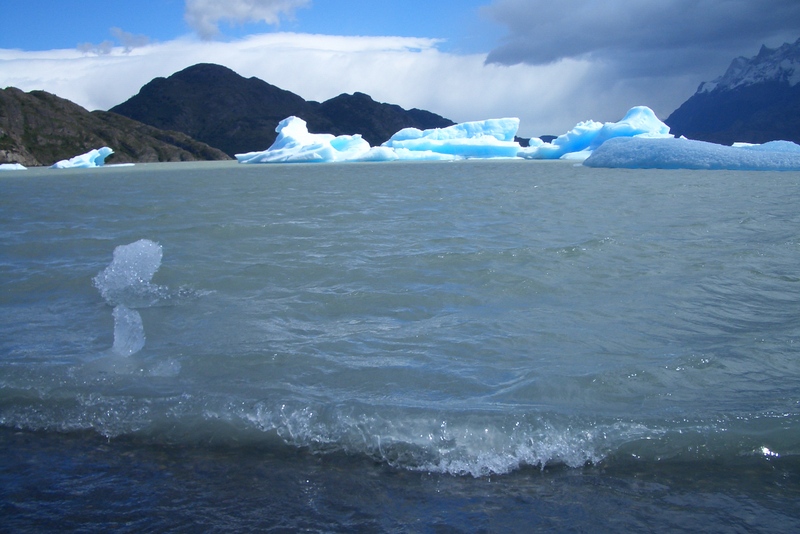
When the glacier calves, icebergs float down the lake to the sandbar, where they beach themselves and lie upturned with their bellies in the air, and dissolve slowly in the sun.

It’s an ice-elephant graveyard.

We walked along the shore of Lago Grey out to the sandbar, but that terrible wind was too strong for us. Little Laurie cried as ice crystals sliced his cheeks. The wind whipped around the edges of the Torres and raced down the length of the lake to wrap its fingers underneath us to pry us off the sand and lift us off our feet –

For a family holiday, it all felt entirely gratuitous. So we walked back down the lake to where we’d parked the car and we drove to the Hotel Grey and sat in its viewing lounge with the wind on the other side of plate glass windows. We had a lovely view twenty-six kilometers straight up the lake to the glacier, and we enjoyed it over cups of hot chocolate and coffee.
That is the civilized way of doing glaciers.

Laurie had an accident with his milk carton and had to be carried back to the car wrapped in Miles’ wind jacket. If you’re inclined to think that we were taking our holiday too soft – you imagine hiking a glacier with a two-year old in your backpack. And thank your lucky stars for plate glass windows.
Tuesday, July 2, 2013
Torres del Paine: Into the Park
At the end of April, while our Aussie guests were here, we all flew together down to the far south of Chile. We were heading into the pampas – the thousands on thousands of rolling kilometers of open southern grasslands, going to Puerto Natales and the Torres del Paine.
We were going tower hunting.
The National Park of Torres del Paine begins a hundred kilometers north of Puerto Natales, but the park is a large one, and the towers themselves are another hundred kilometers further north. If you want to go see them in one day, you have to start very early indeed.
We left our hotel before the sun was up and drove out into a thick white fog. Little Laurie in his car seat passed the time counting ‘birds on poles.” Nothing was moving in that fog. Even the birds were grounded.
These weren’t dainty meadowlarks or plover. Talons like garden forks were sunk into fence posts on both sides of the road and above them, hawks and eagles the size of combine harvesters loomed damp and indistinct, waiting for the fog to lift.
We drove slow, peering into the swirling fog, watching out for headlights of other cars and gauging bends. Watching so close, you see things in the mist – swirling shapes that come out of the fog and go back into it before you know if you’re seeing truly or seeing ghosts –
Ahead of us, the white began to boil. We hesitated, braked, in case the boil was real - and sudden as a camera shutter coming down, the fog turned and we were driving through sheep. Masses of sheep. hundreds of sheep. As sea of shaggy white backs, huasos (cowboys) on horseback, little islands in their sheepskin trousers and flat, wide-brimmed hats bobbing among them like little floating islands. A dozen working dogs slunk low against the grey grass, tag-teaming strays that tried to bolt out of the herd into the fog, growling and nipping, chivvying them back into the pressed mass. The huasos slapped their reins and whistled to the dogs and jinked their horses left, right, and left again – and the whole boiling, seething mass flowed around us like a river in a flood, carried swiftly down upon a current of snapping dog and jinking horse -

Twenty kilometers further up the road, we met cattle. They came at us in snatches of shifting brown bodies, bellowing and steaming all around us in the murk. Mindful of another bull we’d met, on different road down near Lago Ranco, we pulled to the side of the road and stopped.
A huaso on his horse loomed up out of the white. He wore a patch across his right eye, and in his frilled sheepskin trousers and flat hat he looked a proper pirate. He grinned down at us from his horse and raised his hand, and like the parting of the waters, a narrow slot opened up between the churning animals. We edged forward. A dog barked –one sharp crack – and a great big brown body lurched. We shot forward and were through.
Behind us the one-eyed cowboy gave a whoop and waved his hat – and we were gone – they were gone, swallowed up again by the white.

So late in the year, many people don’t see much more of the park than this. Even in high summer you might come for a week and see no more than ghosts of foothills, thinly, through the shifting mist.
But for whatever reason – perhaps our one-eye’d huaso had called it up - it was our day. As we cleared the grazing country and started up into the foothills of the park the fog lifted, and there they were: the Torres del Paine –
As if the road were a geological divide, a massif rose up- crowned with hanging glaciers and shattered rock fingers - a slab of mountain like the bottom of the world turned on its end and reaching up into the sky-

We were back to improbable poetry again. How else could anybody sensible describe this place? When a white fog rises one expects- the narrative demands - something windswept and barren, a sere and alien beauty – if beauty at all.
Not this–
We had come out of the fog into the middle of a moonscape - domed hummocks and puddle lakes that meandered out to eternity with no horizon and no base level. There was no perspective– just up and down and round, vivid in primary yellow and primrose and green.

We drove for hours over the rolling ground, the towers on our right drifting in and out of clouds. Here at the top of the world, roads snaked and switch-backed, throwing themselves from one side to the other of pocket-handkerchief-sized valleys with their bellies full of water, little lakes, overgrown, in tones of emerald, chartreuse, gold and burgundy and olive, sweeping out from the centre, and then emerald again, where the water met the autumn grass at the edge of the next rise –

And over that next rise, we’d teeter on the lip of a hanging valley: three hundred meters straight down to a long lake the color of blue glacier ice, and on the other side of that, that wall again–no trees, no bushes, no grass, no green, just a fist punching up through the roof of the world –

Wednesday, July 18, 2012
Cuttlefish Cargo Cult Day 1: Here's to the Cuttlefish!

Almost exactly a
year ago, just before we left Australia, I had a second opportunity to go
diving with the Giant Australian Cuttlefish.
The dive happened a
week and a half before we left Australia, when I was in a rather busy period of
my life. I have always intended to talk
about it, because that day dive was, if anything, even more extra-ordinary than
the first dive: the sun was
shining and the water was clear and there were exponentially more cuttlefish
out and about than when Dr Tabubil and I went diving- but what with the move, and then one thing
and then another, the photos have been languishing on my desktop for the past
year and I haven’t found the moment.
And then a couple of
weeks ago, Australian friends sent news that made my cuttlefish images very
topical indeed.
For those who aren't
aware, the Australian Giant Cuttlefish is the largest cuttlefish species in the
world - up to a meter across, and the coast of the Spencer Gulf in South
Australia, where I lived, is a place very special to these animals.
Those unfamiliar
might read my post HERE and
explore its own attendant links, or if you're in a hurry, you might just read
this quick summary. And then go look up
the BBC documentary series 'LIFE' (2009) and check out the episode 'Creatures
of the Deep.' (after which you will want
to go read the post linked above anyway, because the giant cuttlefish so entirely fascinating).
The nutshell:
The Australian Giant
Cuttlefish is the largest cuttlefish species on earth. They lead a solitary,
leave-me-alone-and-to-hell-with-the-neighbors sort of life, but once a year,
they come by the thousands to breed along a very small and very specific
stretch of the coast along the upper Spencer Gulf in Southern Australia.
Point Lowly, this little stretch
of coast, is the world's only known mass cuttlefish spawning ground. Just outside the coastal mining town of
Whyalla, the sandy floor of the gulf gives way to a litter of sandstone slabs,
built up with ledges and overhangs under which the cuttlefish can lay and leave
their eggs.
When they have
finished breeding they disappear. We
have no idea where they go or what they do – all we know of them we know from
this brief annual window of time and breeding behavior, and when they leave
they vanish out of science and out of human knowledge.
Because of the scale
of this breeding event, the Australian Giant Cuttlefish is a species that lives
in a tenuous equilibrium. An event that
disrupted the breeding colony would have a huge effect on the viability of the
whole species.
When I left
Australia, there were two threats to the cuttlefish.
Threat the first:
A large Australian multinational firm (BHP
Billiton) wished to build a desalination plant for their inland mining
operations, and they had chosen this same specific piece of coast to build it
on. The scientific reports are
inconclusive to hypothetically optimistic – there is no direct evidence to
indicate that an upsurge of salinity in the local region would affect the
breeding grounds.
BUT:
The local geology of
the breeding site holds nothing special for the desal plant. A few kilometers in either direction across
hundreds of kilometers of gulf coastline would have made no difference either
way to the economics or feasibility of the plan. When you are building around a species so
special, so evanescent and so terribly unknown, in what sort of human universe
would you want to take that risk?
Local landowning
interests had played NIMBY and refused to give up any of their sheep pastures,
and the state-owned land that is this very special breeding ground seems to
have been the only piece of coast that did not have someone in government
willing to stand up for it. Shame on
South Australia. When I left, the
proposal was still, slightly, on the fence; the people of the gulf coast cared
– even if their elected representatives didn’t, and there was some tenuous
hope.
Threat the second:
When Dr Tabubil and
I made our first dive last year, Tony's dive shop was a busy place:
on his sofa was a pair of Japanese documentary film-makers (if anyone
knows who they were filming for or how to find the footage that they took,
please let me know. I’d love to see it)
and at the back of the dive-shop, drinking coffee and talking in low,
frustrated tones, was a team of bemused biologists and marine scientists. The cuttlefish numbers were low that year –
very low. The winter drop in water
temperature had happened more slowly than usual, and the cuttlefish had been
coming late and slowly. And when they came, they had been much
smaller than the average. The scientists
watched, futilely, and took censuses, and waited to see what would happen. And
wondered why the cuttlefish that came were so small.
That was 2011. In June of 2012, two things happened. BHP Billion
won. The desalination plant is going
ahead. Huzzah for Big
Businesses. Huzzah.
But it may not
matter one way or the other. This year,
the cuttlefish did not come back. The
numbers at the breeding ground were low last year, but nothing like low enough
to affect species viability. The water
conditions at the breeding ground have not changed. Whatever has happened happened out wherever
the cuttlefish go when they do go, and it happened extremely enough that within
two years, an entire submarine ecosystem may be gone forever.
And so, in a spirit
of cargo cults and magical thinking, we’re going to have a week or so of
cuttlefish: perhaps, if we wish hard
enough, a critical concentration of photo and video will bring them back from
wherever they have gone.
Given a large enough set of universes, nothing
is impossible. They’re curious
creatures, cuttlefish. Look at this one
here – he found me, a long, dark-blue-neoprene-and aluminum-tank thing,
floating a foot or so above the surface, and was moved enough not to run but to
swim over to me and investigate. He came on and on and would have snatched the
camera from my hands if I had let him.
Here’s to the Cuttlefish:
Friday, March 30, 2012
Nitmiluk
Before we relocate to Chile, we are taking a week's holiday driving a great big equilateral triangle (For a given definition of triangle, and an even looser definition of equilateral) through Australia's Top End.
Enjoy!

The morning after our night-time boat-ride, we had been promised a boat ride in the daylight in a place called Nitmiluk. And that's all we knew about that. Having done all of my schooling in other places, my Australian geography is rather spotty, and in all our driving we were busy being stunned by the geography happening outside the windows of the car and we never took the time to do half the reading in the guide-books that we ought to have done.
A necessary pause in the narrative:
Take a moment and open up Google earth, or Google maps, set it to satellite view, and do a search for Katherine Gorge. Then zoom in until you can see individual tree-dots and white-caps on the water on the Katherine River. I'll even cheat - there's a shortcut on this page: photo number eight.
Do you see it?
Fissures in the landscape - kilometers long, as if the great red back of Australia had taken a mighty continent-cracking blow and split open along its planes and faces. The cracks snap out at right angles, regular, geometrical and rectangularly precise. The damage is industrial, almost, at a planet-spanning scale - the fissures are kilometers long and a hundred meters deep.
Fissures in the landscape - kilometers long, as if the great red back of Australia had taken a mighty continent-cracking blow and split open along its planes and faces. The cracks snap out at right angles, regular, geometrical and rectangularly precise. The damage is industrial, almost, at a planet-spanning scale - the fissures are kilometers long and a hundred meters deep.
Imagine us, with no expectations beyond a ride on a pretty, silty-banked river in the daylight, approaching a bluff - a scrubbly, rubbly eucalyptus-and-mulga infested bluff, and stepping forward to see a wall of burnt red rock fall away from our feet, down and down and almost out of sight, to a strip of limpid blue water. A big water hidden in the desert.

In another twin-hulled swamp boat , we motored along the bottoms of those great cracks, through narrow passages between sheer red walls that opened into right-angled pools of electric blue water that turned its face up to an even bluer sky. There was exhilaration, an awareness of unreality like you walk through in dreams, with tall trees turned to matchsticks by the depth of the canyons, and twenty meters of blue water under our keel in passageways so narrow we could almost brush the walls with our fingers, and there was the knowledge of the mad and the miraculous. Nitmiluk was a place of mad, extravagant, spendthrift throwaway abundance, a slash of wild electric life -technicolor manna in the desert. In a dry country of want and hoarding - a bone-deep desiccated hoarding, of air and sand floors as hot as a scalding bath, and dry sun to parch skin from bones, there was this place only one long step away from sight, hidden between the red rock walls.

The Jawoyn call it Nitmiluk - Cicada place. The place name was given by Nabilil, an important character of their dreamtime. He was travelling across the landscape and when he came to the gorge he heard the cicada calling "Nit Nit Nit!" And he stopped here for a time. The waters of the Gorge come from Bolung, who lives in the second pool. He is the creator and the destroyer - the water as life, but also the floods and storms of the wet season. Because of his capricious nature, Bolung is approached with caution. There is no fishing in the second pool. There is no drinking in the second pool, and pregnant women and initiates (all people on the cusp of great changes in life) may not swim in the Katherine Gorge in case that their own energies disturb him and make him rise.
These little stories are simple, incomplete- Jawoyn kindergarten tales. The Jawoyn, like the other Australian peoples, measure their learning in their own personal knowledge of the world. History lessons and morality tales are bound up in their creation stories, and tied to features of the landscape and the seasons. Babies are taught toddler stories suitable to their own range of understanding - as are white Australians and tourists. As Jawoyn children grow up and move through stages of life and initiation, they graduate to deeper, richer, versions of the early stories, and learn versions of new ones about new places relevant to for their age, their gender, their moiety, and their position within their people.
A man I met at Uluru last Easter had been working there for a year as a ranger with the parks service - babying tourists on walking tours around the rock. He told stories like these about Uluru. The Anangu people there reckoned that since he'd been there about a year, he was about equivalent to a toddler taking its first steps through the place, so they gave him kindergarten stories. Being a gringo isn't the same as being an Anangu. Anangu kids will learn more - upgrading, if you like - as they moved through life and passed through initiations. His initiation, if he chose to pursue it, would be one of endurance - staying there long enough to indicate he cared enough to be worth their sharing.
Theres' a modern-day significance to Katherine Gorge as well. It's the place where the Jawoyn people won the first successful native title claim in Australia. In 1989.
Embarassing, isn't it? The title claim was launched in 1978 and spent nine years grinding its way through the courts and - something that the Jawoyn speak of with a sort of amazed bitterness - days walking through Nitmiluk beside white politicians and judges -
All a white man needed to claim a piece of Australia was a flock of sheep and a gun, and once he had it, the land was his, forever and a day. The whites with the guns wrote about the Aboriginal people hanging around the place when they got there. You could say that there was clearly precedent, in fact: they even wrote down some of the blackfella histories, but that sort of stuff was anecdata. Between the years 1978 and 1989, the Jawoyn people were asked to demonstrate their up close and personal relations, going back 40 000 years, with every bush and boulder and patch of scrub in the place.
But they won. Nitmiluk is theirs now. They promptly rented it back to the park service and, and managing it themselves, share the place with us.
Nitmiluk has thirteen gorges in total, but we only sailed through five of them. In the wet season, the water runs so high and fast that the boats can't run on it, and in low season, the water drops so low that in the necks of the gorges natural weirs block the river. Three times we had to disembark (or demount, possibly - they were very little boats) and walk across the neck of the gorge to another boat floating on the other side.
We went until we couldn't go any further - by boat or on foot, and stood on a high wall of tumbled rock and couldn’t credit that in the wet the water would flood higher than our heads and sail right over the wall with only a few rapids to mark the place.

On our way back up the gorge, we went swimming - which was another surprise for us. Back at the opening of the second gorge, on the downstream side of the gorge, where the river trickled down through a natural weir of sandstone and bottomed into a wide, shallow pool, we were told that our excursion was going to stop for a while so that anyone who wanted to swim could go in.
And we'd no idea. We wished we'd read the brochure. Our bathers were back in the car at the Visitor's Center.
And I had to go in. I absolutely had to - so I pulled off my shorts and went in in my shirt and underpants and it was the very best swim I'd had since we had left PNG nine years ago. A beach is wonderful thing, but fresh water has a glory, and that day, it was like crystal - cold and clear and sharp. I curvetted. And there were no crocodiles within half a kilometer, so I rode the current up and down until we had to come out and go away from that place.

There were no salties there, anyway. The whole park was a water paradise - with people in canoes and bright plastic kayaks and picnicking on the rocks and hiking on the cliffs. The parks service clears out the salties at the end of every wet season, and salts the gorges with saltie traps - the bait is weighed with a tripwire that a freshie isn't heavy enough to spring. The rangers check every morning - if the trip wire is sprung, they go crocodile hunting and no-one goes into the water until the saltwater crocodile comes out.

Back at the Visitors Center, we went swimming again, and the swim there was less than glorious. At the Visitors Center, downstream of the gorges, the water was thick and green and dark. The same sort of silty water we'd been puttering through last night with all those freshwater crocodiles. And right above the little swimming jetty there was a colony of fruit bats in the trees doing what fruit bats do. No-one wanted to come swimming with me, not even the indefatigable Sandor. I was faintly custard-like myself, I confess. I didn't want to swim alone in the dark water, so I waited for another lady to come padding down to the jetty and went in when she did.
We swam with our heads above the water - the stuff was so thick we couldn't see our own limbs below the surface, and floating with yellow pollen besides. We felt pale-fleshed and vulnerable, and we treaded water with our legs tucked up tight against our chests.
"It's marvelous!" We screamed, and waved enthusiastically, at Pippa and Thea and Sandor and Mr Tabubil and told them about all of the wonderful water that they were missing. On shore, all were dour, so the two of us struck courageously out across the river toward the canoes pulled up on the other side, but we lost confidence five meters from the bank and we came back. It wasn't that we didn't believe the harmless freshwater crocodile propaganda, exactly. It was just that we weren't confident that they could sense us either in the murk, and didn't want to have to have to test their good behavior in a head-on collision.
So we came out.

Monday, March 26, 2012
Shaken, Rattled and Rolled!
We have had a fun weekend, we have!
At 4:30 on Saturday morning, the whole city was woken up by quite a NICE little earthquake - it was only a 5.1, but it was also only 41 km away, and it rang us like a bell.
We felt two great bangs, as if our building had been hit with a huge sledgehammer, and a great roar with each one, and much vibration after each - like a struck bell vibrating until it dampens down.
I felt the first one in a dream and woke up to the after-shaking, and the second one hit while I was solidly awake and when it stopped Mr Tabubil and I lay still, waiting to see if there would be any more. And it was some time before we went back to sleep.
So that was Saturday.
Today we went out to lunch with friends, and everyone was inspired to talk about earthquakes - we heard hair-raising stories about the 8.8 quake in 2010 - which is still big conversation here a year later. My friend Alba and her husband Sebastian live on the 10th floor of their building - they were having a party when it hit. Sebastian told us "There were 50 people in our flat - so imagine 50 people's worth of wine glasses and wine bottles and water glasses and water bottles going smashing to the floor."
The quake started small - and then grew, and the power went out, so Alba staggered to the kitchen for candles, and then it grew so big that Sebastian herded everyone into the point of the apartment where three door-frames and two structural walls met, and they sheltered there while the shaking and the roaring grew and picked them up and tossed them and threw them from wall to wall to wall. Drifts of smashed glass were washing across the floor, back and forth, hissing on the tiles, and the earthquake was roaring, and outside, the dark was lit up by red and yellow explosions as power transformers blew up, and right in front of them, while they watched, a wall split open from floor to ceiling. I felt the first one in a dream and woke up to the after-shaking, and the second one hit while I was solidly awake and when it stopped Mr Tabubil and I lay still, waiting to see if there would be any more. And it was some time before we went back to sleep.
So that was Saturday.
Today we went out to lunch with friends, and everyone was inspired to talk about earthquakes - we heard hair-raising stories about the 8.8 quake in 2010 - which is still big conversation here a year later. My friend Alba and her husband Sebastian live on the 10th floor of their building - they were having a party when it hit. Sebastian told us "There were 50 people in our flat - so imagine 50 people's worth of wine glasses and wine bottles and water glasses and water bottles going smashing to the floor."
It was quite a night.
Another couple we know live on the third floor of a very small building and got down and outside during the quake, and afterwards, they climbed back upstairs to change their pajamas for real clothes, and packed backpacks full of water bottles and apples (which is what they had to share) and spent the night hiking across town to see if anyone needed help. All the way through the city they had to step around sheets of smashed glass and fallen lumps of concrete the size of dining tables.
It's a damn good thing that that earthquake happened at night. If it had happened during the day when people were out and on the streets - there would have been a terrible terrible mess.
At any event, we came home this evening feeling quite happy that the local tectonic plates had had their big stretch-out before we arrived.
And then tonight, at about half past seven, I stepped out of the kitchen into the living room where Mr Tabubil, who'd been sorting power cables for his electronic bits and pieces, was sitting upright on the sofa.
"Did you feel that?"
"Feel what?"
"Maybe it's dying down."
"Maybe. Is that -?"
It lasted a long time. We stood there, Mr Tabubil with his arms tight around my shoulders, until it stopped.
And THEN I was frightened. There wasn't any time for it during - I had to worry about how I'd find shoes if glass began to smash, and how we'd get out during the shaking if it grew any worse -
The final verdict was a 7.1. And THAT is quite a quake! There has been very little damage, and only one reported death, an elderly woman from a heart attack. Chileans build their buildings WELL.
There were some evacuations on the coast, but for precaution only. The sea receded in places, but there were no tsunami warnings - and no tsunamis.
But that's how it goes, you know? If the ground shakes, you go uphill.
And for some reason, many Chileans didn't learn that after the Asian Tsunami in in 2004- and they died here when they wouldn't go uphill on 2010. Sebastian had a friend who was on the coast when it happened. He ran for the hills, and he lived. A man who'd stood next to him said "My car is down on the beach!"
Sebastian's friend looked at him and said "You're crazy! RUN!"
But the man went for his car - and he died.
They all know now. The ground shakes and they go uphill.
Subscribe to:
Posts (Atom)

