
 Posts
Posts


Showing posts with label weather. Show all posts
Showing posts with label weather. Show all posts
Tuesday, November 29, 2016

Tuesday, August 16, 2016
Doors and Holes
Mr Tabubil is feeling peevish. That 8.3 earthquake last September knocked our front door out of skew. and we now have a one centimeter gap between the bottom of the door and the floor. It's not much gap, but in cold weather it leaks heat like a broken sieve, and whenever there's a wind, the draft hits the far side of the apartment with a speed that makes one ponder more exotic aspects of physics and meteorology. It's probably something quantum.*
Mr Tabubil has bought a rubber weather strip to cover the gap.
We didn't get one last winter, because most of the city was in our position, and there was a run on the hardware stores and by the time everything was back in stock, the weather was warm.
This evening he took the door off its hinges, screwed on the brass plate of the weather strip, and spent three quarters of an hour fussing and straining and worrying and fiddling and putting a hold in his hand and hammering and crimping and bashing and pulling to get the un-skewed door back on its hinges. Turns out a lot of things were out of skew.
And then he closed the door - and the rubber bit of the weather strip, quite unceremoniously, peeled off.
Ow.
Right now he is browsing the websites of the major hardware chains with the request to be left alone please, and, at intervals, huffing hugely.
*(Sir Pterry - respect.)
Mr Tabubil has bought a rubber weather strip to cover the gap.
We didn't get one last winter, because most of the city was in our position, and there was a run on the hardware stores and by the time everything was back in stock, the weather was warm.
This evening he took the door off its hinges, screwed on the brass plate of the weather strip, and spent three quarters of an hour fussing and straining and worrying and fiddling and putting a hold in his hand and hammering and crimping and bashing and pulling to get the un-skewed door back on its hinges. Turns out a lot of things were out of skew.
And then he closed the door - and the rubber bit of the weather strip, quite unceremoniously, peeled off.
Ow.
Right now he is browsing the websites of the major hardware chains with the request to be left alone please, and, at intervals, huffing hugely.
*(Sir Pterry - respect.)
Wednesday, July 13, 2016
Pirates!
It is cold tonight! The air is cold and damp and I'm puffing it out in clouds. I'm rugged up - coat, scarf, gloves and a big pink wool beret.
And as I headed out, a family walked in the door. A small girl gasped.
"Look!" she crowed, pointing at my beret. "A pirate!"
Her face had gone white and eyes were as large as stars. Every storybook she owned had just come to life in the middle of mundane everyday-world Santiago.
I grinned and said "That's right." and came very close to screwing up my face and growling "Argh."
But I didn't. I settled for a pirate grin, and walked out, feeling rambunctious and yo-ho-ho-y.
And as I headed out, a family walked in the door. A small girl gasped.
"Look!" she crowed, pointing at my beret. "A pirate!"
Her face had gone white and eyes were as large as stars. Every storybook she owned had just come to life in the middle of mundane everyday-world Santiago.
I grinned and said "That's right." and came very close to screwing up my face and growling "Argh."
But I didn't. I settled for a pirate grin, and walked out, feeling rambunctious and yo-ho-ho-y.
Tuesday, December 8, 2015
Summer in Santiago
Summer Summer has hit. For real. The air is light and balmy, the platano trees are a mass of green and a bird is chirping its little heart out just outside our window.
This afternoon I went places. I took a taxi. We were stopped at a light; the windows were down and I lay in my seat with my head back and my eyes closed, enjoying the early summer warmth, overlaid with the smells of petrol and hot tarmac. There was music coming from another car nearby, happy boppy summer pop-
"Look." The taxi driver said.
I opened my eyes. The music was coming from the next car over - a red Volkswagen beetle; not fire-engine red, but ladybird red, which is brighter and more alive, and behind the wheel was a girl. Her lips were painted a bright barbie pink. Her long hair fell down a high ponytail, tied up with a blue twist, and she was dancing in her seat, shaking that long fall of hair, bouncing her fingers on the wheel, singing and shimmying her shoulders, sending her summer-blue shirt slithering and slithering from one bronze collarbone to another.
It was a performance, but she wasn't playing to anyone. She was dancing her heart out for herself in her bright red summer car.
"Look." The driver said again, and his voice was one long sigh. "She even has a flower."
I looked. There was a flower, a peony tied with a bit of ribbon to the rear-view mirror.
"Es ella una maravilla." (She is a marvel.) "Una maravilla." He folded his hands on the wheel and watched.
She was Joy, and in a whole day full of summer, she was the most wonderful thing I saw.
This afternoon I went places. I took a taxi. We were stopped at a light; the windows were down and I lay in my seat with my head back and my eyes closed, enjoying the early summer warmth, overlaid with the smells of petrol and hot tarmac. There was music coming from another car nearby, happy boppy summer pop-
"Look." The taxi driver said.
I opened my eyes. The music was coming from the next car over - a red Volkswagen beetle; not fire-engine red, but ladybird red, which is brighter and more alive, and behind the wheel was a girl. Her lips were painted a bright barbie pink. Her long hair fell down a high ponytail, tied up with a blue twist, and she was dancing in her seat, shaking that long fall of hair, bouncing her fingers on the wheel, singing and shimmying her shoulders, sending her summer-blue shirt slithering and slithering from one bronze collarbone to another.
It was a performance, but she wasn't playing to anyone. She was dancing her heart out for herself in her bright red summer car.
"Look." The driver said again, and his voice was one long sigh. "She even has a flower."
I looked. There was a flower, a peony tied with a bit of ribbon to the rear-view mirror.
"Es ella una maravilla." (She is a marvel.) "Una maravilla." He folded his hands on the wheel and watched.
She was Joy, and in a whole day full of summer, she was the most wonderful thing I saw.
Friday, October 9, 2015
Today I saw...
I wish a phone could capture the light the way it really looks. It was the most extraordinary evening - not the faintest hint of smog - you could see clear to the ends of the earth and the sky was filled with that golden liquid light that you get before a thunderstorm.
At one point in the evening, as dusk fell, I looked out the window and gaped - it was falling like molten gold on the glass panels of the buildings and the sky was very dark and stormy and the shock of that bright gold against a dark sky was the most extraordinary thing.
A few of us crowded onto the balcony and stood and watched while it faded.

At one point in the evening, as dusk fell, I looked out the window and gaped - it was falling like molten gold on the glass panels of the buildings and the sky was very dark and stormy and the shock of that bright gold against a dark sky was the most extraordinary thing.
A few of us crowded onto the balcony and stood and watched while it faded.

Thursday, October 1, 2015
The Estufa
When you live in an earthquake zone, reliably solid stuff like walls and roofs and windows are somewhat less reliable than they are in places where the earth doesn't rumble and realign itself every other week.
Walls develop cracks. Inspectors and building contractors smile and tell you that the cracks are superficial and happening exactly where they're meant to - along slab lines or down the side of a core - places where the building is designed to flex. Because Chileans build really really solid.
Structural integrity is a very good thing, but in the day-to-day, non-crisis scheme of things -
There are air gaps everywhere!
Doors work their way off plumb, and spaces appear between door and frame. (Our front door has been sticking pretty good since Wednesday last. Opening it takes a shoulder and a shove.)
Windows rattle out of alignment and lean tipsily in their frames, and narrow wedges of empty space keep the air circulating in and out.
Every couple of years you call in a man who spends a couple of days pushing on the glass, whispering to it, and tapping gently at pressure points with a rubber mallet, and you're right and tight again for a month or three But mostly you shrug your shoulders and be glad that no room is sealed too tight for health or happiness.
In winter, it takes bit of remembering. Winter storms whistle straight through your healthy, happy environment- running up and down the curtains, ruffling furniture, knocking over bottles over the kitchen -
It makes you feel like a protagonist front and center in a really theatrical surround sound experience, but a winter storm that breaches the walls and comes right in the apartment and cozies up next to you on the sofa is cold.
The first really cold day of autumn nuzzles its way into your bed in the night and burrows deep into the thermal mass of the cracked concrete walls and the next thing you know you're sleeping under four feather quilts and wearing hot- water-bottles strapped to your waist under your winter coat. (This isn't an exaggeration. I've a friend on the top floor of a building in El Golf who wears a hot water bottle every year from May to September.)
Freezing isn't actually mandatory. Most of the apartments built in Santiago in the last half century have radiant heating.*
Unfortunately, running radiant heat is extremely expensive. Chile has no natural fuel reserves. Hydro exists only in the south where the rivers are.** Coal, oil and natural gas are imported from overseas, and the prices reflect it.
Most Santiaguinos spend winter wrapped around their estufa. An estufa is a small portable gas heater that sits on a little wire trolley. You trundle it around your apartment from room to room to work up a nice localized fug, and you are very happy that the local geology has blessed you with natural ventilation that lets the fumes out as fast as they build up.
The average human being is not overly gifted with foresight. In Autumn we watch the leaves fall and we talk about the cold weather that's coming but hardly anybody remembers to fill their kerosene can in advance of the winter. On the first really wet, windy morning of the year, the whole city rolls out of bed, winces as warm toe meets icy floor, and lets out a collective damn.
Because now you have to queue.
The kerosene that fuels your estufa is purchased at your local service station. There's snow on the mountains, which would be cause for celebration, but you can't see it because of the low grey mist rolling between the trees and the buildings. A slow rain works steadily down your collar, drip by icy drop. The chill creeps up through the soles of your shoes into your feet. The gas station attendants have to fit filling kerosene cans in between serving the cars that are pouring in (because anyone with a car is torn between filling the kerosene and getting up into the mountains to see the snow in person) and it looks like this -

* Most of them under the floor as per general spec, but in our first apartment here in Santiago, some unsung architectural genius installed the radiant heating network in the ceiling. The only winter we didn't spend in three layers of sweaters and a woolly hat was the year the people downstairs had a sick baby and ran their own heat all day long. They burned whole gas-fields keeping the temperature up to 70, and we walked around in shirtsleeves and bare feet.
** There's a major political kerfuffle right now over a possible huge high-voltage power line that would run 2000 kilometers from Aysen up to Santiago.
Tuesday, August 11, 2015
Rains Bring Disaster in Northern Chile
The rains might have been welcome, and pleasurable, here in Santiago, but on the coast and in the north of Chile they've brought disaster.
The Atacama desert is - normally - one of the driest places on earth, with an average annual rainfall of just 15 ml. It is so dry that wet doesn't register as a potential state of being. When we lived in Antofagasta, and we did get a few drops of rain, the interior walls of buildings would be peppered with rain-spots, because nobody noticed the cracks in the roof and the walls. (Earthquake zones do that.)
Up there in the north, even a few drops of rain can be a problem. The dry earth forms a thick layer of dust, and without plants to break down the surface rock, water doesn't soak into the ground; it sits on the top of the ground and forms a muddy slurry, and when the drops turn into a rainfall, and when they fall on a slope, the slurry gives way under its own weight and you get landslides.
In 1991, not too long before we moved there, a storm had caused a slide to come roaring through - unheralded, in the middle of the night - and taken out a whole group of houses, with the inhabitants inside.
This week the rain tracked unexpectedly north, and the heavy, southern-suitable rains are doing the same thing - gathering into a thick muddy slurry and pouring through towns. At least six people are dead across Chile, and clear skies down here in Santiago feel like a heck of a price to pay for all that.
The Atacama desert is - normally - one of the driest places on earth, with an average annual rainfall of just 15 ml. It is so dry that wet doesn't register as a potential state of being. When we lived in Antofagasta, and we did get a few drops of rain, the interior walls of buildings would be peppered with rain-spots, because nobody noticed the cracks in the roof and the walls. (Earthquake zones do that.)
Up there in the north, even a few drops of rain can be a problem. The dry earth forms a thick layer of dust, and without plants to break down the surface rock, water doesn't soak into the ground; it sits on the top of the ground and forms a muddy slurry, and when the drops turn into a rainfall, and when they fall on a slope, the slurry gives way under its own weight and you get landslides.
In 1991, not too long before we moved there, a storm had caused a slide to come roaring through - unheralded, in the middle of the night - and taken out a whole group of houses, with the inhabitants inside.
This week the rain tracked unexpectedly north, and the heavy, southern-suitable rains are doing the same thing - gathering into a thick muddy slurry and pouring through towns. At least six people are dead across Chile, and clear skies down here in Santiago feel like a heck of a price to pay for all that.
Saturday, August 8, 2015
Gustery, Blustery, Oooooooh....
This winter has been a rotten one for Santiago. With the exception of a storm on the 12th of July, we've had almost no rain at all. The occasional apologetic drizzle doesn't count for much, and day by day the air has gotten fouler and fouler and measured in how far the amber air-quality alert shades into emergency-red and by which license plates are allowed on the road in today's restricción vehicular.
It's been absolutely awful. Nobody in the city has dared to hope for more; we've been continually promised breaks in the weather, but the sheer act of hoping has caused the clouds to perversely shear off and go somewhere else. Anywhere else.
But this week it happened.
Mum called me on Monday. "The satellite says you're getting rain this week."
"Shh!!"
"It's going to be enormous. The temperature is going to drop, and then it's going to pour-"
"I'll believe it when I'm walking through it. Seen any good films lately?"
"-and it's going to last for days. Aren't you excited?"
"Of course I'm not excited! We've been refusing to get excited about it for days now! Stop talking! If you keep talking, you'll scare it away!"
Mum kept talking, but somehow, the rain still came. Not even the weight of seven million tentative, tremulous enthusiasms turned it from racing straight toward Santiago, and when it hit, it hit hard.
First the wind, howling and snarling, and then the rain, bursting through bedroom windows and flooding roads and overpasses.
That was Wednesday. Thursday was bigger than Wednesday, and Friday was bigger than Thursday, and I sat in in our living room with the whole apartment sealed tight and the curtains swelled and billowed while winds came whistling through through -
The reality of life in an earthquake zone is that a sealed building envelope is more of a concept than an actual thing. Every quake shifts doors and windows subtly out of alignment with the walls, and the cumulative effect is - well, in big storms, it's actually rather fun.
Today, the fourth day of the storm, was a howling torment. The curtains on the (sealed) living room windows billowed and snapped. The venetian blind on the (sealed) bathroom window clattered so loudly we wound it all the way up and then we stuffed a sock between the (closed) bathroom door and the door frame to stop the slamming door driving us irretrievably demented. Outside it poured and blew, and we went back to bed with books.
Sometime around four it stopped. Just stopped. The clouds blew away and the sky turned cerulean and a golden light illuminated a world that for once was fresh and clear and bright clean out to the mountains, which stood up stark and crisp and heavy with snow.
It was magical.
And half an hour ago the clouds came back in and the wind began to rise and the trees are bending and the evening is flat and grey - not evening dark but storm dark. Heaven.
It's been absolutely awful. Nobody in the city has dared to hope for more; we've been continually promised breaks in the weather, but the sheer act of hoping has caused the clouds to perversely shear off and go somewhere else. Anywhere else.
But this week it happened.
Mum called me on Monday. "The satellite says you're getting rain this week."
"Shh!!"
"It's going to be enormous. The temperature is going to drop, and then it's going to pour-"
"I'll believe it when I'm walking through it. Seen any good films lately?"
"-and it's going to last for days. Aren't you excited?"
"Of course I'm not excited! We've been refusing to get excited about it for days now! Stop talking! If you keep talking, you'll scare it away!"
Mum kept talking, but somehow, the rain still came. Not even the weight of seven million tentative, tremulous enthusiasms turned it from racing straight toward Santiago, and when it hit, it hit hard.
First the wind, howling and snarling, and then the rain, bursting through bedroom windows and flooding roads and overpasses.
That was Wednesday. Thursday was bigger than Wednesday, and Friday was bigger than Thursday, and I sat in in our living room with the whole apartment sealed tight and the curtains swelled and billowed while winds came whistling through through -
The reality of life in an earthquake zone is that a sealed building envelope is more of a concept than an actual thing. Every quake shifts doors and windows subtly out of alignment with the walls, and the cumulative effect is - well, in big storms, it's actually rather fun.
Today, the fourth day of the storm, was a howling torment. The curtains on the (sealed) living room windows billowed and snapped. The venetian blind on the (sealed) bathroom window clattered so loudly we wound it all the way up and then we stuffed a sock between the (closed) bathroom door and the door frame to stop the slamming door driving us irretrievably demented. Outside it poured and blew, and we went back to bed with books.
Sometime around four it stopped. Just stopped. The clouds blew away and the sky turned cerulean and a golden light illuminated a world that for once was fresh and clear and bright clean out to the mountains, which stood up stark and crisp and heavy with snow.
It was magical.
And half an hour ago the clouds came back in and the wind began to rise and the trees are bending and the evening is flat and grey - not evening dark but storm dark. Heaven.
Sunday, July 12, 2015
Today it Rained. Lots.
A large city surrounded by mountains is not necessarily a pleasant place. Santiago's air has been foul this winter. The contaminación has been at its absolute peak - the worst it has been in sixteen years. When the sun hits the air, clear vision extends for about twenty meters, and then there's haze. Across the street is fuzzy, the air tastes foul and scorches your throat and causes nasty gnawing headaches that linger for days. Wheee.
Since our one decent rain back in April, we've had nothing. Bone-dry and static cling. Sweating through these last months before the winter rain has become an exercise in spiritual endurance - closing one's eyes and closing one's windows and steadfastly - for want of alternatives - not thinking about the air. We've had driving restrictions (40% of license plates ordered off the roads) for the first time in almost a decade, but as a solution it's cosmetic, and ignores the lumbering elephants of root causes and tacit acceptances of levels of industrial and auto output that could (and probably has) choke a horse.
But last night the rains came. We were woken at 4:30 this morning - a tremendous gale had set off car alarms up and down the street. The rain began, and the wind began to howl and whine and squeal through our (closed) bathroom windows and set the curtains on our (closed) living room windows flapping and billowing. (Living in an earthquake zone renders perimeter seals more of a theory than an actual thing. It doesn't help with the contaminación either.)
By ten this morning the storm had blown itself out and settled down to a persistent, drenching rain. The streets and sidewalks were invisible - you could hardly tell where one started and the other stopped, because the platano orientale trees, which normally hang onto their brown leaves all through the winter, had had almost everything blown off at once!
The poor concierges of all of the apartment buildings have had their work cut out for them. Santiago possesses (in the spirit of possess insisting on too many esses) a mania for keeping one's pitch impossibly immaculate. A gentle autumn breeze is the concierge's bête noire- the most particularly dedicated sort will spend whole afternoons hovering just outside the front door, rake in hand, primed to pounce on each leaf as it drifts to earth. It's personal.
Solid freezing rain wasn't going to put them off clearing their lawns. No, Sir -
But the rain fell and the leaves kept dropping, and wet sacks of sodden leaves in a sea of more leaves took on the most sad, futile aspect -
And by mid-day pretty much everyone had given up.
Mr Tabubil and I splashed out through the rain and leaves up to our local supermarket, and came home and made the best brownies in the world and roasted a chicken and left the window open while we ate. Fresh, clear air is worth dinner in down jackets, as often as we can get it!

Wednesday, April 15, 2015
The Autumn Rains Bring Unexpected Gifts
Thunder! Lightning! Power Outages (small ones). RAIN!
We have had our first rain of the Autumn season and it was a good one - howling torments and running around like mad closing summer-open windows as the rain poured in.
The morning after, I sent this email to Mum:
This morning we discovered that our open windows had let in a piteous trail of refugees - all the summer spiders and pill bugs, coming in out of the rain. As for ants - the ones that live in the bougainvillea outside the bathroom window got flooded out and headed straight in a body towards dryer pastures.
Mr Tabubil met them before I did. There was much howling. "They're coming in EVERYWHERE!"
"What are? From where?!"
"Ants! Lots and lots of ants! I don't KNOW! EVERYWHERE! Do something!"
I squeezed a lemon so I could break their trail with citric acid and went in. I've found.... six ants so far.
A very large part of me would love to see Mr Tabubil go work for a year in Papua New Guinea for a while, just for a sense of perspective.
-Me
Mum wrote back:
Mr Tabubil needs a good tropical experience all right - with ants and cockroaches and spiders and geckos - and snakes of course. Did I tell you what happened to your father when he opened his suitcase on our return from PNG last week? In front of him and myself, a gigantic cockroach climbed out of his valise. It was awfully big and I had to go thumping after it with a shoe.
This cockroach had hitchhiked its way across border crossings to lend to strut its stuff in front of all the not quite as gigantic, Australian cockroaches. The bold effrontery of this specimen. I am sure it had plans to improve on the gene pool of Australia's cockroaches. I did eventually lay waste to its plans with a final and more enraged assault. I suppose in a way, it's speed and cunning, pitted against - ??? -- I guess I could only offer 'size', gave it the huge advantage. My size meant nothing against its deviousness.
Have you noticed how hard it is to exterminate a determined insect!?
Yes, I surely have. Mr Tabubil has as well. Mum and I can't really talk, of course. My deep-freeze Canadian Mr Tabubil might be climbing the furniture but he holds cards of his own. When the giggling starts, all he has to do is mention Mum's Canadian Bear bells. And bear stick. And bear flare. And the car she picked out because it looked square and solid enough that a hungry bear wouldn't be able to roll it on the first go...
Tuesday, November 18, 2014
Zephyrs and Divans and Ladies of Leisure
It's been a quiet few months here at Tabubilgirl. A medical situation has turned me into a Lady of Leisure, and I have spent the spring reclining genteelly on a sofa (proper divans being in short supply) watching the world turn green outside my window, while the Platanos Orientales unfurled their green canopies across the street -
Which meant coughing (genteelly) into a hanky as the year's first warm zephyrs drew the platano pollen out from between those green leaves - and then coughing less genteelly and with more steel as the spring winds built in force and the damn trees dropped their annual load of toxic yellow fuzz all over the damn place -
At which point, picking platano pollen out of my teeth, I decided that Ladies of Leisure were more inclined towards Farscape marathons in a darkened room with the window firmly shut than quiet contemplation of nature's annual miracle.
That particular miracle is a loaded one. Both barrels.
This past Sunday, when the zephyrs were turned off for the afternoon and the fuzz was away on half-holiday, Mr Tabubil took me for a stroll around our local park. As we progressed toward the children's playground, we noticed that the children we passed all seemed to be lightly tinted pink.
Their mouths were sticky, their fingers were worse, and their little faces were either dazed and ill or carooming off the trees in some sort of hyperactive fit-
Leaving Mr Tabubil in the dust, I made a beeline for the playground. The Fairy Floss man was here!
Our fairy-floss man pushes a hand-cart with a treadle-powered fairy-floss machine. Pumping the treadle with his foot, he dips a wooden stick into the spinning sugar vat, and neatly twirls you a cloud of pink sugar-floss larger than your head.
Mr Tabubil treated me to a stick, and I ate it, and life was very good. We wandered back up the park, and I found a man with a hose who let me wash my hands and drink some water, and life was even better. Fairy-floss is divine, but sticky is sticky.

Tuesday, July 29, 2014
The Park When the Weather is Unseasonal
This weekend,
the winter went on vacation. The
temperature rose, and the skies turned blue, and Mr Tabubil and I took a nap on
the floor in front of an open window, while a breeze blew air at twenty-four
degrees celcius across our faces.
Look!
Here's a man walking a little Scottie dog on a leash with its white whiskers hanging down, and its long white tail standing up, and its white legs twinkling as it runs.
And after that, we
went to our park. With the winter somewhere else, it was a rather busy park. The children's playground was one big buzzing sea of primary-colored sweaters (chilean mothers
dress their offspring to the season, not the weather*) and away from the pre-teen scrum playing cards and smooching on the benches, the lawns under the
trees were practically standing-room only. It was exactly like
one of those cardboard picture books that you
give to small children with
fascinating and singular activities hapening in every square meter of green grass -
Look!
Here's a man walking a little Scottie dog on a leash with its white whiskers hanging down, and its long white tail standing up, and its white legs twinkling as it runs.
Here's a group of
little boys playing football with a big red ball almost as tall as they are.
Here are a young man
and a young woman having a picnic. They
are sitting on a blanket and drinking wine from long stemmed glasses and smiling at each other, rather foolishly.
And here's a baby,
pushing along a plastic walker that plays Farmer in the Dell over and over and over, while his parents cheer him on and he makes enormous grunting noises with
the effort of every step.
Here's a group of girls with a life-size cardboard cutout of a singer, grinning wildly and taking selfies on their cell phones.
Here's a group of girls with a life-size cardboard cutout of a singer, grinning wildly and taking selfies on their cell phones.
And here's another
baby - a baby bulldog with great rolls of puppy fat around his shoulders and enormous puppy feet. He's as big as tank, and he's yanking his leash out of his owner's hand and bounding about the lawn, tangling up the football game, desiring to bepetted
by every single person in the whole park, all at the same time. Doesn't matter if they want to. He'll make them want to - he's bigger than they are.
The baby with the
walker is looking hard at the couple on the blanket. Now, all on his own, he is slanting, unblinking, towards them across the grass, and
they are sitting very still, side by side.
The woman has put her glass down on the grass and is holding out her arms-
One f the girls with a cell phone is knocked flat. The puppy bowls over her like a panzer tank, a cardboard cutout with a marvelous white smile goes flying andthe air fills up with screams. The baby with the walker loses interest in the man and woman on the blanket and angles away. The couple sigh deeply and sit back on the blanket, like puppets whose strings have been cut and the woman reaches out for her wine and drinks, deeply, looking at the grass.
Above them in a tree, red aerial silks are slung over the highest branch, and another man and another woman practice their twists and falls high above the ground -
Above them in a tree, red aerial silks are slung over the highest branch, and another man and another woman practice their twists and falls high above the ground -
And a Canadian sits with an Australian on another blanket. They are pretending to read books and watching every single thing -
We watched until
the sun went down, and then sometime in the night, I became cold and dragged an
extra blanket up the bed. And in the
morning we woke to a chill, damp fog. The winter was back from vacation and we could scarcely see the building next door.
*Winter is winter and what the weather is actually doing in the streets is an irrelevance. The calendar says that winter starts June 21st, and on June 22, women push strollers filled completely by small humans wrapped in woolly hats and fleece vests and puffy coats and layered over of their padded trousers, hand-knitted woolen leg warmers. And after all that, the occupant of the stroller is buried under so many blankets that half the time you have to take the existence of the baby on faith.
When Sarah and Miles were visiting us last year, little Laurie was going through a growth spurt. If I hadn't know them I could still have tracked their progress through the streets of Santiago following a chain of Chilean matrons giving them the stink-eye because it was cool enough for a cotton cardigan and when Laurie sat in his stroller his pants rucked up there was an inch of leg visible between the top of his sock and the bottom of his trousers.
Dearie me.
When Sarah and Miles were visiting us last year, little Laurie was going through a growth spurt. If I hadn't know them I could still have tracked their progress through the streets of Santiago following a chain of Chilean matrons giving them the stink-eye because it was cool enough for a cotton cardigan and when Laurie sat in his stroller his pants rucked up there was an inch of leg visible between the top of his sock and the bottom of his trousers.
Dearie me.
Tuesday, June 3, 2014
El Smog

Sometimes, the extraordinary in the everyday is more everyday than one would really like. Here is my poor city yesterday at noon, drowning in its contaminación. Santiago sits in a valley like a bowl at the bottom of the Andes, and in winter, when there is no
breeze to blow it away to torment other people elsewhere, it sits, and it grows, and it stays.

On the bad days - like yesterday - you can taste it on your tongue.

And at the bottom of the bowl, the smog is so thick that the sunlight lies like bars of grey soap on the streets...
(All photos courtesy of Charmaine.)
Tuesday, April 29, 2014
Recipe: Cheese Scones
The weather has turned. Overnight. I woke in the small hours of the morning dreaming that I was being force-fed ice cream and not liking it much. Trying to snuggle in against Mr Tabubil, I found that he’d he had taken his half of the blankets and rolled himself around and around like a caterpillar, so I climbed out of bed and padded barefoot across the icy floor and to drag the rug up onto the bed with me.
Morning dawned sunless and sullen, with a dark, heavy sky. Cold, dark days inexorably bend my mind to thoughts of cooking. Hot food. Comforting food. Scones.
The pantry being unaccountably bare of clotted cream, I took my mother's scone recipe and swopped the sugar for mustard powder and tipped in a cup of grated parmesan cheese(a canny pantry keeper NEVER being short of a good nippy cheese) and set to stirring.
The scones came out hot and steaming and vaguely redolent of pizza, but something was missing so we peeled half a bushel or so of vegetables and whipped up a tureen of fragrant, autumnal,pumpkin soup.
By now, we were on a roll. The bit between our teeth, we turned out a batch of Chocolate-Guinness Ice-Cream (courtesy of David Lebovitz' A Perfect Scoop), a loaf of Gramercy Tavern Gingerbread and no less than two Madeira cakes.*
Between Madeira Cakes One and Two, Mr Tabubil made a run to the shops for more eggs and came back with an incidental sack full of whipping cream, so we shrugged our shoulders and whipped up a metric lake (give or take a liter) of that as well. With sugar and vanilla.
All of this sweet stuff was starting to jangle on our taste buds, so we rounded out the afternoon with a batch of Oatmeal Raisin Cookies. The oatmeal sounded healthy, and cookies looked granola-ish and virtuous, but as they stood steaming on the counter. Mr Tabubil began to swear that he could hear them begging to fulfil their true destiny as the world’s greatest ice-cream sandwiches. He even pulled The Perfect Scoop back off the shelf and searching the index for vanilla ice-cream, but it was dinnertime, so we stopped. And looked at the trays and tureens all around us, and began to wonder who might be available to help us eat some of it. And possibly begin to sweep up some of the flour on the kitchen floor.
The weather boffins are promising us a cold, wet winter, but if it doesn't clear up and let us out of the kitchen once in a while, what this winter is going to be is spherical.
*That old canard about opening an oven door on a rising sponge cake on a cold day? It's true. I opened the oven door a squeak to toss in a last dusting of sugar glaze and that sponge opened up like a Florida sinkhole on the first day of the rainy season and sank without even a sigh.

Cheese Scones
Ingredients
1 3/4 cup self raising flour
1/3 tsp salt
2 tsp mustard powder
80 grams butter - diced
3/4 cup buttermilk*
1 cup strong cheese, grated (Cheddar is best. Parmesan is also good.)
extra flour to dust ledge
*If you can't obtain buttermilk, use the same amount of regular milk, stirred with 2 teaspoons white vinegar.
Topping
15 grams butter - melted
3 tblsp whole grain mustard
1/2 cup extra cheese
Essential Equipment
Small scone cutter (>2 inches diameter)
Pre-heat oven to 220 degrees C.
Mix the topping ingredients together in small bowl.
Sift the flour into a large bowl and stir in the dry ingredients. Cut the butter into the flour with a knife, and use your fingertips to work the butter into the flour, working quickly until you have a bowl of fine crumbs, without any loose unmixed flour at the bottom of the bowl.
Add the buttermilk and stir gently with a spoon until the mixture is just congealed and no further.
Note: There is no yeast or extra baking powder in this recipe - scones require a delicate touch to preserve the springiness of the dough, otherwise they will come out of the oven like rocks and knives will not avail you.
Accordingly, turn the scone mixture onto a lightly floured surface and with your hands, form the dough into a mound and knead lightly. Bring the dough together, flatten it down, turn it over - for no more than a minute perhaps, until the dough is springy and one defined mass. If the dough is wet and refusing to form, add flour a spoonful at a time until the dough coalesces.
Spread a sheet of baking paper on a baking tray. Press dough gently until about an inch in thickness. Starting at the edge, wasting none of the dough (the less re-kneading and reforming of scraps you do, the better!) cut small scones. One by one, cut and lay on the tray.
Spread the tops of the scones with the topping recipe.
Bake at 220C for 9-12 minutes, until they are risen and lightly golden on top, but not scorched.
Thursday, July 18, 2013
Puerto Natales and Pampas
At the end of
April, while our Aussie guests were here, we all flew together down to
the far south of Chile. We were heading into the pampas – the thousands
on thousands of rolling kilometers of open southern grasslands, going
to Puerto Natales and the Torres del Paine.
We were going tower hunting.

Puerto Natales is the base camp for the Torres del Paine - from here you go out hiking, trekking, white water rafting, and for all of the other reasons people come down to the end of the world - even hang-gliding those stone fingers, if you’re semi-suicidal.

Since my last visit to Puerto Natales, the little town has gone upscale. The houses have turned into hostels and vegan cafes, and downtown, the shops cater almost exclusively to people needing sports shoes, hiking gear and artisanal chocolates of surpassing mediocrity.
(After a week in the park, I imagine that any sort of chocolate looks pretty good – especially chocolate that says “artisanal” on the wrapper and comes tied up in little ribbons. Caveat Emptor and all that, but if you’ve been hiking for a week, singing paeans to the wilderness over a smoky campfire and plates of tinned baked beans, any chocolate at all might actually taste just as good as that slab of grade-A Belgian dark that you’ve been dreaming about at night.)
The shabby little shop where nine years ago I had eaten hamburgers with a view has been gutted and painted white and turned into a temple of southern cuisine – serving up local Patagonian lamb and export-grade salmon like Chileans usually never get. They hadn’t changed the view, though. (an upgrade to that view would require a celestial choir and a couple of seraphim, and the seraphim would send you down to ten thousand thousand years in purgatory for imagining that it might need a coat of paint -)
This little town currently boasts at least 33 gastronomic establishments of sufficient note to have earned serious reviews across the interwebs, several of whose renown stretches beyond Patagonia. The afro-chilean fusion cuisine of Afrigonia regularly and reliably stacks up against high-concept palaces of cuisine in capital cities across the world. We considered it, even stood thoughtfully at the door, and then we went away and ate pizza. It’s the sort of thing you do when one member of your group is two feet high and prefers to spend his dinner hour crawling around the floor underneath the coat rack.
“We could eat in the other places” Sarah said “but it’s not a very nice thing to do to other diners. People go to places like that for romantic evenings out. They don’t want a small child shrieking and banging the silverware to remind them how romantic evenings can end up!”
“Canoodling with consequence.” I said.
“Exactly.” Miles reached out and caught a shaker of oregano before it hit the floor of the pizza parlor with a terminal crash. He raised a wry eyebrow. “Anywhere with real glasses is basically out. But pizza is good.”
This pizza was very very good indeed. Wood-fired, freshly made - at the Pizzeria Mesita Grande, on the corner of the Plaza de Armas at Arturo Prat 196, Puerto Natales.

Sarah, Miles and Laurie left Puerto Natales by boat – catching a ride on the Navimag cargo ferry up to Puerto Montt. Mr Tabubil and I waved them goodbye, and hopped in our car to drive back to Punta Arenas.
The pampas were blanketed by a heavy frost – the tall grass showing silver, each blade and leaf etched in ice. I asked Mr Tabubil to stop the car and stepped out to bring him sprays of grass, each autumn seed netted with rainbows where the headlights hit.
We were out so early that we were driving before the truckers were up, before the farmers and ranchers were out, and on all that long road it was only us-
As the sun rose, low places on the road filled up with mist – pooling there in choking fogs that lifted as we climbed out of the hollows to give shifting views of a world of color beyond the car - red and russet and gold, with eagles wheeling above us in the sky and herds of winter cattle with their heads down, blowing steam into the frozen grass.
We held hands across the gearstick, and smiled out at the silent autumn world and in toward each other – it was one of the moments, one of the times where you know, even as they happen, that you’ll be coming back to them over and over again for years. One of those Moments, you know?

We were going tower hunting.

Puerto Natales is the base camp for the Torres del Paine - from here you go out hiking, trekking, white water rafting, and for all of the other reasons people come down to the end of the world - even hang-gliding those stone fingers, if you’re semi-suicidal.

Since my last visit to Puerto Natales, the little town has gone upscale. The houses have turned into hostels and vegan cafes, and downtown, the shops cater almost exclusively to people needing sports shoes, hiking gear and artisanal chocolates of surpassing mediocrity.
(After a week in the park, I imagine that any sort of chocolate looks pretty good – especially chocolate that says “artisanal” on the wrapper and comes tied up in little ribbons. Caveat Emptor and all that, but if you’ve been hiking for a week, singing paeans to the wilderness over a smoky campfire and plates of tinned baked beans, any chocolate at all might actually taste just as good as that slab of grade-A Belgian dark that you’ve been dreaming about at night.)
The shabby little shop where nine years ago I had eaten hamburgers with a view has been gutted and painted white and turned into a temple of southern cuisine – serving up local Patagonian lamb and export-grade salmon like Chileans usually never get. They hadn’t changed the view, though. (an upgrade to that view would require a celestial choir and a couple of seraphim, and the seraphim would send you down to ten thousand thousand years in purgatory for imagining that it might need a coat of paint -)
This little town currently boasts at least 33 gastronomic establishments of sufficient note to have earned serious reviews across the interwebs, several of whose renown stretches beyond Patagonia. The afro-chilean fusion cuisine of Afrigonia regularly and reliably stacks up against high-concept palaces of cuisine in capital cities across the world. We considered it, even stood thoughtfully at the door, and then we went away and ate pizza. It’s the sort of thing you do when one member of your group is two feet high and prefers to spend his dinner hour crawling around the floor underneath the coat rack.
“We could eat in the other places” Sarah said “but it’s not a very nice thing to do to other diners. People go to places like that for romantic evenings out. They don’t want a small child shrieking and banging the silverware to remind them how romantic evenings can end up!”
“Canoodling with consequence.” I said.
“Exactly.” Miles reached out and caught a shaker of oregano before it hit the floor of the pizza parlor with a terminal crash. He raised a wry eyebrow. “Anywhere with real glasses is basically out. But pizza is good.”
This pizza was very very good indeed. Wood-fired, freshly made - at the Pizzeria Mesita Grande, on the corner of the Plaza de Armas at Arturo Prat 196, Puerto Natales.

Sarah, Miles and Laurie left Puerto Natales by boat – catching a ride on the Navimag cargo ferry up to Puerto Montt. Mr Tabubil and I waved them goodbye, and hopped in our car to drive back to Punta Arenas.
The pampas were blanketed by a heavy frost – the tall grass showing silver, each blade and leaf etched in ice. I asked Mr Tabubil to stop the car and stepped out to bring him sprays of grass, each autumn seed netted with rainbows where the headlights hit.
We were out so early that we were driving before the truckers were up, before the farmers and ranchers were out, and on all that long road it was only us-
As the sun rose, low places on the road filled up with mist – pooling there in choking fogs that lifted as we climbed out of the hollows to give shifting views of a world of color beyond the car - red and russet and gold, with eagles wheeling above us in the sky and herds of winter cattle with their heads down, blowing steam into the frozen grass.
We held hands across the gearstick, and smiled out at the silent autumn world and in toward each other – it was one of the moments, one of the times where you know, even as they happen, that you’ll be coming back to them over and over again for years. One of those Moments, you know?

Tuesday, July 9, 2013
Lago Grey
At the end of
April, while our Aussie guests were here, we all flew together down to
the far south of Chile. We were heading into the pampas – the thousands
on thousands of rolling kilometers of open southern grasslands, going
to Puerto Natales and the Torres del Paine.
We were going tower hunting.
We ate a lunch of peanut-butter-and-olive-paste sandwiches (try it before you knock it!) on a bench at a refugio (hiking camp) on the shore of one of those fantastic long blue lakes.

The electric water was spun into a chop by a wind- a tremendous, bloody-minded wind. It vacillated between gale-force and merely ferocious and it never, ever ceased. It was harsh enough to rush you off your feet, knock over the lip of a hanging valley, shake the car like a Christmas toy with all five of us inside it.
Snugged up against the feet of the Torres is one more long lake- Lago Grey, (although like the other lakes in the park, it runs to electric blue - and there's a scientific explanation for that) and at the end of the lake is the Grey Glacier (equally electric.) Lago Grey is bounded on the south by a wide sandbar that runs into a craggy island.
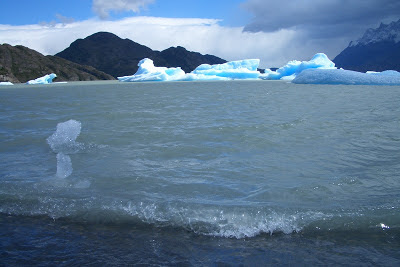
When the glacier calves, icebergs float down the lake to the sandbar, where they beach themselves and lie upturned with their bellies in the air, and dissolve slowly in the sun.

It’s an ice-elephant graveyard.

We walked along the shore of Lago Grey out to the sandbar, but that terrible wind was too strong for us. Little Laurie cried as ice crystals sliced his cheeks. The wind whipped around the edges of the Torres and raced down the length of the lake to wrap its fingers underneath us to pry us off the sand and lift us off our feet –

For a family holiday, it all felt entirely gratuitous. So we walked back down the lake to where we’d parked the car and we drove to the Hotel Grey and sat in its viewing lounge with the wind on the other side of plate glass windows. We had a lovely view twenty-six kilometers straight up the lake to the glacier, and we enjoyed it over cups of hot chocolate and coffee.
That is the civilized way of doing glaciers.

Laurie had an accident with his milk carton and had to be carried back to the car wrapped in Miles’ wind jacket. If you’re inclined to think that we were taking our holiday too soft – you imagine hiking a glacier with a two-year old in your backpack. And thank your lucky stars for plate glass windows.
We were going tower hunting.
We ate a lunch of peanut-butter-and-olive-paste sandwiches (try it before you knock it!) on a bench at a refugio (hiking camp) on the shore of one of those fantastic long blue lakes.

The electric water was spun into a chop by a wind- a tremendous, bloody-minded wind. It vacillated between gale-force and merely ferocious and it never, ever ceased. It was harsh enough to rush you off your feet, knock over the lip of a hanging valley, shake the car like a Christmas toy with all five of us inside it.
Snugged up against the feet of the Torres is one more long lake- Lago Grey, (although like the other lakes in the park, it runs to electric blue - and there's a scientific explanation for that) and at the end of the lake is the Grey Glacier (equally electric.) Lago Grey is bounded on the south by a wide sandbar that runs into a craggy island.
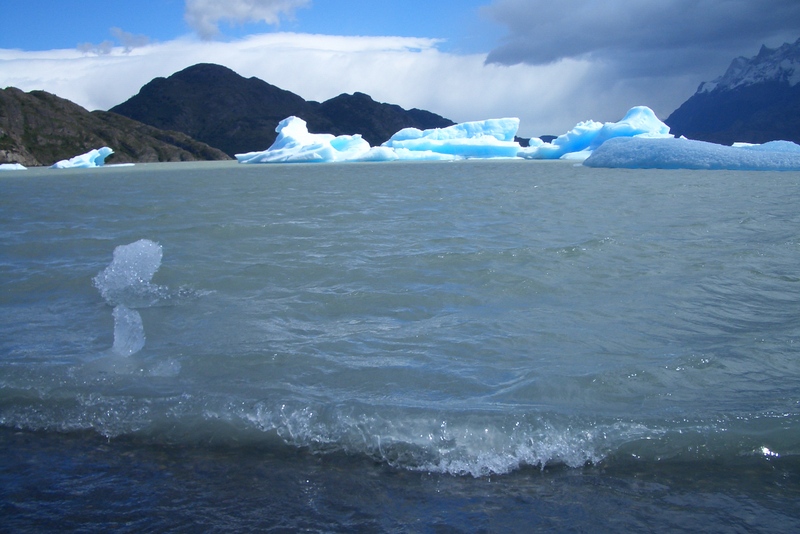
When the glacier calves, icebergs float down the lake to the sandbar, where they beach themselves and lie upturned with their bellies in the air, and dissolve slowly in the sun.

It’s an ice-elephant graveyard.

We walked along the shore of Lago Grey out to the sandbar, but that terrible wind was too strong for us. Little Laurie cried as ice crystals sliced his cheeks. The wind whipped around the edges of the Torres and raced down the length of the lake to wrap its fingers underneath us to pry us off the sand and lift us off our feet –

For a family holiday, it all felt entirely gratuitous. So we walked back down the lake to where we’d parked the car and we drove to the Hotel Grey and sat in its viewing lounge with the wind on the other side of plate glass windows. We had a lovely view twenty-six kilometers straight up the lake to the glacier, and we enjoyed it over cups of hot chocolate and coffee.
That is the civilized way of doing glaciers.

Laurie had an accident with his milk carton and had to be carried back to the car wrapped in Miles’ wind jacket. If you’re inclined to think that we were taking our holiday too soft – you imagine hiking a glacier with a two-year old in your backpack. And thank your lucky stars for plate glass windows.
Tuesday, July 2, 2013
Torres del Paine: Into the Park
At the end of April, while our Aussie guests were here, we all flew together down to the far south of Chile. We were heading into the pampas – the thousands on thousands of rolling kilometers of open southern grasslands, going to Puerto Natales and the Torres del Paine.
We were going tower hunting.
The National Park of Torres del Paine begins a hundred kilometers north of Puerto Natales, but the park is a large one, and the towers themselves are another hundred kilometers further north. If you want to go see them in one day, you have to start very early indeed.
We left our hotel before the sun was up and drove out into a thick white fog. Little Laurie in his car seat passed the time counting ‘birds on poles.” Nothing was moving in that fog. Even the birds were grounded.
These weren’t dainty meadowlarks or plover. Talons like garden forks were sunk into fence posts on both sides of the road and above them, hawks and eagles the size of combine harvesters loomed damp and indistinct, waiting for the fog to lift.
We drove slow, peering into the swirling fog, watching out for headlights of other cars and gauging bends. Watching so close, you see things in the mist – swirling shapes that come out of the fog and go back into it before you know if you’re seeing truly or seeing ghosts –
Ahead of us, the white began to boil. We hesitated, braked, in case the boil was real - and sudden as a camera shutter coming down, the fog turned and we were driving through sheep. Masses of sheep. hundreds of sheep. As sea of shaggy white backs, huasos (cowboys) on horseback, little islands in their sheepskin trousers and flat, wide-brimmed hats bobbing among them like little floating islands. A dozen working dogs slunk low against the grey grass, tag-teaming strays that tried to bolt out of the herd into the fog, growling and nipping, chivvying them back into the pressed mass. The huasos slapped their reins and whistled to the dogs and jinked their horses left, right, and left again – and the whole boiling, seething mass flowed around us like a river in a flood, carried swiftly down upon a current of snapping dog and jinking horse -

Twenty kilometers further up the road, we met cattle. They came at us in snatches of shifting brown bodies, bellowing and steaming all around us in the murk. Mindful of another bull we’d met, on different road down near Lago Ranco, we pulled to the side of the road and stopped.
A huaso on his horse loomed up out of the white. He wore a patch across his right eye, and in his frilled sheepskin trousers and flat hat he looked a proper pirate. He grinned down at us from his horse and raised his hand, and like the parting of the waters, a narrow slot opened up between the churning animals. We edged forward. A dog barked –one sharp crack – and a great big brown body lurched. We shot forward and were through.
Behind us the one-eyed cowboy gave a whoop and waved his hat – and we were gone – they were gone, swallowed up again by the white.

So late in the year, many people don’t see much more of the park than this. Even in high summer you might come for a week and see no more than ghosts of foothills, thinly, through the shifting mist.
But for whatever reason – perhaps our one-eye’d huaso had called it up - it was our day. As we cleared the grazing country and started up into the foothills of the park the fog lifted, and there they were: the Torres del Paine –
As if the road were a geological divide, a massif rose up- crowned with hanging glaciers and shattered rock fingers - a slab of mountain like the bottom of the world turned on its end and reaching up into the sky-

We were back to improbable poetry again. How else could anybody sensible describe this place? When a white fog rises one expects- the narrative demands - something windswept and barren, a sere and alien beauty – if beauty at all.
Not this–
We had come out of the fog into the middle of a moonscape - domed hummocks and puddle lakes that meandered out to eternity with no horizon and no base level. There was no perspective– just up and down and round, vivid in primary yellow and primrose and green.

We drove for hours over the rolling ground, the towers on our right drifting in and out of clouds. Here at the top of the world, roads snaked and switch-backed, throwing themselves from one side to the other of pocket-handkerchief-sized valleys with their bellies full of water, little lakes, overgrown, in tones of emerald, chartreuse, gold and burgundy and olive, sweeping out from the centre, and then emerald again, where the water met the autumn grass at the edge of the next rise –

And over that next rise, we’d teeter on the lip of a hanging valley: three hundred meters straight down to a long lake the color of blue glacier ice, and on the other side of that, that wall again–no trees, no bushes, no grass, no green, just a fist punching up through the roof of the world –

Subscribe to:
Posts (Atom)

