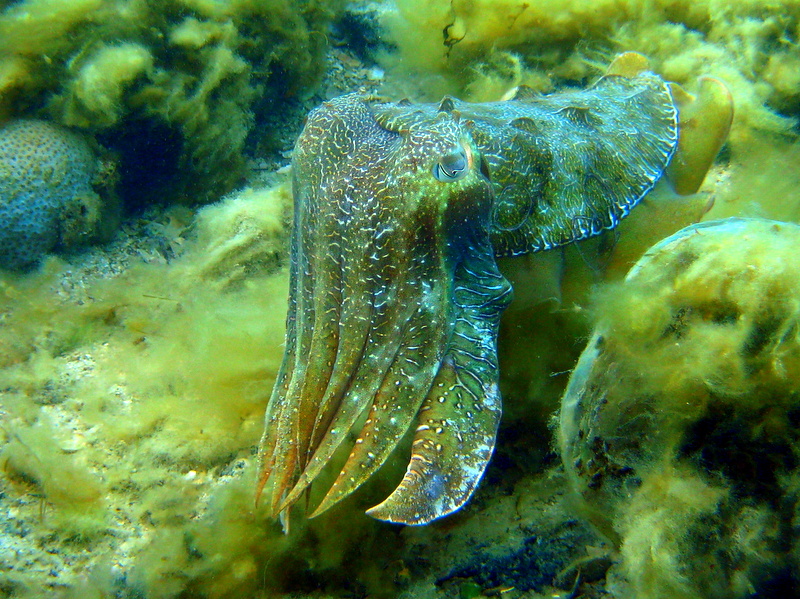
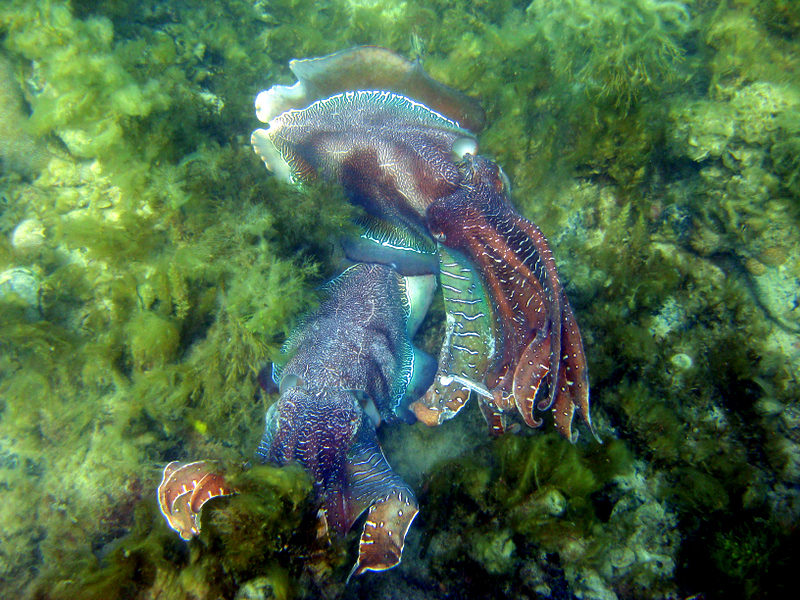
In 2011 I went diving with the Australian Giant Cuttlefish. In 2012 they did not come back. In a spirit
of cargo cults and magical thinking, we’re going to have a week or so of
cuttlefish: perhaps, if we wish hard
enough, a critical concentration of photo and video will bring them back from
wherever they have gone. I didn't get chilled
after my icy dive - we waded out of the
water and traded our neoprene suits for
flannel pajamas and wool sweaters and fuzzy hats, and we sat in the sun
and drank thermoses of hot tea and climbed into a truck with a heater in the
cab and by the time we were back in town we were warm as toast.
It was all very
civilized.
Under the water,
on the other hand -
Nature is red in
tooth and claw, and here is the juicy stuff, all of the blood and sex and
hormones and raw unbridled passion that makes for Grand Opera and even grander
daytime soap-opera (because you can show the exciting bits that get edited out
on stage and replaced by Arias and Extreme Death Scenes) and is exactly the sort of thing to make the
three hearts of every wandering cuttlefish feel a pang, and make him - or her -
want to come home for the winter.
Here, a Stalwart
Male is Attacked By a brave Challenger
who Wants His Woman. See him - Flushed
with Rage - Fight Back!
Here, two Alpha Male Types are Locked in Awful Combat. Who will Prevail?
And here, at last,
the video you've all been waiting for: A
violent attack - only centimeters from a Rocky Niche where a Rea Man defends
his Harem of Females. They Love, they Fight,
they Consummate their Passion - all for the camera! There is no editing, folks,
it's all Real, and it's all Here - exclusively on Tabuilgirl.
So - Hsst! Hey!
Cuttlefish! You-all!
The water is icy,
the tourists have all gone home, and the
sea-urchins and sea-stars are flourishing while you're away, so there's an
all-you-can-eat buffet laid on.
In 2011 I went diving with the Australian Giant Cuttlefish. In 2012 they did not come back. In a spirit
of cargo cults and magical thinking, we’re going to have a week or so of
cuttlefish: perhaps, if we wish hard
enough, a critical concentration of photo and video will bring them back from
wherever they have gone.
I had more fun
underwater than I had when i went diving with Dr Tabubil- which is saying something because that first time I was bouncing off of walls for a week on the memory of
it.
That first time, I was entirely under the control of Tony the dive master. He held my hand as we stood against a stuff current, and as
well, my buoyancy was out of kilter - I was either heading for the roof or
bouncing across the sea-urchins on the bottom.
This second time, I was rather more on my own -
One of the Melbourne
ladies had her open water certification - she was buddied with one instructor,
and the other two of us were buddied up with the other. My tourist-buddy had a problematic dive-vest
- an air bubble on one side sent her
tumbling in counter-clockwise barrel rolls and I was waved off to join the big
kids while our instructor returned her to an even keel. In water as clear and as still as this it was
rather like sitting at the bottom of a 10 foot swimming pool so therewas no
danger, and without anyone's hands on my own, I started to find the hang of
things, and learned to float -
And I dug it. I really dug it. I'm an original
tropical water-baby, and it felt just the way swimming underwater should be -
without needing to come up for breath, or being tied to the surface with a
snorkel. Just me and the water - the way
it should be, all comfy-like and giving.
To a point. Swaddled in neoprene, weighed down by lead
shot, breathing through straws out of a glorified great soda-siphon strapped to
my back, I didn't belong half as well as the cuttlefish all around me.
Look at this one -
see him fly:
They were all
around me - for every cuttlefish that I saw, if I paid attention and looked a
little harder, noticed there at least two more - hiding in the weeds. When one emerged from under a rock, two or
three would be tucked in there behind.
The females seemed to be shyer than the males - these photos invariably show a male in technicolor display shadowing a female in her reddest 'I am NOT happy' drag:
This particular instance is a little different. Here the male is in full furious panoply, and the female is playing it soft and quiet and blending into the scenery. Check in with us next time to find out why!
In 2011 I went diving with the Australian Giant Cuttlefish. In 2012 they did not come back. In a spirit
of cargo cults and magical thinking, we’re going to have a week or so of
cuttlefish: perhaps, if we wish hard
enough, a critical concentration of photo and video will bring them back from
wherever they have gone.
The previous cuttlefish post didn't have much to interest the cuttlefish - it was about things that were going on above the water.
Into the water,
then. We were five on the
dive - two instructors, myself, and two lovely young women from Melbourne
visiting Adelaide for business purposes, who were driving the 8 hours to
Whyalla and back to Adelaide in a day so that they could do the dive. We kitted up, walked down the refinery fence-line into the water, winced on account of the seriouslycold temperature of the water, followed the fence out until
we were chest deep, and we put on our masks and dipped below the surface.
And there the cuttlefish were
- hundreds of them. Just hanging
out. Swimming languidly around the
rocks, you know? As they do. Loitering, paying errands, going visiting, courting, mating, laying down their eggs underneath the rocks, and flashing our
cameras with multi-spectrum shows of interactive color gradation.
The cuttlefish are
terribly inquisitive about us- as much
as we are about them, I suspect. If you
float still, just above the bottom , they'll come right over to you. We were told not to let them come closer than
2 inches of our bodies because they will
bite - on spec, just to see if we taste any good, I suspect.
Immediately on
entering the water I came across a very large feller - not so large as the
giants Dr Tabubil and I saw on our dive - perhaps only two feet across. I stopped to take a photograph - as one does
- and as I focused, less and less of him was fitting in the frame. He had decided to come up and say hello. I had an awful lot of trouble with that all
through the dive - half my photographs are blurred and out of focus because the
subjects were determined to be on the other side of the camera, sort of the way
a really determined labrador retriever will try and say hello by seeing what the back of your head looks
like on the way over the top from the front.
Back on shore after
the dive, while I raved about one of my closer close encounters, one of the of
the other girls laughed and said "I saw that! I was trying to get
your attention - while you were looking at that cuttlefish, there was another,
smaller one sheltering in the curve of your knee!"
A curious cuttlefish looks in:
And draws in his arms in consideration:
And now, a taste of cuttlefish home life. Here a male guards a female while she lays his eggs under a rock. As she emerges, he makes his position clear and rippling patterns begin to flare across his mantle:
In 2011 I went diving with the Australian Giant Cuttlefish. In 2012 they did not come back. In a spirit
of cargo cults and magical thinking, we’re going to have a week or so of
cuttlefish: perhaps, if we wish hard
enough, a critical concentration of photo and video will bring them back from
wherever they have gone.
In 2011, I went dove twice, the first time with my sister, Dr Tabubil, off of Black Point, near the Point Lowly lighthouse. We saw dozens of cuttlefish - enormous ones, fighting and flaring as they went through their seasonal mating. The second time, we didn't have to dive off of Black Point, humping our gear down an escarpment and over the rough sandstone to the water. The winds were in
our favor and we were able to dive right off of the beach at Point Lowly - pull
the van up to the shore, sit on a wooden deck while we geared up, then follow
the fence line of the Port Bonython Natural Gas Refinery right down into the
water.
The gas refinery was quite large on our local
radar at that time -
A few weeks prior to
the dive, when the craze for planking was at its height, two young
employees at the gas refinery had taken photos of themselves planking right
across the mouth of a flare stack.
These geniuses were proud. They circulated those photographs
far and wide.
Have you heard of the Darwin Awards? The
purpose of a flare stack is to flare – as needed, which means randomly, and
without notice. These two young idiots were high-odds-on gold-medal Darwin
Awards contenders.
In this particular
instance, the idiots got lucky and missed the medal - the stack did not turn
the subject of the photo into extra-crispy, but if there was ever a case of
‘have your belongings in a box and be off the property in thirty minutes’ this
was it. And in a town as small as ours,
where the industries (mining and large-scale agriculture) revolve around
familiarity with heavy and dangerous machinery, certain public voices were loud against the prospect of two young
louts being considered responsible enough to wield so much as a spanner by any
employer between Port August and Port Lincoln.
The Port Bonython Gas Refinery has turned out to be something of a boon for the cuttlefish. Explosive security concerns require that you
keep a hell of a wide berth around a refinery,
and the water along the shore
here is shallow enough that their loading jetty stretches more than two
kilometers out into the gulf. The refinery has a null effect on the
local marine-scape, and what with the security buffer zone on shore and out on
the water, a rather large stretch of shoreline has been marked off from
fishermen and recreational divers, and gives the cuttlefish something of a
break. No sanctimonious cuttle-fishermen here. Just us,
on the other side of the fence-line.
The dive happened a
week and a half before we left Australia, when I was in a rather busy period of
my life. I have always intended to talk
about it, because that day dive was, if anything, even more extra-ordinary than
the first dive: the sun was
shining and the water was clear and there were exponentially more cuttlefish
out and about than when Dr Tabubil and I went diving- but what with the move, and then one thing
and then another, the photos have been languishing on my desktop for the past
year and I haven’t found the moment.
And then a couple of
weeks ago, Australian friends sent news that made my cuttlefish images very
topical indeed.
For those who aren't
aware, the Australian Giant Cuttlefish is the largest cuttlefish species in the
world - up to a meter across, and the coast of the Spencer Gulf in South
Australia, where I lived, is a place very special to these animals.
Those unfamiliar
might read my post HERE and
explore its own attendant links, or if you're in a hurry, you might just read
this quick summary. And then go look up
the BBC documentary series 'LIFE' (2009) and check out the episode 'Creatures
of the Deep.' (after which you will want
to go read the post linked above anyway, because the giant cuttlefish so entirely fascinating).
The nutshell:
The Australian Giant
Cuttlefish is the largest cuttlefish species on earth. They lead a solitary,
leave-me-alone-and-to-hell-with-the-neighbors sort of life, but once a year,
they come by the thousands to breed along a very small and very specific
stretch of the coast along the upper Spencer Gulf in Southern Australia.
Point Lowly, this little stretch
of coast, is the world's only known mass cuttlefish spawning ground. Just outside the coastal mining town of
Whyalla, the sandy floor of the gulf gives way to a litter of sandstone slabs,
built up with ledges and overhangs under which the cuttlefish can lay and leave
their eggs.
When they have
finished breeding they disappear. We
have no idea where they go or what they do – all we know of them we know from
this brief annual window of time and breeding behavior, and when they leave
they vanish out of science and out of human knowledge.
Because of the scale
of this breeding event, the Australian Giant Cuttlefish is a species that lives
in a tenuous equilibrium. An event that
disrupted the breeding colony would have a huge effect on the viability of the
whole species.
When I left
Australia, there were two threats to the cuttlefish.
Threat the first:
A large Australian multinational firm (BHP
Billiton) wished to build a desalination plant for their inland mining
operations, and they had chosen this same specific piece of coast to build it
on. The scientific reports are
inconclusive to hypothetically optimistic – there is no direct evidence to
indicate that an upsurge of salinity in the local region would affect the
breeding grounds.
BUT:
The local geology of
the breeding site holds nothing special for the desal plant. A few kilometers in either direction across
hundreds of kilometers of gulf coastline would have made no difference either
way to the economics or feasibility of the plan. When you are building around a species so
special, so evanescent and so terribly unknown, in what sort of human universe
would you want to take that risk?
Local landowning
interests had played NIMBY and refused to give up any of their sheep pastures,
and the state-owned land that is this very special breeding ground seems to
have been the only piece of coast that did not have someone in government
willing to stand up for it. Shame on
South Australia. When I left, the
proposal was still, slightly, on the fence; the people of the gulf coast cared
– even if their elected representatives didn’t, and there was some tenuous
hope.
Threat the second:
When Dr Tabubil and
I made our first dive last year, Tony's dive shop was a busy place:
on his sofa was a pair of Japanese documentary film-makers (if anyone
knows who they were filming for or how to find the footage that they took,
please let me know. I’d love to see it)
and at the back of the dive-shop, drinking coffee and talking in low,
frustrated tones, was a team of bemused biologists and marine scientists. The cuttlefish numbers were low that year –
very low. The winter drop in water
temperature had happened more slowly than usual, and the cuttlefish had been
coming late and slowly. And when they came, they had been much
smaller than the average. The scientists
watched, futilely, and took censuses, and waited to see what would happen. And
wondered why the cuttlefish that came were so small.
That was 2011. In June of 2012, two things happened. BHP Billion
won. The desalination plant is going
ahead. Huzzah for Big
Businesses. Huzzah.
But it may not
matter one way or the other. This year,
the cuttlefish did notcome back. The
numbers at the breeding ground were low last year, but nothing like low enough
to affect species viability. The water
conditions at the breeding ground have not changed. Whatever has happened happened out wherever
the cuttlefish go when they do go, and it happened extremely enough that within
two years, an entire submarine ecosystem may be gone forever.
And so, in a spirit
of cargo cults and magical thinking, we’re going to have a week or so of
cuttlefish: perhaps, if we wish hard
enough, a critical concentration of photo and video will bring them back from
wherever they have gone.
Given a large enough set of universes, nothing
is impossible. They’re curious
creatures, cuttlefish. Look at this one
here – he found me, a long, dark-blue-neoprene-and aluminum-tank thing,
floating a foot or so above the surface, and was moved enough not to run but to
swim over to me and investigate. He came on and on and would have snatched the
camera from my hands if I had let him.
Last year we went snorkeling in the tail of the cuttlefish mating season. It was late July. The water was extremely cold. And only a few, solitary giants were left, cruising for last-come, last-served egg-laying spots under the rocks.
It's a different situation this year. In most years the water temperature begins to drop in late May and it drops steadily, a few degrees a week, until it reaches it's winter plateau of 11 or 12 degrees Celsius.
This year the water temperature dropped more slowly than usual, and then plateau at 17 degrees for several weeks. The cuttlefish were confused by the uncharacteristic variation, and have arrived slowly, in very small numbers -the smaller, first-season cuttlefish first arriving. The numbers are beginning to rise now, if very gradually, but the cuttlefish that have come are still few and small - a team of marine biologists spoke quietly in the corner of Tony's dive shop that morning, while we waited for a phone call with the morning dive report - a census update from the dawn divers telling us where on the coast there were numbers enough to be worth a dive.
The crew of a Japanese nature television show was in town to film the cuttlefish. They were diving three times a day, every day, in all weathers. Two men, one young, one middle aged, sat silently on a sofa at the back of the dive shop, mainlining mugs of hot coffee and bags of jelly sweets with the grim expressions of men who spend far too much of their time shrugging in and out of cold, clammy wetsuits in dark weather and really, seriously need the calories.
After half an hour, the call came in - and we headed out to Black Point - a outcropping of shingle coast few kilometers in toward from the lighthouse at PointLowly.
The sun was out, the breeze was stiff, the rough parking lot at the Point was a sun-trap thirty feet above a rocky shore. We kitted up and sat in the sun, drowsy as cats, stiff as neoprene mummies in our rented suits. Don't try this without a spotter. If you fall over you're not going to get up without someone to hoist and heave and unhook and unlatch and unseam -
Getting down to the water was equally involved - we three penguin-analogues in full scuba kit humping flippers and masks and tanks and weight belts down a narrow path across the cliff face, and then scrambling for several hundred slippery, stumbling meters across the same sort of unstable, rocky shore we'd skipped rocks across a few days earlier.
Our entry point was a small cove in the lee of a point of rock. We sat on its sun-side, recovering ourselves and then - breathing. Breath, you asthmatic aspiring- scuba-diver you! Long, slow, breaths! Slowly in, slowly out, in and out, in and out, make a smooth, even rhythm and let it lead you, step by step, out into the water.
And fall down. I'm an original Australian water baby, Bondi-born and Gold Coast-bred, but with a regulator in my mouth and a tank on my back my center of balance was all off. It was disorienting and helpless-feeling. Tony took me in slowly. Rocking and stumbling as the waves hit, fighting back instead of rolling.
Two years ago, in the Cook Islands, I tried a shallow reef dive. Nobody warned me beforehand that when I used a regulator I'd have to draw hard to take a breath. When you're asthmatic, having to pull hard for a breath is a warning sign that you're starting an asthma attack. You spend your life working to avoid exactly that. Underwater, my reflexes never stopped red-lining and they never had to - the reef was so shallow that if I had a problem, all I had to do was unbend my knees and stand up. So I never tried.
Tony was gentle as a man with an newborn baby. Slowly - waist deep - put the mask on. Chest deep - put your face into the water. Breathe. Breath was pressure on my lungs - I fought - I couldn't get enough air! I lifted my face out of the water and spat out my regulator and took a deep breath - and breathed just the same as I'd breathed underwater. Hah. Tony was right. It's psychosomatic, you dill. Breathe and keep that CO2 moving and you're right as houses. I popped the regulator back in and Tony took me by the hand and led me out into the gulf. We stepped underneath the water and his hand was so strong and secure on my own that fear was impossible. And there was so much to see.
It was strange to be a human down there. Tony had me at slightly negative buoyancy, and I spent my time bouncing across the bottom on my belly, sliding over seagrass and, initially alarming, big black sea urchins - but it put me at eye level with the cuttlefish. They were small, but they were everywhere. If this was nothing, small potatoes, low season - my god.
It was a busy world. The water was cloudy and the same color as the seagrass, and the cuttlefish emerged, dreamlike, from the shadows as we came upon them - grass taking form into cuttlefish, rather than the other way round. They drifted across the bottom and I drifted after them, their colors shifting and sliding from green to brown to purple into red, blue iridescence shining along the rims of their mantles.
Two giants were facing off, hanging broadside to each other, their mantles flared, their bodies shifting through a repertoire of color - their heads were red, their rims were green, and across the flat screen of their mantles ribbons of color pulsed and flared.
We hung there, drifting in space, watching them. I was so enthralled I lost the rhythm of my breathing. I inhaled too much and found myself gently rising from the sea floor and tipping inexorably upside down, and hung there, stranded, with my hair brushing the seafloor and my flippers pointed at the distant, sun-spangled surface 4 meters above.
Dr Tabubil cleared her ears to regularize her pressure and in her own distraction shot the bubbles down the front of her suit. Out of the corner of my eye I saw her shooting toward the surface like a bottle rocket. I imagined that I heard her giggling.
I got twisted around down there - the top of my oxygen bottle had slid up against the back of my head and I had no forward or upward vision. I was restricted to seeing straight ahead and sideways. It was limiting, claustrophobic even, but Tony's hand was firm on mine and, somehow, my limited field of view enhanced the otherworldliness of the experience. A limited view was right and proper, and matched my limited understanding and my slender awareness of myself in this place, where I was so strange and clumsy and out of joint.
Bouncing back along the bottom again, I found myself eye to eye with a foot-long female cuttlefish squeezed into a crevice under a rock. She was laying eggs, her color reduced to a pearly blue-white pallor. A male rushed to guard her. I stood my ground and hung nose to nose with him until she emerged and slanted color-wise into purple and then to sandy green, and lifted her tentacles and squirted sideways away into the grass.
Tony squeezed my hand and moved off. I was completely lost down there - I figured we'd surface where we were and paddle back to shore above water, but he was leading me steadily up an incline and the grass shaded into bare rock and we were up. Out.
We had been underwater for almost forty minutes. It felt as if it had been ten. Barely. I wasn't cold. Just dazed. Amazed.
We lay on the rocks in the sun, smiling foolishly at each other. Then we humped our gear back up the cliff, and stripped and changed into warm flannel pajamas, and ate sweet imperial mandarins and blocks of chocolate and drank our way through thermoses of hot tea.
And i did all right - no asthma. Tony is all fired up to take me out again. When the numbers climb, and we can watch 'em by the hundreds.
Photographs and Video (and if you do ONE thing - watch the video.):
Dr Tabubil reclining (gingerly) above Black Point.
Finding my balance underwater.
A cuttlefish emerges from the seagrass - notice how his front half is red with rage (pushy humans!) while his back half is still the color of the grass.
For every one we see, there is at least one more hiding in the grass. Probably more! See how the one on the right holds his tentacles to mimic the tangled shape of the grass.
At the peak of the season, the numbers of cuttlefish mating along our coast approach the thousands.
Last year, however, we went out at the tail end of the season - quite literally so, in the very last week of it. The enormous numbers had dispersed. We saw perhaps two dozen of them, in the forty minutes that we were in the water
We were a party of four- myself, Mr Tabubil, Miles and his wife Sarah. The day was low and grey and overcast, but very quickly, even in the cold mid-winter shore wind, we were perspiring in our heavy neoprene suits. Sweating and squeaking, we waddled down to the water, clutching our flippers and masks clumsily to our padded chests. Looking rather like penguins on land, actually - aerodynamically implausible and hydrodynamically peculiar. We rather hoped that the analogy would hold true when we were four meters out from shore - anything less suited to swimming than our swaddled and squeaking selves we couldn't imagine.
The first shock of the water was - shocking. As we waded deeper there were howls and certain profane gasps as the water rose to meet sensitive bits of our anatomy, but swiftly, far more swiftly then we'd anticipated, the chill gave way to a generous cool - warm, almost, in contrast to the icy sea. We sat down in the water, strapped on our flippers and adjusted our masks, paddled five meters out to sea - and there they were, three meters below us, monster cuttlefish- half a meter long - brown and white and livid red, and edged with luminescent green running lights, that played and shifted along their bodies as they moved.
There weren't hordes of them - in the forty minutes we were in the water we saw perhaps two dozen, but they were all of them large, and all of them incomparably splendid.
It was thing- one of those moments when you know you are fortunate beyond belief to be where you are, in the moment that you're in. It’s a marking point for your life - everything you do or have done marked as Before or After you saw the cuttlefish. And you hang there, holding your breath and letting that moment extend - and extend - as long as it will let you.
The cuttlefish went about their lecherous business completely oblivious to our presence - courting, mating, and sliding underneath slabs of rock to lay their eggs in total disregard of the flippered monsters wallowing above their heads with cameras around their necks. Our problem was getting down to them. Even with pounds of lead shot strapped to our persons to give us some pretense of neutral buoyancy, swaddled in all our neoprene we weren't so much swimming as wallowing on top of the water. We thrashed and floundered, moving by swinging our arms and legs and gripping for purchase on the surface - rather like jesus beetles on a rapid-moving stream of water. All up, no down, plenty of sideways. Duck diving down to the bottom meant required working up a good head of steam, arrowing down as hard and fast and as hydrodynamically as we could, then flailing our flippers madly and getting in one swift close-up look before we shot back to the surface like a bottle rocket. Feet first.
Ten meters further up the coast, a dolphin made mockery of our foolishness with languid, lazy curvettes as it grazed on the cuttlefish in the sea grass bed. It ignored us with indifferent equanimity - just like the cuttlefish it preyed on. It wasn't our world. We were privileged to visit, merely. Momentarily.
A cuttlefish resting in the seagrass:
Can you see it? It's red and it's cranky, and its about 11 inches long!
Posturing male cuttlefish three meters below us - each is about 2 feet long.
Note the play of color and irridescence. Red signifies anger. I don't know what white is, but you tend to see it when they are mating.
A male guards a female as she lays eggs underneath a rock ledge.
A female cuttlefish in the seagrass.
This cuttlefish was the only one that deigned to notice us. And he did NOT appreciate our coming close to him.
Three males with a female underneath: the largest is huge - almost a meter in length!
The small male on the left has turned red - he is holding his tentacles up in a threatening posture.
The Giant Australian cuttlefish is the largest of the cuttlefish species known to man. A member of the taxonomic class coleoida, it have a venerable lineage - stretching back almost 200 million years in time, it outlived the dinosaurs, trumpeted proudly past the mammals as they arose, and survived to grace the waters of our present day oceans.
The Australian giant cuttlefish is, in principle and in general, a solitary creature. It lives its life in a race for mass and volume, spending almost 95% of its day in hiding, pouring its metabolism into brute size, waiting for the one great event of its life.
It is a short lived creature. It grows, it mates, and then it dies, its weakening body falling apart on the seabed. Most male cuttlefish live solitary lives, waiting for a female to pass - and be seized and impregnated and sent on her way to lay her eggs.
The Giant Australian Cuttlefish plays life differently. Giant Australian Cuttlefish live their lives in quiet obscurity, eschewing company, abhorring fuss, painting themselves the color of the seabed, and sending marine biologists frantic with curiosity. Where? Where do they go? Where do they hang out? Nobody knows.
Once a year, however, something extraordinary happens right in my backyard. The Spencer gulf has a flat-bottomed sandy bed, and cuttlefish require rocky coasts for laying their eggs. They attach the eggs to the under-sides of rocks, where they can mature undisturbed by predators and currents. Sand flats don't provide much scope for growing baby cuttlefish.
But right here, on the edge of town, there is one rocky shore. Thin slabs of sandstone shingle tumbled together make a long, shallow, sloping seabed. And when the temperature drops at the beginning of winter, the cuttlefish arrive. All of them.
Thousands of them. This is the only place in Australia - in the world - where cuttlefish congregate in numbers like this. They play a whopping mating game - the giant males collect harems, the females scope partners for size and skill, and the males face off, threatening each other with a sort of display that must be absolutely unique -anywhere.
Cuttlefish skin is colored by pigment-filled sacs called chromatophores. These pigment sacs are under conscious control, and the cuttlefish can change its coloration to match its environment, to reflect its mood and, and uniquely, to indicate its intentions. The chromatophores can not only be controlled individually, but also sequentially, so that the cuttlefish becomes a floating movie screen. The enormous males face off - streams of color rippling down their bodies, the colors become wilder and more intense, until one male will give way and retreat - or the confrontation becomes physical, and the two males fight, slashing at one another with their sharp parrot beaks.
While the largest males are lighting up the seabed, the females in their harems are quietly getting the best of all possible sperm-sets for their eggs. The large males are the ones who have had two seasons to grow. The males who come to maturity in the first season of their life are very small - too small to compete head to head with their larger compatriots.
Their opportunities require guile. The same size as the small females, they adjust their color, their posture, even their behavior to match the ladies. While the males guard their harem, these small male mimics will sidle up to them and mate with their females right under their bellies. The females are enthusiastic and complicit - by taking a variety of partners, they can maximize the potential of their offspring - producing great bruisers as well as small, sly sneakers, and increasing the probability that their male offspring will all mate in the next few seasons.
Like all wonderful nature stories, the tail has a human sting. There are plans to build a desalination plant on this coast, so that the mines up in the red center won't have to rely on Southern Australia's over-burdened sources of fresh-water. The gulf has hundreds of miles of coastline of no particular distinction, but this short stretch of coast- this singular, extraordinary stretch - is the one that has been chosen. By eminent domain. A team of marine biologists is working on an environmental impact statement, and their present conclusion, based on current data and probability, is that the currents and the water densities will keep higher levels of salinity out of the breeding area, and the plant has governmental approval - but around here - we want to know why. Why this coast? Why not 30 kilometers - fifty kilometers - further out of town? Or ten kilometers out of town on the other side?
Murmurs of special interest - farmers and graziers playing NIMBY with the regional council - make the rounds.
People nod knowingly. But they're upset and bewildered, so of course they nod - and nothing is confirmed.
This place and this annual event is so special. Ecosystems are fragile. Unstable. Full of unexpected, or mis-estimated, factors. Why push for this coast? Why take the risk?
Or if you want to see some really extraordinary footage, check out the BBC documentary series Life (2009). Look up the episode "Creatures of the Deep" and prepare to be astounded.
I am an Australian architect, married to a Canadian who followed me home.
In September 2011 we relocated from rural South Australia to the bustling metropolis of Santiago, Chile, where it's warmer than Canada, but less insect-y than Australia.
How's that for a compromise?

 Posts
Posts