Monday, December 24, 2012
An Account is Settled
Mr Tabubil and I have just returned from three weeks holiday – a week in Holland, so that I might see a bit of his country and meet his family, and two weeks together after that in Italy. Right now, we're in Venice.
That night, wandering, we heard children shouting. On a wide and empty avenue, alongside a narrow canal, we saw a knot of small boys jumping and pointing toward the water. They were caught in one of the pitfalls of being six years old in Venice: with a certain amount of narrative inevitability, the soccer ball IS going to be kicked into the canal.
Ahead of us, an elderly couple in furs and evening dress arrived at the scene of the disaster. There was a babble of tut-tut-tutting and "Better wait for a boatman" drowned out by a rising chorus of "Oh, PLEASE."Enter the heroine.
"Oh NO, dear!" The elderly lady was horrified.
The heroine was cool, serene, and purposeful of word and movement. A confident smile quirked the corner of her mouth.
"I really think I can." I said calmly.
The lady cogitated briefly.
"All right. But I'm going to keep a good hold of your legs."
So I lay full length on the paving stones and with two manicured handfuls of trouser securing me to dry ground, swung my torso out and into space.
And an axiom sixteen years old was disproved: Tabubilgirl does not HAVE to fall into the canal. Even when doing something very silly and far more perilous than the original circumstances had been. (And THAT is a story for another time, and I may never tell.)
Standing once again by the canal, the heroine solemnly, almost ritualistically, received her purse and her hat and her scarf, returned to her item by item by a reverent six year old boy. Deep inside, the she was elated. Nothing can wipe away the permanent embarrassment of falling into the Grand Canal of Venice at age eight, but tonight, the score had been evened slightly.
Friday, December 21, 2012
We try Venice. Venice is Charming.
Mr Tabubil and I have just returned from three weeks holiday – a week in Holland, so that I might see a bit of his country and meet his family, and two weeks together after that in Italy. Right now, we're in Venice.
We took a noon train from Florence to Venice (260km, 2.5 hours) and then the Venice Vaporetto from the Stazione Santa Lucia to our vaporetto stop (3km, 1 hour). Transport efficiency might vary between the ancient and the modern, but the slow Venice barge certainly has the best views; we hung over the side rail and gawped at the sun glittering off the boats and white bridges, and at the palazzos sliding sideways into the icy blue water.
We had a room in a charming little residence on the edge of the Campo San Maurizio, tucked into the side of a narrow lane across a little white marble bridge, with a gondola moored to a lacquered post underneath - very Cole Porter. Our room was small and low-ceilinged, filled with a dim-underwater light, and stuffed to the gills with faux-antique wooden furniture, every piece carved and painted and brocaded and gilded until the surfaces were panting for relief. Even the walls of our little room were padded, and covered floor to ceiling in a green and gold polyester brocade. In the event of fire, we were instructed to tie the gold brocade bedcover into a rope and slither around the charming wrought iron screen that kept us from falling past the silver brocade curtains and out of our charming little picture window into a window box filled with perfectly charming geraniums.
We napped, briefly, in our little room on the golden bed, then we went walking and found all of the ways the local streets dead end into the water. It took some time to outpace the tourist hordes and art-glass shops, but by sunset we were in a narrow maze of stone paved alleys that opened into small Piazzas or dead-ended into blue canals, with washing lines strung across the water.
There is a quality of light here – it glitters over the canals and crooked streets, settling like a luminous, electric blanket over the white marble spans and the waterways. The city has the soft, limpid quality of a fever, with heady currents and electric heat just under the surface. Earth and water exist here in an impossible balance; the natural division between the two elements has broken down, become imperceptible. Natural laws simply fail to operate - or be remembered - or have never existed to BE remembered. Tall stone palazzos are built on top of the water, with the sea lapping halfway up the doorpost. Stone pillars and stone archways lean crazily inward on each other; walls have an open relationship with the vertical - when I think about it, it is perfectly sensible; the foundations have no foundation; instead they rise and fall with the waxing and waning of the moon.
We walked down narrow ways into the Piazza San Marco, where four separate chamber orchestras were playing in four separate corners. We sat on a stone bench by the water and looked out at the night, and felt immeasurably pleased with ourselves.
Wednesday, December 19, 2012
Segways in Florence.
Mr
Tabubil and I have just returned from three weeks holiday – a week in Holland,
so that I might see a bit of his country and meet his family, and two weeks together
after that in Italy. Right now, we're in Florence.
On our last afternoon in Florence, we rented a pair of segways from a little shop across the street from the Pitti Palace. A Segway is second in fun only to a barrel full of puppies. When you know what you’re doing, control is very near telepathic – the subtlest shifts in balance and inclination are transmitted directly to the wheels and that barrel full of puppies starts looking as if it has a very VERY narrow lead. It’s the next best thing to flying.
Presuming you’re doing it right.
We weren’t.
The rental shop gave us exactly thirty seconds of instructions, than aimed us at the door and sent us buzzing gently out into the street.
In a corner of the
palace wall we made a few experimental swoops and curvettes, and then we were
off – we had our eye on the Piazza Michelangelo, a hilltop overlooking the
city, whose approach is a series of steeply raked switchbacks that would be
rather less pleasant in the summer heat on foot than on two wheels –
It wasn’t quite as
much fun as I’d expected. I didn’t
appreciate how subtle the steering control really was, and I had some idea that
I had to horse the machine around by main force with my upper body, shoving it
hard into the curves and throwing myself forward and to slow myself down and to
speed myself up – I could hardly manage the weight of it on the turns, and as I
leaned into the hills the thing accelerated like a good Italian racing car and
it was all I could do to hang on for the ride.
We took a trial run
straight up the face of the Costa dei Magnoli. Despite the heavy handling, it was an absolute JOY to go whirring up the steep stone
streets, buzzing past the walkers and climbers puffing along in their drooping sun-hats and
hiking boots, smiling magnanimously at them as we came rocketing in and out of
view, dipping daringly into the turns without a breath or a hair out of place,
and leaving sighs of appreciation and rueful envy in our wake –
Horsing the segway
through all of those turns was exhausting.
At the top of the hill, as we turned out of the last switchback and onto
the promenade of the piazza, I lost control of the machine and drove head first
into a lamp-post. The segway recoiled
and shot off sideways. I flew off in the
other direction. It was a busy road and
I was falling toward a group of elderly ladies –
“If
I land on THEM” I thought, “I’m going to take out at least three hips -”
Throwing myself forward and sideways, I missed the ladies, but landed hard on the pavement on my left hand. It hurt. Coming up for air, I took stock - I'd sprained my wrist and
dislocated my thumb.
The elderly ladies
were impressed. Descending on me in a
mass, they picked me up and carried me into a café and demanded ice –
‘Lots of
it! Your husband will take care of that infernal
machine, you sit, cara, sit and rest. Are you bleeding? No? Oh, your poor
hand-”
They petted and
soothed, darting and fussing and around me like a flock of small birds, till
one of them pointed at her watch.
Bird-like, they shrieked and with a profusion of final pats, fled out of
the café and onto a waiting bus.
Exeunt Omnes.
I sat in the café
with a bag of ice on my wrist, and a bag of ice on my knee, which had begun to
swell, and felt rather lost. And, I
suspected, rather foolish.
Up on my feet again,
my thumb put right, the view from the top of the hill was worth quite a lot of the bother. And on the ride back down the hill, I
couldn’t use my hand at all, and I discovered just how subtly and elegantly the segway had been designed. Control was
effortless when I was no longer trying
to control it. I forgot my hand and
dipped and soared and FLEW down the hill – a bird myself.
After we had
returned the segways, I began the process of lying my head off to Mr Tabubil
about just how much my wrist hurt. I
wasn’t going to waste any of my holiday in a doctor’s office – my goodness, no!
Lying to Mr Tabubil
became lying to myself. My wrist refused
to improve, but I refused to notice, and it wasn’t until I was back home in Santiago that a
friend bullied me into seeing a doctor.
The eight weeks since have involved a parade of X-rays, CAT and
MRI scans, threats of surgeries, hand, thumb and wrist immobilizers, and a
lesson in just how badly you can bruise bones.
Keeping up with this
blog has involved spurts of typing, followed by protracted periods of serious
discomfort, during which Mr Tabubil looks righteous, puts his nose in the air
and makes vaguely religious pronouncements about the karma of lying one’s head
off to a Loving Spouse about a Serious Injury, and wouldn’t it all have been
easier if we’d just Come Clean and had it seen to when it First Happened? And
have we learned our lesson yet?
And then he cuddles
me, and feeds me chocolate. So that’s
all right.
And the immobilizer splint came off a week ago.
It’s almost all
better now.
Friday, December 14, 2012
We Climb a Tower
Mr Tabubil and I have just returned from three weeks holiday – a week in
Holland, so that I might see a bit of his country and meet his family,
and two weeks together after that in Italy. Right now, we're in Pisa,
visiting the Leaning Tower.
After
we had listened to music happening in the baptistery of the Pisa Duomo,
we went and climbed the infamous leaning bell tower. The lean has been
stabilized – at great effort and expense – and today you can climb it
all the way up to the top. The climb is a deeply enjoyable head trip. The lean of the tower is
only four degrees from vertical, but four degrees from vertical raised
sixty meters in the air can feel like some considerable angular
displacement – almost four meters. Go check your trigonometry.
A spiral staircase around the perimeter of the tower climbs sixty meters to the top, housed in a stone shell between the inner and outer walls. There are a few narrow windows here and there, but almost all of your orientation comes from your inner ear. Part of the time you’re climbing uphill, and part of the time you’re almost walking flat, and part of the time the stairs are twice as tall as they should be, and ALL of the times that you pass a window, the view is just plain WRONG. Sort of stomach-dropping, and inductive to manic giggles. XXXX
XXXXAt the top of the tower, the stairs pop into open air and you circle the sloping tower on a narrow walkway with only a metal mesh between yourself and the view. There was a breeze at the top of the tower – a soft, cool, gentle wind that would certainly pick you up and toss you against the mesh, and the mesh would burst and you would blow outward and fall -
“It's strong, see?" Mr Tabubil said, leaning on it – leaning out and leaning DOWN. "Made of steel!"
I burst into tears. I don’t do heights, and I do depths even less than I do heights, and when the depths are more than fifty meters deep and you’re leaning toward them on a slippery stone ledge that doesn’t stay flat like any respectable stone ledge fifty meters in the air –
Urrrggghhh.
About when I was ready to release my death-grip from the door-frame, we popped back inside the tower to climb another thirty-six steps up another weirdly sloping stone shaft up to the very top where the bells were.
“Steel.” Mr Tabubil urged. “Strong as houses. I’m an engineer. I know these things. Would I lie to you?”
I believed him implicitly, but my stomach wasn’t hearing it. I wanted to do a circuit of the roof sitting flat on my bottom and sort of scooting around with my back pressed tight against the tower wall. And to look at the view with my eyes closed.
But I did it. Slowly, and stiffly, but on my very own two feet and with my eyes wide open. It took some time; most of our group was half-way back down to the ground level by the time that I was half-way around the top. But I did do it, and even I stopped to admire the view. On the uphill side. On the downhill side, I moved faster and I may have cried again. Just a little.
Uuuurrrrrgggghh.
Back on the ground, I fell asleep on the grass, and Mr Tabubil took photographs of people taking photographs of other people pretending to hold up the tower. Out of context, it makes for MARVELOUS family photos.
Labels:
architecture,
art and design,
laughter,
spirituality,
tourists
Wednesday, December 12, 2012
Buildings that Lean in Pisa
One day we took the fast train to Pisa and saw the Leaning Tower. Arriving at the Pisa Centrale Train Station, we stopped at the ticket counter to ask what bus we ought to take out to the Piazza dei Miracoli (Field of Miracles). The lady behind the counter looked up from her book of crossword puzzles with a distracted sort of air.
“You want a what?”
“A bus, please. To the Piazza dei Miracoli–“
“No buses. Not today. They’re all on strike.”
She shrugged one shoulder in a half-apology, and turned back to her crossword puzzle.
Bus strikes were one of the great certainties of the time I spent in Tuscany. Timing for maximum chaos, striking without warning, bus drivers will stay off the road during the morning rush hour, then come back on duty for the rest of the day, or they will knock off early, just in time to gum up the evening commute –
At least once a month I’d come out of an evening class and discover that the bus home wasn’t happening. If I were lucky, there’d be a paper notice taped to a post at the school bus stop. If not, I’d stand with the other stranded students, waiting for forty-five minutes or an hour - until it became clear that even the erratic Florentine bus fairy (the magic schedule fairy that pops busses out at supremely irregular intervals) had exceeded her mandate, and then I’d walk home.
In clear weather, it was a lovely walk, particularly in the spring: an hour of soft skies along the river, and quiet quattrocento back streets. In winter, in the wet, with a howling storm blowing umbrellas inside out and driving you down the sidewalk ahead of bursts of hail and sleet, it was not so nice. Not even a little bit.
A spring day like that would be lovely for walking through a new town, but on a late-summer day with a sky like a flat blue oven, and the world stretched thin and pegged out flat, and quivering under the weight of a sun like a great glaring brass disk, hot riveted to the flat center of it –
Not a day for walking.
We mooched out of the train station and stood in the shade of the arcade and looked around us for a taxi. Under the weight of that awful burning blue sky, nothing moved. There were no taxis, no cars, no bicycles, no people–
We sighed, and slunk deeper under the awning, and a municipal bus sailed grandly into the turning circle before the station, and stopped only a few dozen yards from where we stood.
“Strike?” The driver looked at us, puzzled. “Not today. NOT a day for strikes, a day like this.”
We asked again for the Piazza dei Miracoli -
“You bet.” He said. “That’s my route. Hop on, and I’ll let you know when to get off.”
He grinned at us, and we saw that the bus had air-conditioning, and we decided that we loved him.
The bus ran a twisting route through the old stone city, across the river and into a suburban Pisa where the old stone buildings had front and back gardens, and stopped before a high stone wall, and here - here there was movement in the world. Through a pair of tall gates we saw a long stretch of green grass. White buildings glittered in the sun and around them moved a twisting, churning, seething mass of humanity – none of it Italian. And all of it carrying cameras.
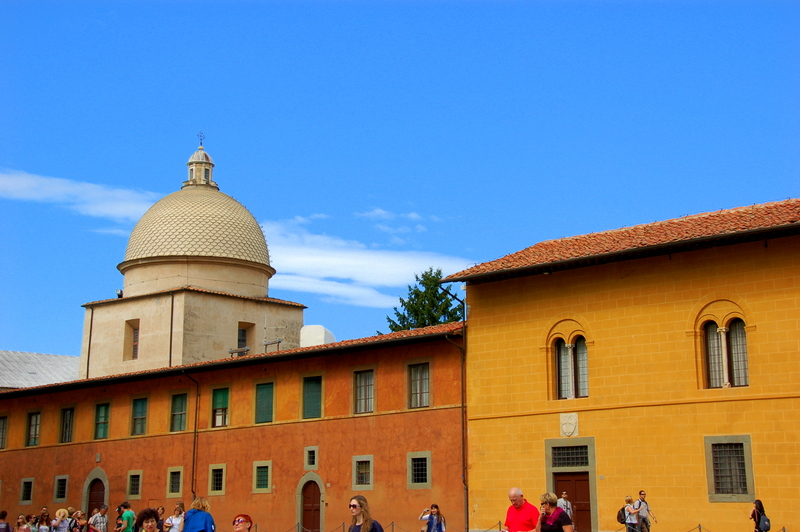
The Piazza dei Miracoli is lovely– even on a burning blue summer day. Tall white walls surround a wide green field, and buildings grow out of the grass, here and there – a duomo, the infamous bell tower, and a high, round baptistery. They are built of white marble, and they glare under the sun, and all of them lean sideways.
The foundations were built shallow, and the buildings have had more than a thousand years to settle into a soft, unstable soil. The cathedral complex was begun in the tenth century CE, and is mostly built in the style of that time – a style that is today known as the Romanesque. Tenth century engineers hadn’t yet discovered the load-bearing potential of the pointed arch (the spectacular extent of which was what allowed the towers of the Gothic to soar so high) and they built with hefty stone walls, and rounded arches and fat stone columns to support the walls' weight. It is a stately style – solid, substantial, and comfortable looking.
All along one side of the precinct is a paved road set up as a very long souvenir shop. There must be half a hundred little stands and wagons, all of them hawking little copies of the leaning tower - as t-shirts, as fridge magnets, as postcards, posters, kitchen aprons, hats, paperweights, little resin paperweights, middle-size resin paperweights, and gigantic fiberglass paperweights more than two feet high. They are all of them irredeemably awful. Nobody sells replicas, or even posters, of the duomo and the baptistery, which is an oversight and a meditation on the shallowness of fame. Because the Duomo and the Baptistry are lovely buildings, each entirely unique and special in their own right.
The Pisa Duomo is quite possibly my favorite church. The Florence Duomo is marzipan-exquisite on the outside, but inside is more or less like a barn. Baroque churches tend to suffer from interior -decorator-itis, San Marco in Venice was dim and dark and dusty (or as dusty as a church can become when it stands ankle deep in water!) but the Duomo in Pisa is just RIGHT. The Pisan Romanesque is vaguely Venetian, faintly Moorish, with touches of Gothic in the Arches, Byzantine Glamour in the mosaics, Baroque in the paintings – and all of it in entirely charming balance. Begun in 1063 and a work in progress (like all good churches) ever since, it has grown up elegantly, and with a certain style- gently proportioned to itself and entirely suited – inside and out – to the site and the celestial majesty of the baptistery next door.
The thick stone walls of the Romanesque baptistery keep out the summer heat. Inside, we sat on a ledge and listened to the half-hourly demonstration of the echo. The acoustics in the Baptistry are unusual. The Baptistry is one single circular room, almost fifty meters tall, and an accident of construction, a double-shell roof, has turned it into a resonance chamber fit for a choir of Catholic angels. Every half-hour the ticket guard closes and locks the doors and walks into the very centre of the space and sings. Three simple notes fall upward into the empty space, cascading into complex cascades and harmonies of that were never actually sung.
We climbed up to the high gallery and sat in the cool of the lovely building and waited until the next performance, and heard it again. Sometimes the gatekeeper was a whole choir and sometimes his voice becomes an instrument – a clarinet, occasionally, and an oboe, often. Mr Tabubil turned to me and his face was wide, full of happiness.
We were filled up.
Labels:
architecture,
art and design,
bus,
spirituality,
weather
Wednesday, December 5, 2012
The Instant Expert’s Guide to a Foreign City (Florence Edition)
Mr Tabubil and I have just returned from three weeks holiday – a week in Holland, so that I might see a bit of his country and meet his family, and two weeks together after that in Italy. Right now, we're in Florence.
Florentine drivers are as bad as South American drivers, but they are more phlegmatic about the situation. The narrow streets are not EVER going to be wide enough for the traffic, so the lunatic in front of you dancing his Fiat across the cobbles on two wheels can be given the finger in a relatively relaxed fashion. You’re not stopping, he’s not going to ram you, and you can call down the imprecations of God and Man in a purely philosophical and speculative sense. Neither of you will take it personally.
Old Florence is a tourist town. There’s no getting around it. Florence is the fount and fountain of one of the great advancements of western philosophy – the Renaissance. This city is where all the good stuff happened – it is a city of FIRSTS. Here Brunelleschi built the first great free-standing dome since the Romans, here Donatello re-discovered the lost art of bronze casting and sculpted his David and Goliath. Renaissance architecture began here in Florence, when Bruneleschi built the Ospedale degli Innocenti in the Piazza Due Fontane, beginning a movement that would span all of Europe and return here to be at last overturned, when Michelangelo grew up and designed a façade for the church of San Lorenzo, and a staircase for the library next door. There are splendid things on every street corner, and the best way to explore (in my opinion, and I am never short of opinions) is go out and get yourself thoroughly lost.
Start in the Piazza Due Fontane. Close your eyes and turn around three times, then open your eyes and orient yourself toward the façade of the Ospedale degli Innocenti.
The Ospedale was an orphanage commissioned by the Arte de Seta (Silk Guild) in 1419. The commission was given to an architect named Filippo Bruneleschi. Brneleschi is widely regarded as the true father (or instigator) of renaissance archutectire, and the Ospedale degli Inocento was one of the very first buildings that he designed in the trendy new style. It was (and is) certainly the best known. Admire the regularly spaced columns with their classical capitals. The Ospedale is built of simple geometrical volumes, piled one atop each other in individual, disconnected units, which isn’t quite how the Romans did it, but the new style certainly looked pretty.
Turn right and walk down the Via dei Servi until you come to the Piazza del Duomo. Admire the splendid bronze doors of the baptistery (another bronze-casting first) and spend some time admiring the big fat Victorian façade on the Duomo.
The outside of the Duomo looks like nothing else anywhere – with the exception of the chocolate-box frontage of Santa Croce. The two facades were perpetrated at the same time at the same persons, but while Santa Croce is JUST petite enough to look like a victorian valentine, and rather cute, thereby, the Duomo is so enormously large that is looks like nothing as much as a carved and buttressed marzipan mountain.
The Florence Duomo has survived several facades over its long life (the blue and white pinstriped version, like a vast stone petit-four layer cake was a good look) The current – and hopefully authoritative - version dates to the 1880s. It is splendid and terrible pink flamingos all over the place and I adore it without reservation.
Reserve your admiration for the marble façade – the inside is a
barn, and has horrible acoustics, to boot. I’m terrified of heights,
but if you aren’t, the climb to the top of the dome is very much worth
the time and entry fee. Mr Tabubil enjoyed it enormously.
Disapproving Madonna disapproves of your uncritical approval.
Continue down the Via Calzaiuoli in the direction of the River Arno, until you come to the Piazza della Republica. This pizazza was the site of the original pre-roman settlement here, and it has remained variously prominent and notorious ever since. Used as a market and gathering space for more than two thousand years, by the 19th century it had become the site of Florence’s Jewish ghetto, which made it, in Italian eyes, a natural choice for “reclaimation” by the state to create a grand piazza to celebrate the founding of the Italian Nation in 1856– from which occasion dates the monumental arch on the west side of the Piazza.
I love this Piazza. Although right in the tourist heart of the city, it is still very much a civic space. Fairs pass through; families sit there in the evening, and at night there is. While Telecom Italia couldn’t seem to pipe phone connectivity into my little apartment on the other side of the river, I was usually able get a phone line of a sort on my cell phone if I was in the very center of the Piazza Republica, and I spent many half-hours here at all hours of the day and night, listening to people shouting at me through a storm of Telecom Italia static, and hollering back at them through the same.
Continue on down to the river and cross the Ponte Vecchio. Once all of Florence’s bridges looked like this – cobble-stoned medieval bridges built out on each side with shops and commercial establishments – all of the smelly, water-requiring businesses, like tanning and butchery, that cities like to site far away from the populace. The Ponte Vecchio is the city’s only remaining medieval bridge ; the others perished as the Germans abandoned the city in WW2 – they dynamited the bridges behind them as they retreated, the Ponte Vecchio surviving only because it was reckoned too narrow to support an American tank.
And pretend that there aren't more bloody cherubs everywhere.
A side note –Unlike most of the rest of Europe, the cities of Florence and Rome largely escaped the artistic pillage of the Nazi regime. Goebbels cared very much for art (if not for much else – people, for instance, he thought worth very little), and recognizing the historical value of these two cities, brokered an agreement with the Allied forces that neither city was to be bombed or looted regardless of how heavy or hostile the fighting. This agreement actually held throughout the war, even during the German retreat – the only bombardment that Rome received was over the rail-yards, which were reckoned to be sufficiently distant from the historically and artistically significant areas of the city to be legitimate targets.
The far side of the Arno river is the Oltraro (lit. Beyond the Arno) I used to live on this side of the river. Tourists cross the river and mostly turn rightup the Via Giucciardini, heading for the Pitti Palace. I turned left, passed through an archway cut through a building and climbed half-way up the steeply vertical Costa dei Magnoli . I lived in a small third-floor walk-up flat just before the point on the hill where steeply-vertical became purely vertical and the engines of delivery motorcycles gave up the ghost, delivery men forced to tack back and forth across the narrow street, nursing their rev-counters, and cursing the residents who’d paid for their pizza BEFORE they’d given the address.
It’s a worth-while climb, if you have muscles like a mountain goat – it’s a straight shot up to the Belvedere, a star fort overlooking the city. If your legs are less like steel and more like molasses, veer left up the Via Guicciardi when you come off the bridge, and saunter up to the Pitti Palace, because the Pitti Palace is worth a look and saunter. And a second look – spit-take style.
The Pitti palace was begun in 1458 by an upwardly mobile banker hoping to out-grandiose Florence’s free-spending hard-building ruling family, the Medici. In one of life’s little ironies, Signor Pitti went bankrupt, the Medici bought the palace, moved in, and it became a symbol of THEIR wealth and power for more than 250 years.
It’s been thumbing its nose at Florence ever since. The Pitti Palace is one of the oddest buildings in Italy. Every time I walk away from it I’m certain that I must have been imagining things – no building could possibly be so impossible, but when I turn back to it and look again, there it is – a vast brooding lump of badly piled stone, rough hewn boulders and piled up sandbags. It has all the hulking presence of a squat, seven-story toad. The inside of the Pitti Palace houses a rather nice museum, and the sprawling gardens behind it are a marvelous place to spend a summer afternoon, with a Rococo grotto, and formally geometric promenades, and a cultivated wilderness leading down to a lake. And you can barely see the palace from most of it.
Or pass on – past the palace, turning right, and lose yourself in alleys and cobbled streets of Oltrarno. You’ll pass open doorways and see craftsmen carving mirror frames, restoring old furniture, building violins –
It’ll be a GOOD afternoon.
Labels:
architecture,
art and design,
Cities,
history,
pink flamingos
Monday, December 3, 2012
Eating Well in Florence
Mr
Tabubil and I have just returned from three weeks holiday – a week in
Holland, so that I might see a bit of his country and meet his family,
and two weeks together after that in Italy. Right now, we're in
Florence.
When I lived in Florence, my kitchen was minimal – a half-size sink, a single gas burner of such limited spirit that lightly sautee-ing a handful of fresh vegetables took almost an hour, and a bar fridge too narrow for a paper plate full of leftovers to sit horizontal. I was obliged to learn how to eat out cheaply and well – which is not an easy thing in a tourist town.
There is some extra-ordinarily bad food in Florence. I learned two rules in a terrible hurry:
One - If there are more than two languages on the attractively inexpensive menu, or if the menu on display outside the restaurant is laminated or inside a plastic sleeve, DO NOT GO INSIDE. You won’t like it. And your stomach will pay you for it later.
Second– avoid all of the little shops selling pre-made open-faced sandwiches. They look as if they’ve been sitting there all week because they have been. And any of the students at Polimoda who tried them for lunch always ended up regretting it deeply and going home early with a stomach-ache.
Pizza:
After a couple of weeks of slow cooking and very bad meals, I began to learn my way around the city and find out where real people ate real food, and for a year, I ate like a queen. And I wanted to show Mr Tabubil Everything. At mid-day, we found delis in back-streets, where they sliced prosciutto off the hock and cheese off the wheel. And in the evenings, there were a few little places that I wanted to share with him. One in particular – a hole-in-the-wall pizza shop. Pizza that had nothing to do with the pizza I’d known growing up in American suburbia. For eight years it had been lurking in my back-brain and beckoning in my dreams at night –
And it was still there.
It was still there, attached to the Osteria Cucina Toscana, on the corners of the Via de Lavatoi and the Via Matteo Palmieri, near the Basilica of Santa Croce.
It opens a little after seven, but people are lined up outside in the street by six-thirty. Don’t be deterred – they’re waiting for one of the three tables inside – order takeout and eat your pizza sitting on the stone bench of the small piazza across the corner.
The same man is still there – a little more rounded around his corners and plumpish about the mid-section, - flipping pizzas every evening from seven until midnight.
As a pizza, it is very simple – the distilled essential essence of a pizza, perhaps. A round of elastic dough, splashed with a ladle of fresh-made tomato paste, a fist-size ball of fresh buffala mozzarella, two basil leaves - torn in half and tossed carelessly on top, a caper or two, a splash of olive oil, then three minutes in a wood-fired oven and –
The magic is in the dough –a rich, round, savory bite, umami-ish even, biscuit-thin at the center, rising high and chewy at the edges, and shot through with sweet air pockets two inches high, and where the melting mozzarella lay, no grease or greasy cheese, just puddles of and milky tomato-laced juice –
For me – who learned her Pizza in Suburban California – Dominos for takeout, and Round Table for birthday parties and at home, mum’s own special invention, a pizza so over-laden with pizza toppings that it must be eaten in layers, with a spade and shovel, working downward, strata by strata toward the pre-baked supermarket crust –
The discovery of Pizza’s OTHER definition was nothing short of a divine moment. A revelation.
Mr Tabubil had his Moment, as well. He ate one bite, and then looked at me deeply, with a face full of betrayal.
“You know what you’ve done, don’t you?”
I nodded happily.
“You’ve ruined me for pizza. Forever, possibly. I can never go back, can i?”
I shook my head.
“Now I know why, in all the years I’ve known you, you’ve never ONCE been excited by pizza night. Damn.”
He stared moodily at the pizza-poem in front of him, and sighed, and took another bite. And forgot to be rueful, and ordered three more pizzas.
After that, it was difficult to convince Mr Tabubil that there WERE other places that we might eat while we were in Florence. I can’t say that I tried very hard.
Gelato:
Florence does gelato on every street corner. And it is very good gelato – even if it is mostly out of the same factory, with the same decorative fruit slices on top of each pastel-tinted mountain – factory-made it might be, it is real Italian gelato and LIGHT years ahead of what you find in Australia, where traditional ice-cream comes in five flavors – pink, white, chocolate, rainbow, and hokey-pokey (white with lumps of tooth-breaking toffee), or even in Chile, where artisanal ice-cream bars of awesome flavor and variety seem to be a source of profound national pride.
And yet I said ‘BAH’. And took Mr Tabubil by the hand and dragged him up the Via Isole delle Stinche to the Gelateria Vivoli, where they make their own gelato in the back, and fed him their pear-and-caramel gelato, for starters, just to watch him melt into a happy puddle on the tiled floor, and THEN, we began a sensible five-day exploration of all the flavors that they had with a pear-and-caramel chaser, every time.
The gelato in front of the Café Gilli in the Piazza Republica isn’t bad either. But it’s not the Vivoli.
Alberto:
Alberto:
The place – and person – that I’d most hoped to find in Florence was no longer there. In his place was a travel-agent, and nobody knew where he’d gone.
In memoriam then, I give you a man who made sandwiches like Fischer plays chess, like Michelangelo painted ceilings, like Paderewski played the piano –
On the Via del Oriuolo, behind the Duomo, there was once a run-of-the-mill olive oil shop. Its insides were filled up with strings of dangling chianti bottles in wicker baskets and vials of balsamic vinegar at terrible international prices, and at the back, behind all of the tourist tat laid out to keep the uninitiated away, there was Alberto.
Alberto was an ARTISTE. I was referred to his sandwiches on my third day in Florence by a vendor of computer equipment of shady provenance, and on the strength of his recommendation, I went around directly to case the joint.
At the back of the sandwich shop, I gave the signs and countersigns, and Alberto stood back behind his glass cold-case, staring at me intently, learning my face, and tapping his upper lip.
Eventually, he reached a decision.
"Beef, I think. Marinated in chianti. Perhaps some vinegar, a touch of peccorino cheese, and maybe -”
"Tomato?" I said, entranced.
“No!” Alberto stared at me in horror. “That would ruin the entire scheme!"
I looked at the glass case of roasted marinated and char-grilled everything that stood between us and tried again.
"Roasted bell peppers?" I suggested tentatively.
Alberto cogitated and nodded decisively. "That would be acceptable."
I went back regularly for the food and the company. I remember that there was one day when I was particularly frazzled from arguing with Telecom Italia (and that is a whole book in itself). I walked into the shop and Alberto took one look at me, drew me into the back of his store and put me into a chair, handed me a newspaper, poured me a glass of wine, and said "Rest."
And left me there for an entire afternoon.
He loathed what he perceived as my lack of culinary adventure (which I saw simply as respecting the value of a great sandwich combination – if it works, why change it?) and one day, when I asked for the usual, he hit the rafters.
"Tomato and Bell Pepper and Dijon Mustard? What are you thinking? I never give that combination! Never!"
"You do too. Yesterday."
"Pah!"
"Something else then?"
Deep cogitation and then the voice of the sandwich oracle spoke. "Grilled Eggplant."
"I don't like eggplant."
"DID YOU HEAR THAT?" The whole shop was staring. "I eat everything, Alberto!" He pitched his voice to a deep falsetto, in imitation of an over-fastidious female. "I eat everything. Except EGGPLANT, it appears. FEH! Tomato, then. Rucolet, Balsamic Vinegar and Walnut Sauce! And you'll like it!"
"No Mustard?"
I received a very dirty look, and Alberto ostentatiously turned his back, wiping his hands fastidiously on his apron.
While his concentration was engaged in slicing the beef, I sidled up to his assistant and whispered.
"Could you swap the walnut sauce for mustard, please?"
There was a bellow from the cutting block. "I SAID WALNUT!!!"
It was an extremely good sandwich, actually.
Subscribe to:
Posts (Atom)